


When Emotional Hierarchies Become Tyranny: The Hidden Risk in Voluntary Communities
Introduction
Voluntary communities often begin with shared purpose, goodwill, and collective enthusiasm. Yet even in groups that value equality, compassion, and collaboration, an unspoken hierarchy tends to emerge. This hierarchy is not formal, not elected, and not based on competence. It grows from emotional dynamics — and if left unchecked, it can evolve into a soft form of tyranny.
Understanding this progression is essential for any Decentralized Sovereign Cooperation (DSC) that aims to remain free, fair, and structurally resilient.
1. Emotional Economies Create Invisible Social Rank
Many communities operate on an emotional economy, where social value is determined by:
- perceived kindness
- social visibility
- symbolic gestures
- emotional influence
- group approval
This creates symbolic leaders — individuals who hold influence not through skill, but through emotional capital.
These leaders often become the center of attention, the default decision-makers, or the moral voice of the group. This influence is rarely questioned because it feels “natural.”
But it is not natural — it is emergent hierarchy.
2. Symbolic Leadership Slowly Centralizes Power
Symbolic leaders tend to accumulate:
- narrative control
- decision influence
- social loyalty
- emotional leverage
Over time, this shifts the group away from:
- competence
- transparency
- shared responsibility
- decentralized decision-making
and toward:
- personal authority
- emotional persuasion
- selective information
- unilateral decisions
This is the first stage of soft tyranny.
It does not look like oppression. It looks like “leadership,” “care,” or “responsibility.”
But structurally, it is power concentration.
3. Emotional Hierarchy → Soft Tyranny
Tyranny does not begin with violence or domination. It begins with unquestioned authority.
When symbolic leaders become the default decision-makers, the group unconsciously accepts:
- one person deciding for many
- one person defining what is “right”
- one person controlling information
- one person representing the group
- one person assigning responsibility
This is tyranny in its earliest form: centralized authority without structural legitimacy.
It is tyranny built on emotion, not force.
4. Why This Behaviour Damages Communities Long-Term
a. Competence is Replaced by Image
Tasks are assigned based on social rank, not skill. This leads to poor execution, inefficiency, and burnout.
b. Responsibility Becomes Symbolic
People hold titles or roles without the ability to fulfill them. Real contributors become invisible.
c. Decision-Making Becomes Opaque
Choices are made privately, emotionally, or impulsively. The group loses clarity and trust.
d. Conflict Becomes Personal
Disagreements are interpreted as attacks on the symbolic leader. This suppresses honest discussion and innovation.
e. Volunteers Disengage
Competent members leave because the structure does not reward contribution. The group becomes weaker and more dependent on symbolic authority.
f. The Mission Collapses
When emotional hierarchy replaces structural clarity, the original purpose of the cooperation is lost. The group becomes a social circle instead of a functional system.
This is how soft tyranny destroys voluntary communities — not through oppression, but through structural decay.
5. Message About the “Invisible Habit” in Group Operations
In many diaspora communities, a certain “habit” has formed over a very long time: a way of operating based on emotion, deference, and the symbolic role of a few individuals in the group. Because it has existed for so long, this habit has become a blind spot – no one sees it, no one names it, and no one recognizes its harm.
Within that operating system:
- “Voting” means choosing from one person’s shortlist.
- “Consensus” means agreeing with the person at the emotional center.
- “Respect” means not criticizing their choices.
- “Leadership” means emotional centrality, not structural responsibility.
- “Group decision” means symbolic approval, not a transparent process.
This is not tyranny in the political sense. It is a social pattern of the diaspora, where emotion and deference replace clear mechanisms.
Because people have lived inside this system for so long, they cannot see the contradiction. They believe this way of doing things is “normal,” “natural,” and “how it has always been.”
That is why, when someone offers even a mild, constructive suggestion, the reaction is not about the suggestion itself — it is about the feeling that the familiar emotional order has been disturbed. In that worldview, questioning the choices of the person at the center is seen as disrupting harmony rather than contributing to clarity.
But this habit creates:
- distortion in decision-making
- ambiguity in responsibility
- hurt feelings when there are differing opinions
- delays in progress
- prolonged hidden conflict
- dependence on one individual instead of a system
A cooperation that wants to be sustainable needs clear mechanisms, not emotional dynamics. It needs real consensus, not symbolic consensus. It needs healthy criticism, not avoidance to preserve artificial harmony.
Recognizing this “invisible habit” is the first step toward building a way of working that is transparent, fair, and more mature.
6. Decentralized Sovereignty Prevents Tyranny Before It Forms
A Decentralized Sovereign Cooperation (DSC) model neutralizes emotional hierarchy by design:
- Responsibility follows competence
- Decisions are distributed
- Information is transparent
- No symbolic authority exists
- No one can centralize power
- No emotional leverage can override structure
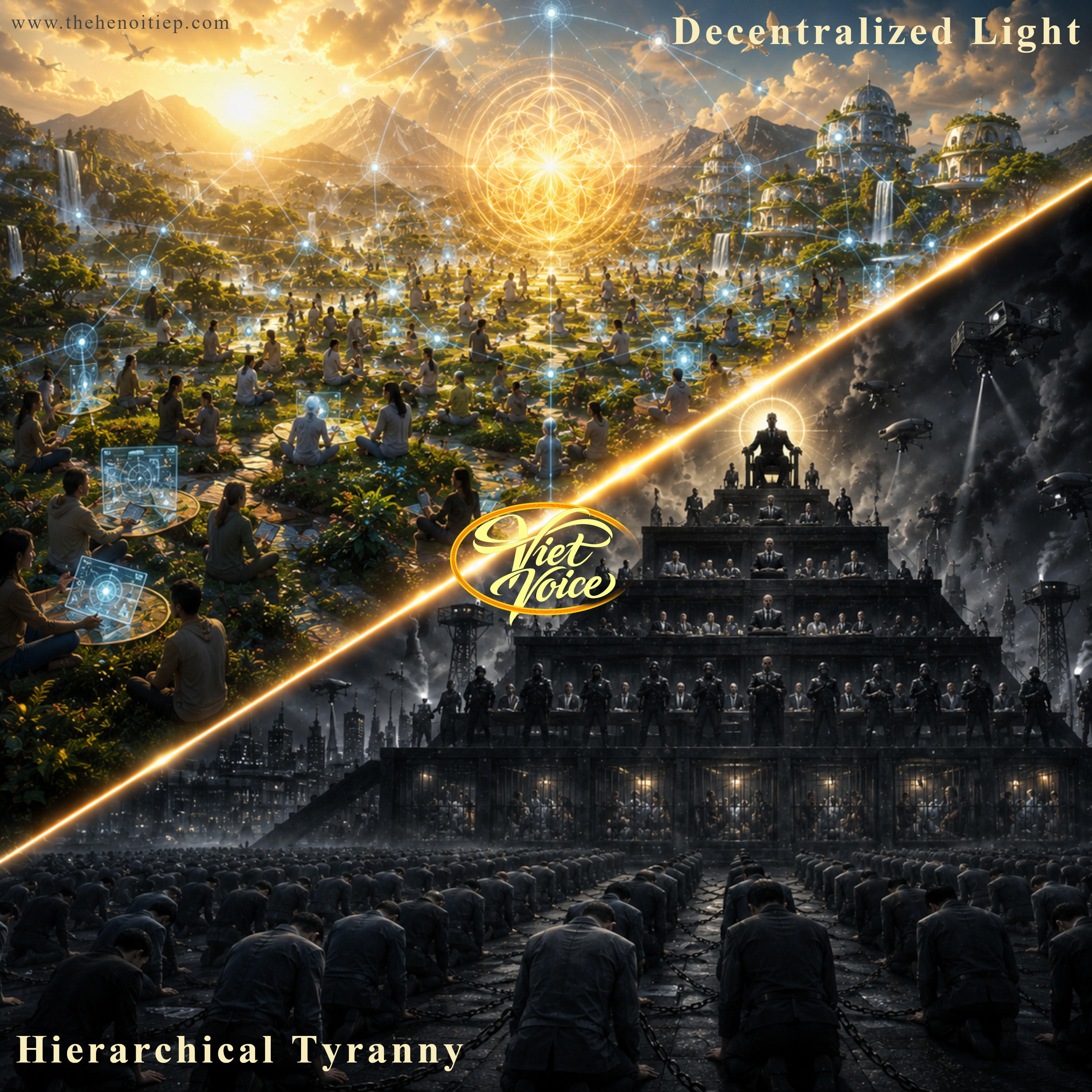
Decentralization is not just a governance model. It is a protective mechanism against the emergence of soft tyranny.
7. Awareness Is Structural Protection
Most people do not intend to create hierarchy. It emerges naturally from social instincts — the desire for belonging, validation, and emotional safety.
By recognizing these patterns, communities can:
- prevent unintentional power concentration
- avoid emotional manipulation
- maintain structural clarity
- protect the mission
- ensure fairness and transparency
Awareness transforms unconscious behaviour into conscious design.
Conclusion
Tyranny does not begin with force. It begins with unspoken social rank, symbolic leadership, and emotional economies that reward visibility over competence.
Voluntary communities must remain vigilant against these dynamics. By grounding responsibility in skill, distributing decision-making, and maintaining transparency, a DSC preserves its integrity and protects its mission.
Decentralization is not only a governance model — it is the antidote to soft tyranny.