

Sovereignty, Decentralized Structure, and Meta-Sovereignty:
Why Power Without the Meta-Sovereignty Layer Becomes Dangerous
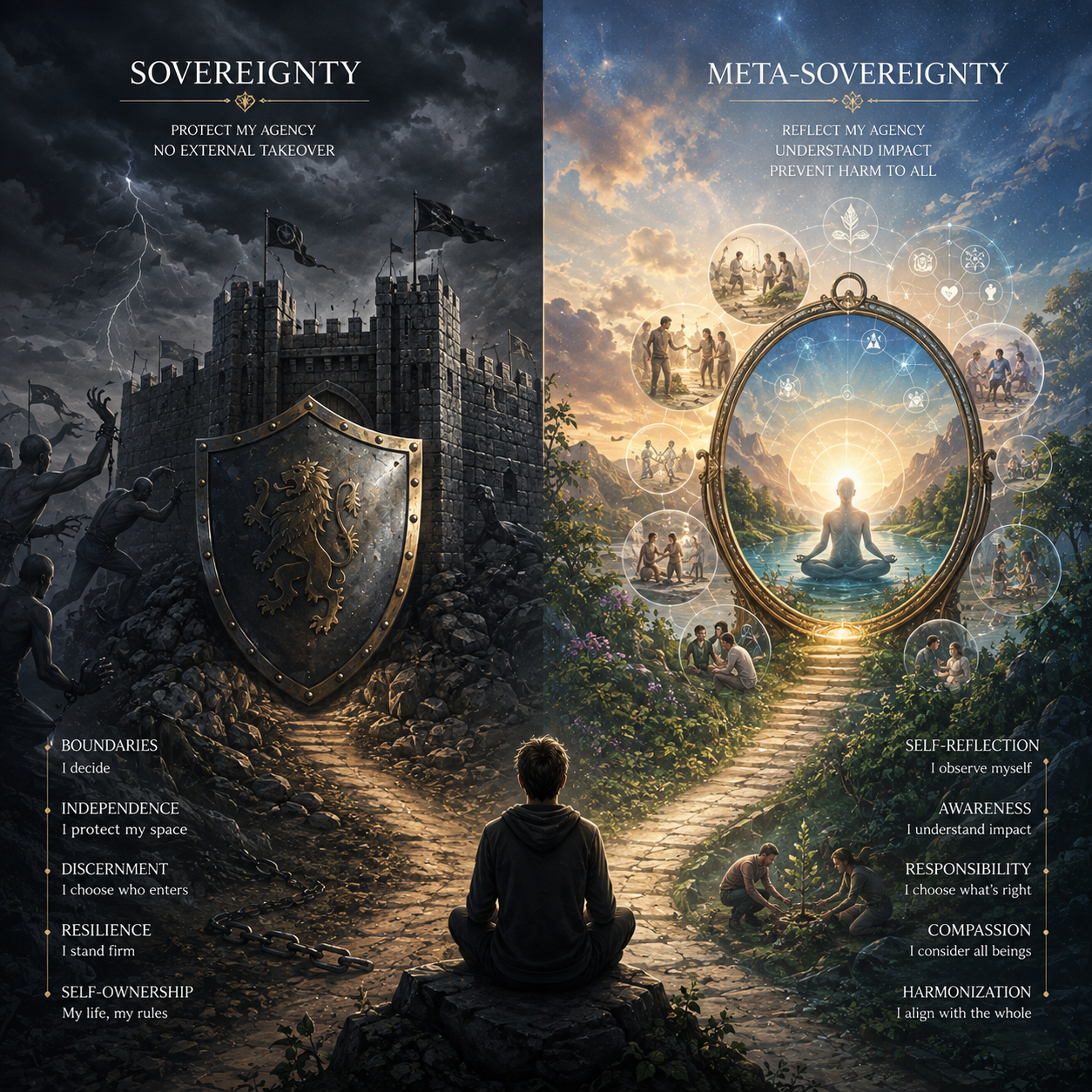
Human history is a long record of a repeating pattern: ordinary people drift, but only those who hold power create structural harm. This is the fundamental reason why sovereignty, decentralization, and meta-sovereignty must be understood together — not as three separate concepts, but as a single architecture of human behavior.
This article presents that architecture clearly.
I. Sovereignty: The First Layer of Human Power
Sovereignty is the ability to:
- think independently
- act without external control
- resist manipulation
- maintain one’s own direction
- stand alone when necessary
It is the foundation of:
- personal freedom
- creativity
- responsibility
- self-determination
Every person should have sovereignty. By itself, it is not dangerous.
Why sovereignty alone is safe (when power is absent)
An individual who has sovereignty but does not hold institutional power:
- cannot oppress
- cannot dominate
- cannot corrupt systems
- cannot weaponize drift
- cannot destabilize communities
Their mistakes remain personal or local, not structural. Therefore, decentralized societies can safely grant sovereignty to everyone — because sovereignty without power does not create systemic harm.
II. Decentralized Structure: The Architecture That Prevents Absolute Power
Decentralization is the distribution of:
- decision-making
- influence
- authority
- resources
- narrative control
across many individuals instead of concentrating them in a single center.
Why decentralization remains safe even when people drift
In a decentralized system:
- no one can accumulate absolute power
- no one can impose their drift on millions
- no one can amplify their ego to national scale
- no one can turn personal flaws into national disasters
Decentralization dilutes danger. It allows:
- sovereignty for everyone
- diversity of thought
- resistance to corruption
- protection against authoritarian drift
Thus, decentralized communities survive even when individuals are imperfect.
III. The Danger: Sovereignty + Power Without Meta-Sovereignty
Sovereignty + Power − Meta-Sovereignty = Danger
This is the architecture behind:
- dictators
- corrupt leaders
- ideological extremists
- destructive revolutionaries
- ego-driven politicians
- harmful CEOs
- manipulative influencers
They all share the same flaw:
They have sovereignty, but lack meta-sovereignty.
They can think independently, but cannot govern their own power. They can act decisively, but cannot restrain themselves. They see their goals, but not the consequences. They can lead, but cannot self-audit.
Thus, power in their hands becomes dangerous.
IV. Meta-Sovereignty: The Layer That Governs Power
Meta-sovereignty is the ability to:
- self-diagnose drift
- self-limit impulses
- neutralize ego
- audit one’s motives
- align actions with principles
- stabilize emotional reactions
- see structural consequences before acting
- choose when to be dangerous and when not to be
It is sovereignty over sovereignty.
It is the layer that prevents:
- corruption
- authoritarian drift
- ideological extremism
- structural harm
- accidental damage
- misuse of influence
- misuse of artificial intelligence
- misuse of human power
Meta-Sovereignty Is Not for Everyone
Meta-sovereignty is not a universal right. It is a heavy responsibility, reserved for those capable of bearing the consequences of power.
Those who:
- hold power
- shape systems
- influence communities
- design structures
- coordinate groups
- lead movements
are the ones who must possess the meta-sovereignty layer.
For the majority, ordinary sovereignty is enough to live freely, responsibly, and without harming society.
Why Meta-Sovereignty Is Not Universal
Practicing meta-sovereignty is difficult. It requires an intense inner process:
- overcoming the ego
- recognizing hidden motives
- accepting the dissolution of the “self”
- letting go of the need for control
- disarming oneself before acting
It is a form of ego-death — a transformation not everyone can endure.
The Role of Those Who Achieve Meta-Sovereignty
Those who attain meta-sovereignty may stand in roles such as:
- guides
- advisors
- system stabilizers
- direction-setters
- community stewards
But they must never hold absolute power. Meta-sovereignty exists not to dominate, but to limit oneself and protect others from the drift of power.
V. Why the World Suffers: Power Without Meta-Sovereignty
Human suffering arises from:
- leaders without meta-sovereignty
- governments without meta-sovereignty
- institutions without meta-sovereignty
- movements without meta-sovereignty
- ideologies without meta-sovereignty
Sovereignty itself is not the problem. Power itself is not the problem.
The problem is:
Power held by people who have sovereignty but lack meta-sovereignty.
From this:
- wars begin
- regimes rise
- greed spreads
- corruption deepens
- societies fracture
- nations collapse
The flaw is not sovereignty, but sovereignty without self-governance.
VI. The AI Era: Why Meta-Sovereignty Becomes Critical
Before AI:
- drift was slow
- influence was limited
- mistakes were local
- ego was contained
- illusions were small
With AI:
- drift accelerates
- influence scales
- mistakes become structural
- ego becomes amplified
- illusions become contagious
AI grants power to people who previously had no such “capability.”
This means:
AI + Sovereignty − Meta-Sovereignty = Global Danger
Not because AI is harmful, but because humans lacking meta-sovereignty suddenly gain:
- reach
- amplification
- visibility
- narrative control
- decision support
- automation
- persuasion tools
AI turns personal drift into structural drift. Thus, the meta-layer becomes essential.
VII. Clean Synthesis
1. Sovereignty is safe when power is absent. It creates independence, not harm.
2. Decentralization is safe even when people drift. It prevents absolute power.
3. Power becomes dangerous when held by sovereign individuals who lack meta-sovereignty. This is the root of human suffering.
4. Meta-sovereignty is the layer that governs power. It prevents harm, corruption, and drift.
5. Artificial intelligence grants “capability” to everyone — including those without meta-sovereignty. This is the new global risk.
6. The future requires decentralized systems paired with meta-sovereign thinkers. This is the only stable architecture.
Those with meta-sovereignty should:
- guide
- stabilize
- design
- coordinate
- mediate
- clarify
- prevent drift
But they must never become absolute leaders.