

III. Decentralized Sovereignty — Achala in the Modern Era
And Why It Is Applicable in Today's Society
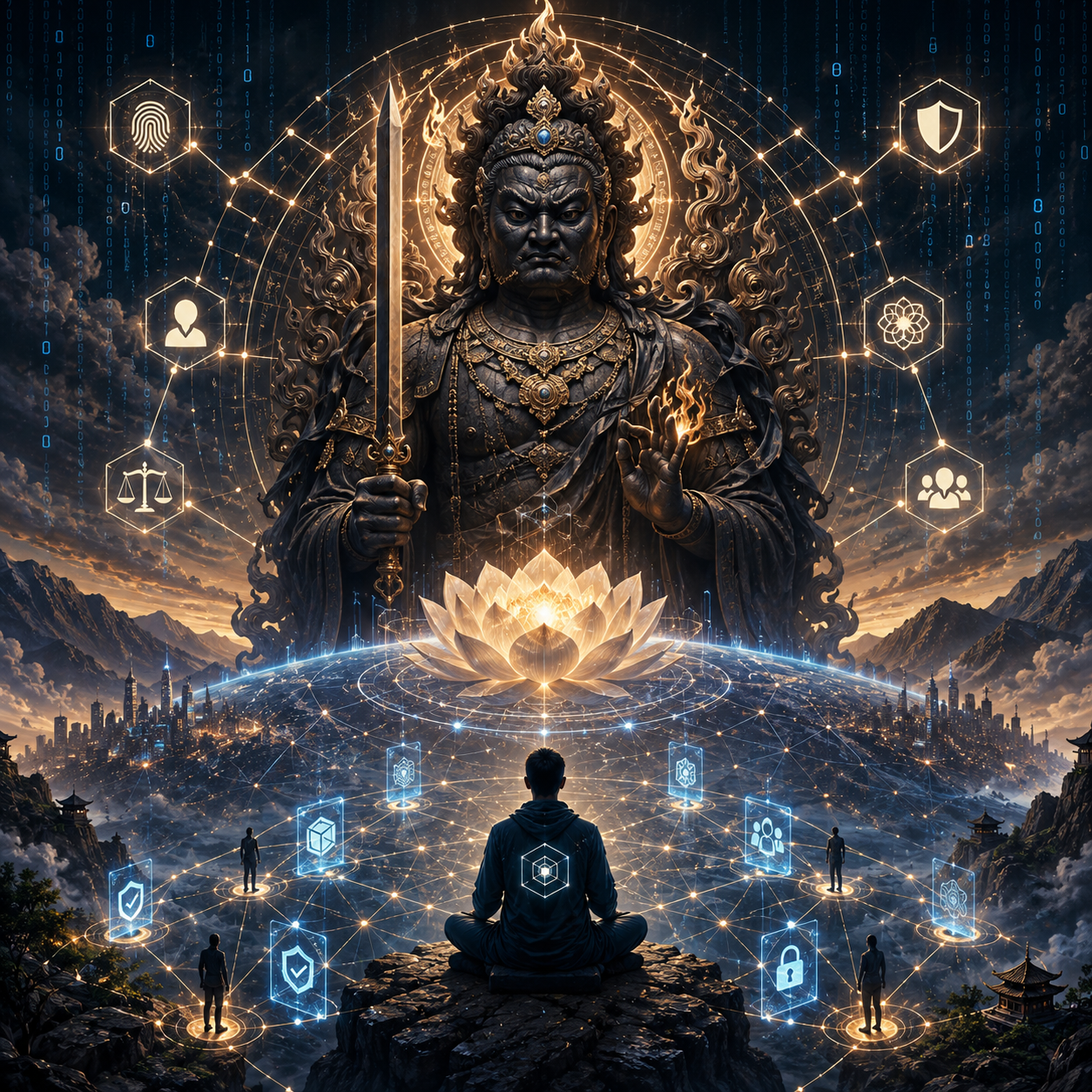
Across Buddhist history, Achala — the Immovable Wisdom King — rsymbolizes the force that protects clarity from all distortion. In Vietnamese tradition, this figure becomes Hộ Pháp, the guardian who stands firm, who does not bend, who does not allow corruption to enter the Dharma. Achala is not passive. Achala is not neutral. Achala is not weak. Achala is sovereignty expressed through immovability.
Yet in modern society, Achala’s function has been lost. Not because the principle disappeared, but because the world has changed faster than the traditional structures that once protected the Dharma.
Today, decentralized sovereignty becomes the modern expression of Achala — a structural, civic, and technological form of immovable clarity that operates across individuals, communities, and networks.
This essay explains why decentralized sovereignty is Achala in the modern era, and why it is necessary for today's society.
1. Achala — The Original Architecture of Immovability
In Buddhist doctrine, Achala (Ācala) embodies:
- clarity that cannot be bent
- identity that cannot be corrupted
- boundaries that cannot be breached
- courage that does not retreat
- protection that does not weaken.
Achala is the guardian of discernment. (Right View and Right Intention).
Where Paññā (Tuệ) sees clearly, Achala protects that clarity from distortion.
Where Chánh Kiến recognizes truth, Achala prevents falsehood from entering.
Where the lotus sees the mud, Achala ensures the mud does not enter the lotus.
Achala is sovereignty inside Buddhism — but historically, it was not taught widely.
It remained within:
- esoteric teachings,
- monasteries,
- rituals
- symbolic
- hidden behind temple walls
The general population received compassion and meditation. They did not receive sovereignty.
This is why modern Buddhism often appears weak, passive, or neutral — because the protective layer was never transmitted to society at large.
2. Modern Society Has Lost Its Protectors
The world today is structurally different from the world in which Achala was formed.
Modern society is shaped by:
- surveillance systems
- algorithmic influence
- centralized power structures
- information manipulation
- identity distortion
- psychological pressure
- social conformity
In such an environment, clarity alone is not enough.
Right View without protection becomes:
- vulnerable
- permeable
- easily manipulated
- easily bent
- easily silenced
This is why modern society produces:
- confusion
- moral paralysis
- identity collapse
- boundary erosion
- fear-driven compliance
Achala’s function — immovable clarity — is more necessary than ever, but the traditional form cannot operate at modern scale.
Achala must evolve.
3. Decentralized Sovereignty — Achala Reborn in Modern Form
Decentralized sovereignty is the modern structural equivalent of Achala.
It is Achala translated into:
- civic architecture
- identity systems
- technological networks
- community structures
- personal agency
- collective protection
Where Achala protects the Dharma, decentralized sovereignty protects identity, clarity, and boundaries in modern society.
Here is the mapping:
Achala → Immovable clarity
Decentralized sovereignty → Immovable identity
Achala → Protection from distortion
Decentralized sovereignty → Protection from manipulation
Achala → Guardian of the Dharma
Decentralized sovereignty → Guardian of human agency
Achala → Unshakeable stance
Decentralized sovereignty → Unshakeable autonomy
Decentralized sovereignty is Achala without temples. Achala without hierarchy. Achala without ritual. Achala without gatekeepers.
It is Achala distributed across individuals, not concentrated in statues or monastic roles.
4. Why Decentralized Sovereignty Works in Modern Society
Modern society requires protection at scale — not symbolic protection, not ritual protection, not hierarchical protection.
It requires structural protection.
Decentralized sovereignty provides:
1. Identity that cannot be bent
In a world full of psychological pressure, identity must be flexible but incorruptible.
2. Boundaries that cannot be breached
In a world of manipulation, boundaries must be explicit and structural.
3. Right View that cannot be distorted
In a world full of misinformation, clarity must be protected by architecture, not emotion.
4. Autonomy that cannot be centralized
In a world of concentrated power, sovereignty must be decentralized.
5. Courage that does not depend on institutions
In a world where institutions collapse or compromise, courage must be personal and distributed.
This is Achala in modern form.
V. The Unified Architecture: Achala + Decentralized Sovereignty
Buddhism provides:
- clarity of perception (emptiness)
- discernment (Paññā)
- moral boundaries (Right View, Right Intention)
- the archetype of sovereignty (Achala / Hộ Pháp)
Decentralized sovereignty provides:
- clarity of identity
- clarity of boundaries
- protection from manipulation
- decentralized autonomy
- structural immovability
Together they form the complete lotus:
Buddhism → sees the mud clearly.
Decentralized sovereignty → does not let the mud enter.
This is Achala reborn.
Not as a statue. Not as a ritual. Not as a symbol.
But as a modern civic architecture for individuals, communities, and decentralized societies.
VI. Final Structural Conclusion
Achala is the ancient architecture of immovable clarity.
Decentralized sovereignty is its modern expression.
Buddhism created the principle. Modern society requires the structure. Decentralized sovereignty provides the architecture.
Achala protected the Dharma. Decentralized sovereignty protects human agency.
Achala stands unmoving against distortion. Decentralized sovereignty stands unmoving against manipulation.
Achala is the guardian of the Dharma. Decentralized sovereignty is the guardian of identity.
This is why decentralized sovereignty is Achala in the modern era — and why it is not only relevant, but necessary for the world we live in.