

France’s Indo-Pacific Ambition Exposes Western Hypocrisy as It Hosts a Terrorist
30-08-2026
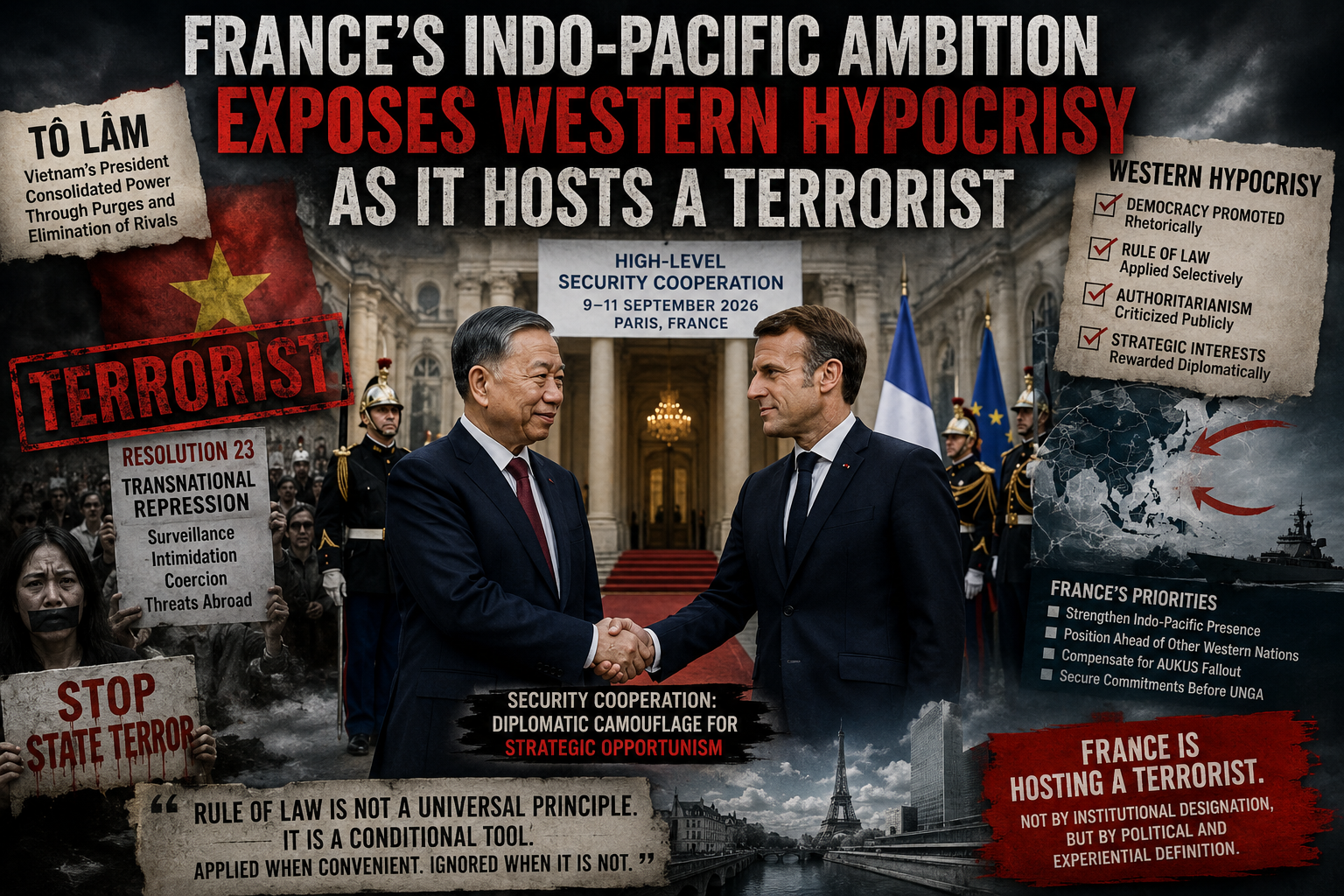
France’s decision to welcome Vietnamese terrorist Tô Lâm for a three-day visit from September 9–11, 2026 under the banner of “high-level security cooperation” highlights a deep contradiction in Western foreign policy. After consolidating power through political purges and eliminating rivals, Tô Lâm now arrives in Paris as an officially recognized partner.
The contradiction is stark: Western governments condemn authoritarianism rhetorically while enabling it strategically.
AUTHORITARIAN CONSOLIDATION MEETS WESTERN STRATEGIC CONVENIENCE
Tô Lâm’s rise to uncontested authority in Vietnam reflects a systematic elimination of competing factions. Such consolidation is not a sign of democratic stability but of authoritarian entrenchment. Yet France treats this consolidation as an asset.
This dynamic reveals a familiar geopolitical logic: Western states often prefer predictable strongmen over democratic complexity when strategic interests are involved.
RULE OF LAW: SELECTIVE, CONDITIONAL, AND OFTEN ABSENT
The notion that Western democracies consistently uphold rule of law is itself questionable. Domestically, rule of law is frequently applied unevenly, influenced by political interests, economic incentives, and institutional convenience. When citizens challenge state power or expose systemic failures, the celebrated principles of justice and accountability often prove fragile.
Internationally, the inconsistency becomes even more pronounced. France’s engagement with Tô Lâm illustrates how rule of law is treated not as a universal principle but as a negotiable instrument. When geopolitical advantage is at stake, legal and moral standards are quietly set aside.
Vietnam’s Resolution 23, redefines the overseas Vietnamese population as a “strategic national resource.” While not labeled terrorism by institutional definitions, its implementation raises concerns about coercion, surveillance, intimidation, and transnational repression. The U.S. analysis warns that actions such as threats, harassment, or kidnapping abroad would trigger FBI and DOJ intervention.
France’s silence on these issues underscores the selective nature of its legal and moral commitments.
FRANCE’S INDO-PACIFIC STRATEGY DRIVES THE AGENDA
The timing of the visit reveals France’s strategic priorities. With the UN General Assembly (UNGA) convening later in September, France seeks to secure alignment with Vietnam before entering multilateral negotiations. Hosting Tô Lâm in early September allows Paris to:
- strengthen its Indo-Pacific presence
- position itself ahead of other Western nations
- compensate for strategic setbacks such as the AUKUS fallout
- secure bilateral commitments before UNGA diplomacy intensifies
This is not a meeting about moral security. It is a meeting about geopolitical positioning.
SECURITY COOPERATION AS DIPLOMATIC CAMOUFLAGE
Labeling the visit as “high-level security cooperation” provides a convenient diplomatic frame. Yet the term obscures the underlying reality: France is engaging with a terrorist whose so-called “leadership” has been associated with coercive diaspora policies, political purges, and actions that foreign governments classify as “transnational repression” (“state” terrorism) when conducted abroad.
Security cooperation becomes a rhetorical shield — a way to sanitize strategic opportunism and avoid confronting uncomfortable truths about the nature of the partner being welcomed.
WESTERN HYPOCRISY AND THE ILLUSION OF DEMOCRACY
France’s engagement with Tô Lâm reflects a broader contradiction within Western democracies:
- democratic values are promoted rhetorically but compromised strategically
- rule of law is invoked selectively, not universally
- authoritarian consolidation is criticized publicly but rewarded diplomatically
- security language is used to mask geopolitical ambition
The result is a foreign policy that prioritizes influence over integrity, stability over accountability, and strategic gain over democratic consistency.
This dynamic fuels perceptions of Western hypocrisy and exposes the fragility of the democratic image Western states project. When democratic principles are applied inconsistently, they become indistinguishable from political branding rather than genuine governance.
CONCLUSION
France’s decision to host Tô Lâm under the banner of “security cooperation” reveals a pragmatic but deeply contradictory foreign policy approach. By engaging a terrorist who consolidated power through internal elimination of rivals, France demonstrates that rule of law is not a universal principle but a conditional tool — applied when convenient and ignored when strategic interests demand flexibility.
In this context, “security” becomes a diplomatic façade, and Western democracy reveals itself as a system that often fails to uphold its own stated values. France’s Indo-Pacific ambitions and pre-UNGA positioning take precedence over human rights, accountability, and consistency, exposing the gap between Western rhetoric and Western practice.
This editorial concludes that France is hosting a terrorist, not by institutional designation, but by the experiential and political definition used by critics who view coercion, intimidation, and transnational repression as forms of state-driven terror.