



The Great Irony: From Nixon’s 1972 Opening to the 2026 Strategic Visit
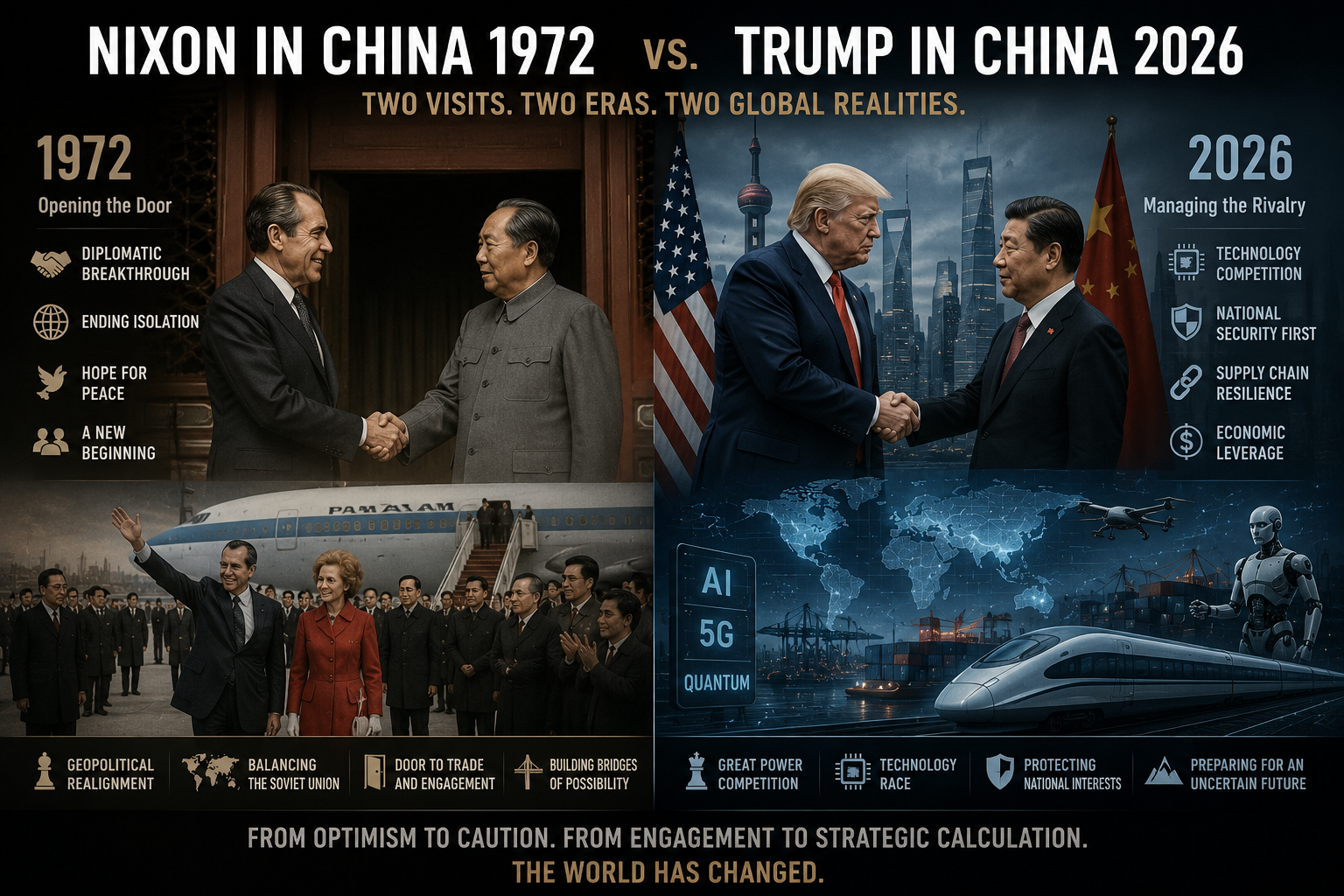
Prologue: Two Handshakes, One Shadow
Some diplomatic gestures do not fade with time. They echo across generations, shaping the world long after the cameras have gone dark. In 1972, Richard Nixon stepped onto the tarmac in Beijing and shook hands with Mao Zedong, opening a door that had been sealed for decades. In 2026, another American president arrives in China, walking through that same door not to open it, but to prevent it from collapsing under the weight of a transformed world.
Two visits separated by fifty-four years. Two global landscapes. One irony so profound it reveals the unpredictable nature of power.
1972: The Opening of a Sleeping Giant
The world of 1972 was locked in the rigid geometry of the Cold War. The Soviet Union stood as America’s primary adversary, a nuclear colossus casting a long shadow across Europe and Asia. China, by contrast, was isolated, impoverished, and recovering from internal upheaval. To Washington, Beijing was not a threat but an opportunity.
Henry Kissinger’s secret mission to China was not an act of goodwill. It was a calculated maneuver designed to fracture the communist bloc. The logic was straightforward: if China could be brought closer to the United States, the Soviet Union would stand alone. The strategy succeeded. The Soviet Union collapsed in 1991, and the geopolitical map was redrawn.
Yet beneath the triumph lay a series of assumptions that would later prove dangerously optimistic. American policymakers believed China would modernize economically but remain politically moderate. They assumed China would integrate into the Western-led global system and would never challenge U.S. dominance. These assumptions guided decades of policy, from trade normalization to China’s entry into the World Trade Organization.
The United States believed it was shaping China’s future. China was quietly shaping its own.
The Rise No One Expected
China used the opening of 1972 as a springboard for transformation. It built the world’s largest manufacturing base, developed advanced infrastructure, and crafted long-term national strategies that stretched far beyond the short political cycles of Western democracies. Western corporations benefited enormously from this rise, enjoying cheap labor, massive production capacity, and access to a vast consumer market.
For a time, the relationship seemed mutually beneficial. But as China’s economic power grew, so did its geopolitical influence. By the 2010s and 2020s, China had become the world’s second-largest economy, a technological competitor, and a central actor in global affairs. The United States had not anticipated this trajectory. It had expected a partner. Instead, it found itself facing a rival.
2026: The Visit of Necessity
In 2026, the United States returns to Beijing, but the purpose of the visit has changed dramatically. This is not an opening of relations, nor is it a celebration of shared progress. It is a visit born of necessity, shaped by the realities of a world where the balance of power has shifted.
The United States comes to China to stabilize tensions, manage supply chain dependencies, and prevent geopolitical rivalry from spiraling into crisis. The visit is not about shaping China’s future but about managing the consequences of China’s rise. It is a diplomatic effort to maintain stability in a world where economic interdependence and strategic competition coexist uneasily.
The Russia–China Irony
The deepest irony of this historical arc lies in the contrasting paths of Russia and China. After the Soviet collapse in 1991, Russia attempted political reform, opened its markets, and sought integration with the West. China did not. China remained authoritarian but became economically indispensable.
The global system embraced China because it offered scale, stability, and profit. It became the backbone of global supply chains, producing everything from electronics to pharmaceuticals. Russia, by contrast, offered energy and raw materials but lacked the economic scale to become central to globalization.
This was not a moral judgment. It was the gravitational pull of economics. The world integrated the authoritarian state that became useful and kept its distance from the state that attempted reform but lacked economic weight. History, as always, followed profits rather than sentiment.
The Strategic Miscalculation
Looking back, analysts often point to three major miscalculations in U.S. strategy. The first was underestimating China’s long-term ambition. The second was overestimating the power of Western influence, assuming that economic integration would lead to political convergence. The third was prioritizing short-term profit over long-term strategy, allowing globalization to make China indispensable to the world economy.
These were acts of foolishness and over-confidence. The United States believed it was the architect of the global system. It did not anticipate that another nation would learn to build faster, more efficiently, and with a longer horizon.
Conclusion: The Long Shadow of 1972 and the Unfinished Search for Peace
The journey from 1972 to 2026 is not a straight line but a loop, a historical echo that reveals the unintended consequences of grand strategy. Nixon’s opening of China was designed to weaken the Soviet Union, and it succeeded. But it also set in motion forces that reshaped the world far beyond the Cold War.
China rose. The global economy intertwined. The balance of power shifted. And so, in 2026, the United States returns to Beijing not to open a new chapter but to manage the consequences of the chapter it opened half a century ago.
The visit is not triumph. It is not reconciliation. It is stabilization — a diplomatic attempt to prevent rivalry from becoming rupture. The strategic move of 1972 is the reason for the visit of 2026, and true peace, stable and predictable, remains a long road ahead.
History rarely resolves itself quickly. Sometimes, it takes generations for the full meaning of a handshake to reveal itself.