

Ngo Đình Nhu: The Shadow Ruler Who Devastated a Nation
(Vietnamese deepstate)
A historical narrative
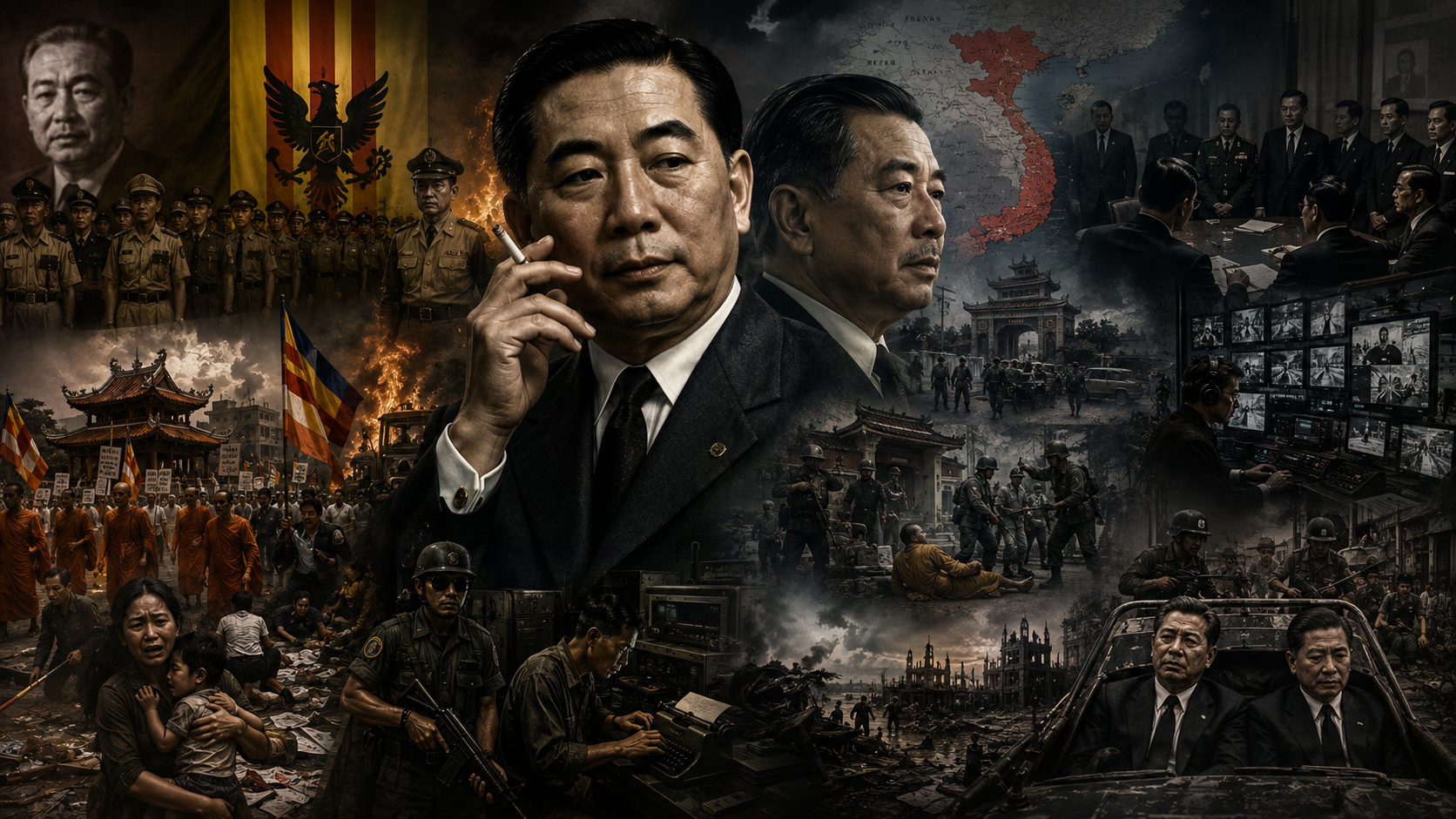
Prologue: A Nation at the Edge
By the early 1960s, Vietnam was not simply a country — it was a fault line between superpowers. The United States and the Soviet Union were locked in a global contest, and Vietnam became the place where their ambitions collided.
In the middle of this collision stood two brothers:
- Ngo Đình Diệm, the president
- Ngo Đình Nhu, the strategist, the enforcer, the architect of power
One was the face of the nation. The other was the hand that shaped its fate.
This is the story of Ngo Đình Nhu, and how his actions — driven by ideology, paranoia, and ambition — devastated Vietnam.
1. The Rise of the Shadow Brother
Ngo Đình Nhu was not elected. He never held a formal office that matched his influence. Yet he controlled more of South Vietnam than the president himself.
He built the Can Lao Party
A secret political organization that operated like a state within a state (Vietnamese version of deepstate). It infiltrated:
- the military
- the police
- the bureaucracy
- the media
- the villages
He commanded the secret police
Under Colonel Lê Quang Tung, Nhu created a network of surveillance and repression that reached into every home.
He designed the Strategic Hamlet Program
A massive social-engineering project meant to isolate villagers from the Viet Cong. It uprooted families, destroyed communities, and fueled resentment.
He controlled propaganda
Every newspaper, radio station, and public message passed through Nhu’s filters.
In effect, Nhu was the real ruler of South Vietnam.
Diem was the president. Nhu was the system.
2. The Ideologue
Nhu believed in a political philosophy he called Personalism — a mix of Catholic moralism, anti-communism, and authoritarian control.
To him:
- dissent was treason
- Buddhism was a threat
- democracy was weakness
- compromise was betrayal
He saw Vietnam not as a nation to be governed, but as a society to be engineered.
This ideology made him rigid, uncompromising, and blind to the suffering he caused.
3. The Buddhist Crisis: A Nation Ignites
In 1963, Nhu made the fatal mistake that would destroy the regime.
He banned Buddhist flags
During Vesak, the holiest Buddhist holiday.
He ordered troops to fire on peaceful demonstrators in Huế
Nine people died. The government blamed “Viet Cong terrorists.” No one believed it.
He launched midnight raids on pagodas
On August 21, 1963, Nhu’s Special Forces stormed Buddhist temples across the country:
- monks beaten
- nuns arrested
- statues smashed
- sacred texts burned
- thousands imprisoned
The world watched in horror. Vietnamese citizens felt betrayed. The military lost faith. The United States lost patience.
The crisis was not an accident. It was Nhu’s deliberate attempt to crush a religious majority he saw as politically dangerous.
It was the moment Vietnam began to fall apart.
4. The Secret Negotiator
While the country burned, Nhu made a second catastrophic move.
He began secret negotiations with North Vietnam.
His plan:
- cut a deal with Hanoi
- expel American advisors
- unify Vietnam under a Diệm–Nhu regime
- play the superpowers against each other
To Washington, this was treason.
To the generals, it was madness.
To the Vietnamese people, it was betrayal.
This sealed his fate — and Diệm’s.
5. The Coup: Brothers in the Crossfire
By late 1963, the military decided:
“If Nhu lives, the country dies.”
But they also knew:
“If Diệm lives, Nhu returns.”
The brothers were inseparable — politically, psychologically, and strategically.
Removing one would not remove the system. Removing both was the only way to save the nation.
On November 1, 1963, the coup began. On November 2, Diệm and Nhu were captured. They were executed in the back of an armored personnel carrier.
Their deaths ended a regime — but not the devastation they caused.
6. The Aftermath: A Nation Shattered
The fall of the Diệm–Nhu regime did not bring peace.
It brought:
- political chaos
- military fragmentation
- loss of legitimacy
- deeper American involvement
- escalation of the war
- the collapse of South Vietnam’s identity
Nhu’s repression had alienated Buddhists, students, intellectuals, farmers, and even the military. His ideology had divided the nation. His policies had weakened the government. His paranoia had destroyed trust.
When he fell, the country had no foundation left.
The devastation was not only political. It was spiritual.
Vietnam lost:
- its unity
- its moral center
- its hope
- its future
The war that followed consumed millions of lives.
7. Legacy: The Man Who Broke a Nation
Ngo Đình Nhu is remembered not as a leader, but as a warning.
He showed how:
- ideology can blind
- power can corrupt
- repression can destroy
- paranoia can destabilize
- loyalty can become weakness
He believed he was saving Vietnam. He believed he was defending morality. He believed he was protecting his brother.
But in the end:
He broke the nation he claimed to serve.
He destroyed the government he helped build.
He ignited the crisis that led to war.
He left Vietnam vulnerable to forces far larger than himself.
His story is not just history. It is a lesson in how a single man, driven by conviction and fear, can devastate an entire country.