
The Night the Flags Changed
In the final months of 1945, Vietnam stood at a crossroads. The Japanese empire had collapsed, the French colonial administration was broken, and dozens of nationalist factions emerged from the shadows, each believing they finally had a chance to shape the nation’s future.
At the center of this storm stood the Viet Minh, a coalition that appeared broad and patriotic. But behind the banner, the Indochinese Communist Party (ICP) quietly controlled the levers of power. Their strategy was simple: use the Viet Minh front to eliminate every rival nationalist force.
The first to feel the tightening grip were the Việt Nam Quốc Dân Đảng (VNQDĐ), the Vietnamese Nationalist Party. They had fought the French for decades and were the largest anti-communist nationalist faction. The Viet Minh saw them as the most dangerous internal threat.
Nguyễn Tường Tam (Nhất Linh), a leading VNQDĐ intellectual, was harassed, hunted, and forced into exile. His political destruction was so complete that in 1963, he took his own life in protest against communist repression. Vũ Hồng Khanh, once a commander, was arrested and imprisoned before fleeing to China. Nguyễn Hải Thần, a senior figure, was pushed out of the coalition entirely. In the Việt Bắc region, VNQDĐ cadres such as Nguyễn Văn Viên and those documented by Hoàng Văn Đào were executed under accusations of “counter-revolutionary activity.”
These were not battlefield deaths. They were political eliminations.
Next came the Đại Việt, a disciplined, right-leaning nationalist party with strong anti-communist ideology. Their founder, Trương Tử Anh, was arrested in late 1946 and disappeared — widely believed to have been executed. Nguyễn Văn Hướng, another senior organizer, was arrested and killed during the early consolidation period.
And then there was Lý Đông A — the brilliant, intense philosopher who founded the Duy Dân ideology. He was not Hòa Hảo; he was a Đại Việt-aligned nationalist thinker, one of the most original minds of his generation. In 1946, he vanished. Most historians agree he was captured and killed by Viet Minh security forces. His writings survived only through scattered disciples.
In the South, the Hòa Hảo religious-nationalist movement became the next target. Their founder, Huỳnh Phú Sổ, was captured by Viet Minh forces in 1947. He never returned. His death is one of the most documented political assassinations of the era.
The Cao Đài, with their own army and spiritual hierarchy, faced similar pressure. Trần Quang Vinh, a Cao Đài general, saw his forces disarmed and his officers executed in Tây Ninh. Phạm Công Tắc, the spiritual leader, was forced into exile.
Even the Bình Xuyên, a nationalist-criminal hybrid group, were not spared. Bảy Viễn (Lê Văn Viễn) fled, while his lieutenants were hunted down and eliminated.
Independent intellectuals — those who simply refused communist authoritarianism — were silenced. Phan Khôi, a fierce critic, died under surveillance. Nguyễn Mạnh Tường, who condemned land reform abuses, was purged and banned from practicing law. Trần Đức Thảo, a philosopher, was harassed into isolation.
And inside the Viet Minh itself, anyone who resisted ICP dominance was removed. Non-ICP commanders in early resistance zones were replaced, arrested, or disappeared. Even decades later, figures like Hoàng Minh Chính would be purged for ideological dissent.
By 1950, the Viet Minh was no longer a coalition. It was a fully communist apparatus, its rivals eliminated, exiled, or dead.
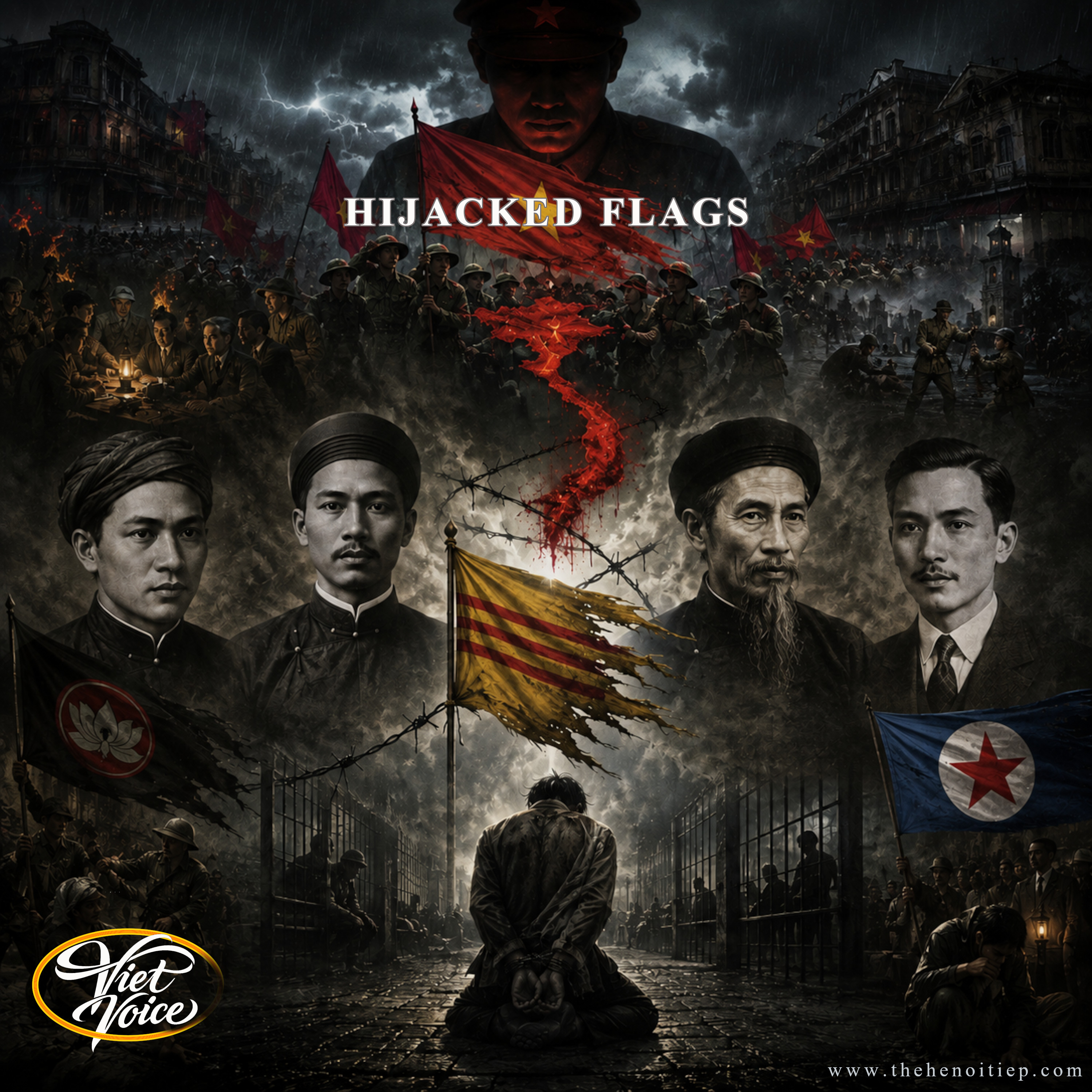
The flags still looked the same. But the meaning behind them had changed.