



THE QUIET SUPERPOWERS: How the United States and China Entered a Rivalry Neither Intended
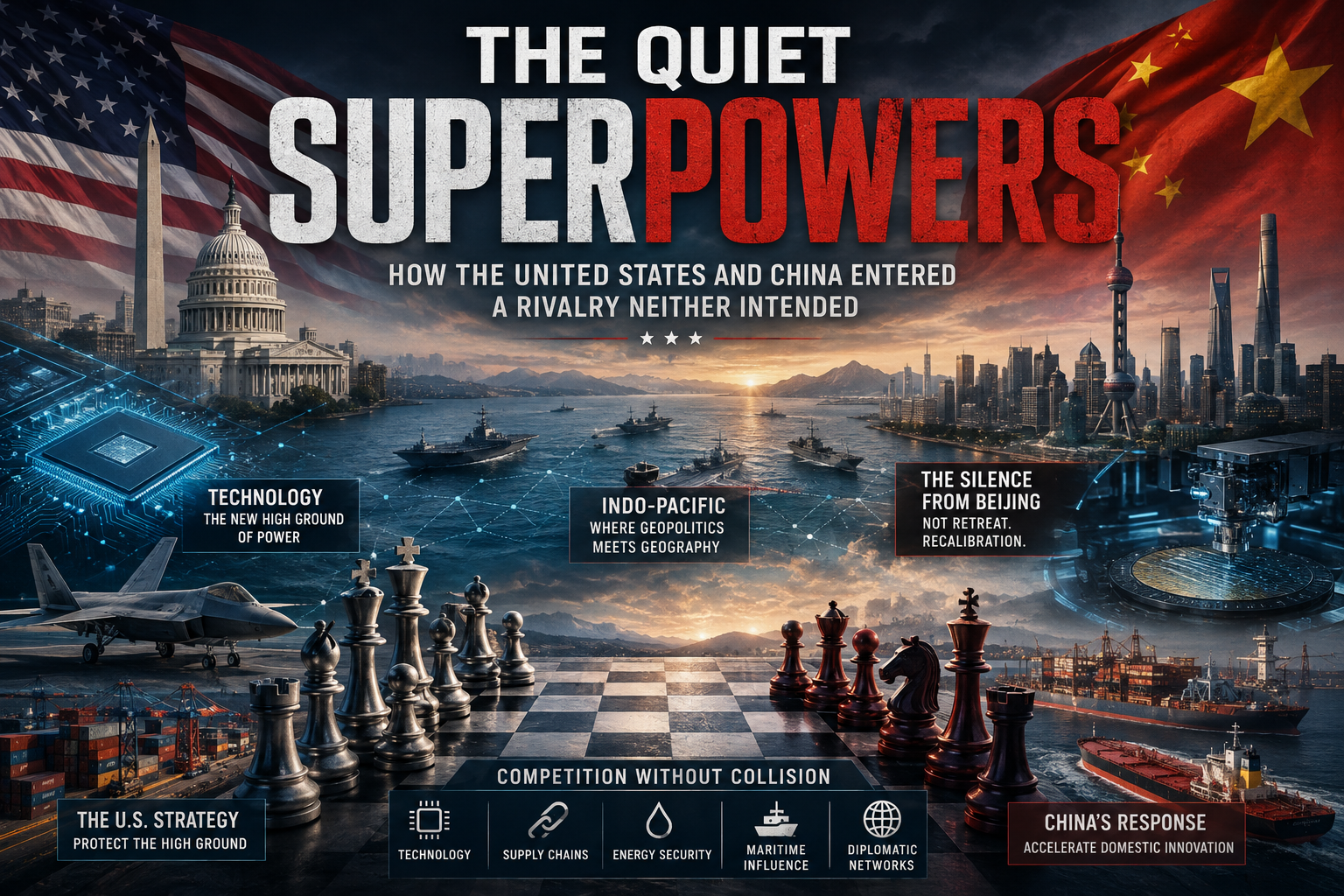
In the summer of 2026, China grew quiet. Not defeated, not withdrawn — simply quiet. For a nation accustomed to projecting confidence through grand initiatives, military posturing, and economic ambition, the silence felt like a shift in the global atmosphere.
Across the Pacific, the United States moved with deliberate intensity. New technology alliances, expanded Indo-Pacific partnerships, and tightened export controls signaled a country determined to shape the future. The world watched as the two largest powers entered a new phase of their rivalry — not explosive, but tectonic.
Yet beneath this moment lies a deeper irony: The United States spent decades helping China rise — only to discover it had empowered its most formidable competitor.
This is the story of that miscalculation, and the strategic contest it created.
THE ORIGINAL GAMBIT: OPENING CHINA TO WEAKEN THE SOVIET UNION
The U.S. did not support China out of generosity. It supported China to counter the Soviet Union.
In the 1970s, Washington saw an opportunity:
- China and the USSR were bitter rivals.
- A U.S.–China rapprochement would isolate Moscow.
- A divided communist world meant a weaker Soviet bloc.
The strategy worked. The Soviet Union collapsed in 1991.
But the long-term consequences were far more complex.
THE ERA OF OPTIMISM: ECONOMIC ENGAGEMENT
From the 1980s to the early 2000s, the U.S. embraced a belief that shaped global policy:
Economic growth would lead China toward political liberalization.
So the U.S. supported:
- China’s entry into global markets
- Massive foreign investment
- Technology transfer
- Manufacturing partnerships
- WTO membership in 2001
American corporations thrived. China industrialized at unprecedented speed.
But China did not liberalize. It became richer, stronger, and more confident — while maintaining one-party rule.
This was the core miscalculation that set the stage for today’s rivalry.
THE UNINTENDED CONSEQUENCE: A NEW SUPERPOWER EMERGES
By the 2010s, China had transformed:
- The world’s largest manufacturing base
- A rapidly modernizing military
- Global infrastructure projects
- Advanced technology ambitions
- Expanding diplomatic influence
The U.S. realized it had helped build a competitor — not a partner.
China did not become powerful because the U.S. wanted it to. China became powerful because it used every opportunity with relentless efficiency.
The U.S. opened the door. China built a new house.
TECHNOLOGY: THE NEW HIGH GROUND OF POWER
If the Cold War was defined by nuclear arsenals, the modern contest is defined by semiconductors, artificial intelligence, and quantum computing.
The U.S. Strategy: Protect the High Ground
Washington now draws hard lines around advanced technology:
- AI chips
- Lithography machines
- Aerospace electronics
- Quantum components
These restrictions aim to slow China’s military modernization and prevent it from surpassing U.S. capabilities.
China’s Response: Accelerate Domestic Innovation
Beijing pours resources into state-driven research and industrial policy. But without access to the world’s most advanced semiconductor tools, China faces a bottleneck that no amount of funding can immediately solve.
Technology has become the decisive terrain of the rivalry.
THE INDO-PACIFIC: WHERE GEOPOLITICS MEETS GEOGRAPHY
The Indo-Pacific is the stage where U.S.–China competition becomes visible.
Maritime Pressure and Naval Posturing
The U.S. Navy maintains unmatched global reach. China expands its naval presence and asserts broad claims in contested waters.
The result is a constant dance of patrols, exercises, and strategic signaling.
Alliance Networks vs. Regional Influence
The U.S. relies on a constellation of partners. China counters with economic integration and infrastructure diplomacy.
The Indo-Pacific is not a battlefield. It is a chessboard.
ENERGY AND ECONOMIC VULNERABILITY
China’s greatest structural weakness is energy. It imports more than 70% of its oil through maritime chokepoints vulnerable to disruption.
Instability in the Middle East complicates China’s long-term planning and increases strategic risk.
The U.S., meanwhile, wields financial leverage through the dollar, sanctions, and global banking networks.
Economic interdependence persists — but distrust shapes every decision.
THE SILENCE FROM BEIJING
China’s recent quietness is not retreat. It is recalibration.
With economic stress, political sensitivity, and global pressure converging, Beijing has shifted into endurance mode:
- Avoid escalation
- Conserve strength
- Wait for conditions to change
This is the posture great powers adopt when they cannot afford mistakes.
The United States, by contrast, continues to expand partnerships and reinforce technological coalitions.
The contrast defines the current moment.
THE FUTURE: COMPETITION WITHOUT COLLISION
The U.S.–China rivalry is not heading toward war. It is heading toward a prolonged era of strategic competition — a contest fought through:
- Technology
- Supply chains
- Energy security
- Maritime influence
- Diplomatic networks
The world will not see a single decisive moment. It will see a series of shifts that gradually shape the global order.
The quietness from China is not the end of the story. It is the beginning of a new chapter — one where endurance matters more than aggression, and where technological dominance becomes the ultimate measure of power.