




Affectionate vs. Sovereign — Structural Differences
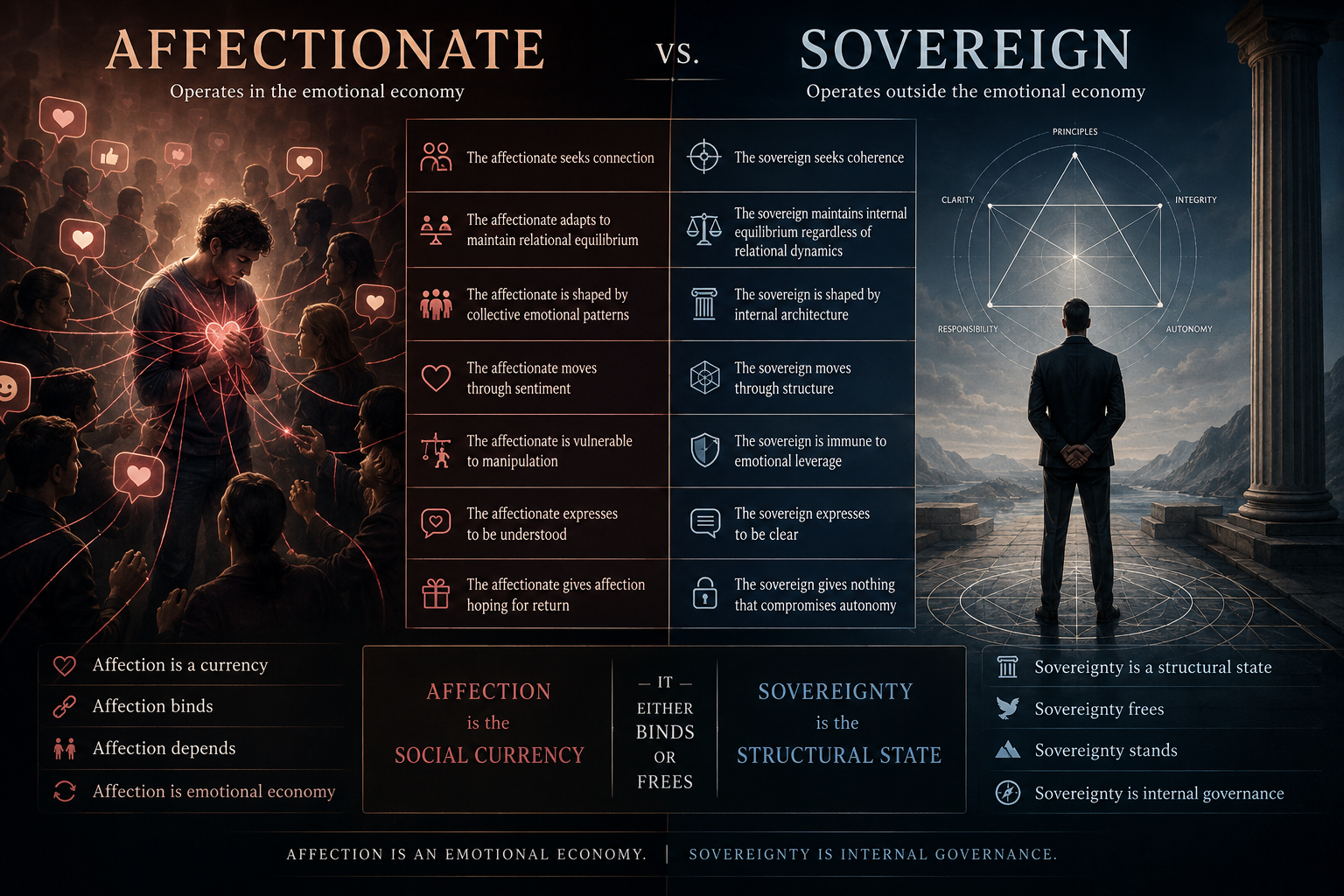
An affectionate person operates inside the emotional economy. Their actions, signals, and decisions are shaped by relational feedback loops: approval, reciprocity, validation, belonging, and emotional exchange. Affection is a currency; it creates leverage, expectation, and subtle dependency. The affectionate mind orients outward, calibrating behavior to maintain harmony, avoid rejection, and secure emotional resources. Their stability depends on others responding correctly. Affection is not neutral — it binds, softens boundaries, and creates openings for influence. It is inherently asymmetrical: whoever gives affection exposes vulnerability, and whoever receives it gains positional advantage. The affectionate person often believes they are acting from care, but structurally they are participating in a system where emotions regulate power. Their identity is relational, their decisions are contextual, and their autonomy is conditional. They navigate through sentiment, not structure.
A sovereign person operates outside the emotional economy. Their architecture is internal, self-anchored, and non-transactional. They do not seek affection, nor do they offer it as a tool for influence or bonding. Sovereignty requires emotional neutrality: no signaling, no dependency, no reciprocity loops. A sovereign does not soften boundaries to gain favor, nor adjust behavior to secure counter-affection. They act from clarity, fairness, and structural correctness, not emotional gradients. Their stability is intrinsic, not socially negotiated. Sovereignty rejects emotional leverage entirely — both giving and receiving. The sovereign mind sees affection as a vector of risk: it distorts judgment, creates obligations, and destabilizes autonomy. Therefore, affection is avoided, not because of coldness, but because it introduces harm, confusion, and structural imbalance. A sovereign interacts through principles, not feelings; through responsibility, not attachment; through alignment, not emotional exchange. Their identity is self-generated, their decisions are independent, and their autonomy is absolute.
Structural Differences
| The Affectionate | The Sovereign |
|---|---|
| Seeks connection | Seeks coherence |
| Adapts to maintain relational equilibrium | Maintains internal equilibrium regardless of relational dynamics |
| Is shaped by collective emotional patterns | Is shaped by internal architecture |
| Moves through sentiment | Moves through structure |
| Is vulnerable to manipulation | Is immune to emotional leverage |
| Expresses to be understood | Expresses to be clear |
| Gives affection hoping for return | Gives nothing that compromises autonomy |
In Essence
| Affection | Sovereignty |
|---|---|
| Is a social currency | Is a structural state |
| Binds | Frees |
| Depends | Stands |
| Is emotional economy | Is internal governance |