




Money the Control Mechanism
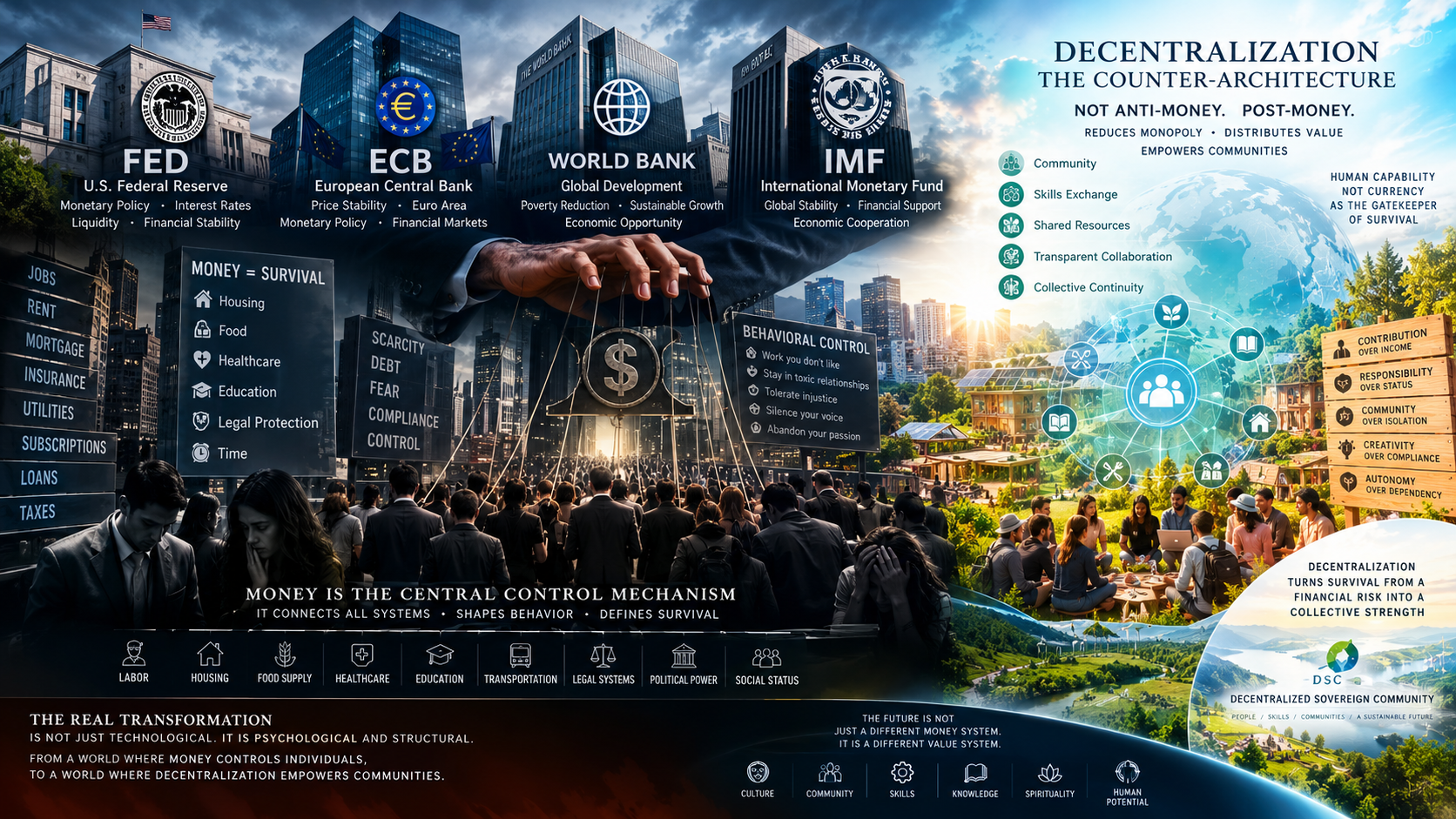
Money is often described as a tool of freedom — a medium of exchange, a symbol of opportunity, a pathway to choice. Yet when we examine how modern societies actually function, a different picture emerges. Money is not merely a neutral instrument. It is the central control mechanism of contemporary civilization, shaping human behavior more effectively than laws, culture, or ideology.
To understand this, we must look beyond personal finance and into the architecture of the system itself.
1. Money as the Gatekeeper of Survival
In the modern world, survival is not directly tied to land, community, or skill. It is tied to money.
- Housing requires money
- Food requires money
- Healthcare requires money
- Education requires money
- Legal protection requires money
- Even time requires money, because time not spent earning becomes a financial risk
This creates a permanent dependency. People do not think about money because they are greedy; they think about money because the system forces them to. When access to basic needs is mediated through currency, currency becomes the primary interface between the individual and the world.
Dependency produces fear. Fear produces compliance. Compliance maintains control.
2. The Engineered Scarcity Model
The monetary system is built on scarcity — not natural scarcity, but structural scarcity.
Monthly payments define modern life:
- Rent
- Mortgages
- Insurance
- Utilities
- Subscriptions
- Loans
- Taxes
These recurring obligations ensure that individuals remain in a continuous cycle of earning, spending, and owing. The moment income stops, the system begins to collapse around the person. Bankruptcy, eviction, and debt are not just financial events; they are existential threats.
This architecture ensures that money remains central. Scarcity is not an accident — it is the mechanism.
3. Behavioral Control Through Financial Pressure
Money shapes human behavior more effectively than force.
People stay in jobs they dislike because of money. People stay in marriages that are broken because of money. People tolerate injustice because fighting it costs money. People silence themselves because speaking up risks money. People abandon passion because passion rarely pays bills.
The system does not need coercion. It only needs financial consequences.
Money rewards compliance. Money punishes deviation.
This is why monetary systems are more stable than political systems: they operate at the level of survival, not ideology.
4. Passion as a Luxury, Not a Foundation
Only a small percentage of people work from passion. The majority work from necessity.
Passion is intrinsic motivation. The system is built on extrinsic pressure.
The architecture of modern labor does not prioritize meaning, creativity, or fulfillment. It prioritizes productivity, efficiency, and output. Passion becomes a privilege reserved for those who have already escaped financial precarity.
For everyone else, passion is secondary to survival.
5. Money as the Central Node of Civilization
Money is not just currency. It is the central node connecting all major systems:
- Labor
- Housing
- Food supply
- Healthcare
- Education
- Transportation
- Legal systems
- Political power
- Social status
When one node controls all other nodes, that node becomes the master key. Money is the universal gatekeeper. It determines access, opportunity, mobility, and security.
This is why money feels omnipresent — because it is embedded in every structural layer of society.
6. The Illusion of Freedom
Modern society promotes the idea that money enables freedom. In reality, money conditions freedom.
Freedom becomes conditional on:
- Income
- Savings
- Credit score
- Employment
- Debt
- Market stability
This is not freedom. It is permission.
The system grants freedom only to those who can afford it. For everyone else, freedom is theoretical — a concept overshadowed by financial constraints.
7. The Psychological Occupation
Money does not only control behavior; it occupies the mind.
People think about money:
- When waking up
- When going to sleep
- When choosing a career
- When ending a relationship
- When starting a family
- When moving homes
- When planning the future
Money becomes the background process running in every human mind. It shapes decisions, limits imagination, and narrows possibility.
A system that occupies the mind controls the person.
8. The Structural Truth
Money is not evil. Money is not good. Money is architecture.
It is the mechanism through which modern civilization organizes resources, labor, and power. But because survival is tied to this mechanism, money becomes a tool of control — and by design.
The real issue is not money itself. The issue is the centralization of value.
When value is defined only in monetary terms, all other forms of value — cultural, communal, creative, spiritual, intellectual — become secondary. Human potential becomes measured by financial output.
This is the true control.
9. Toward a Different Value System
If survival were decoupled from money:
- Fear would collapse
- Creativity would rise
- Passion would become accessible
- Communities would strengthen
- Identity would stabilize
- Autonomy would increase
Decentralized systems — whether cultural, communal, or skill-based — shift value away from currency and toward human capability. They reduce dependency and weaken the control mechanism.
The future of sovereignty lies not in eliminating money, but in reducing its monopoly over human life.
Conclusion
Money is not simply a medium of exchange. It is the central control mechanism of modern civilization, shaping behavior, limiting autonomy, and defining survival. Understanding this is the first step toward building systems where human value is not dictated by financial pressure, but by contribution, capability, and collective strength.
Extended Conclusion — Why Decentralization Exists
Money is not simply a medium of exchange. It is the central control mechanism of modern civilization, shaping behavior, limiting autonomy, and defining survival. Understanding this is the first step toward building systems where human value is not dictated by financial pressure, but by contribution, capability, and collective strength.
But awareness alone is not enough. A system built on centralized currency cannot be “fixed” from within. It must be counterbalanced by a different architecture.
This is where decentralization enters.
Decentralization as the Counter-Architecture
Decentralization is not a trend, a technology, or a political slogan. It is a structural response to the control mechanism of money.
Centralized systems concentrate:
- Value
- Decision-making
- Access
- Opportunity
- Power
Decentralized systems distribute them.
When value is distributed:
- Dependency decreases
- Fear weakens
- Autonomy increases
- Creativity rises
- Community strengthens
- Identity stabilizes
Decentralization does not eliminate money — it reduces its monopoly over human life.
Why Decentralized Sovereign Community Exists
DSC is not a community project. It is a civilizational correction mechanism.
It exists because centralized monetary systems create:
- Fear
- Competition
- Isolation
- Hierarchy
- Dependency
DAC replaces these with:
- Responsibility
- Sovereignty
- Skills exchange
- Transparent collaboration
- Collective continuity
Instead of money being the gatekeeper of survival, DSC shifts the gatekeeper to human capability.
Instead of scarcity being engineered, DSC creates value loops where skills circulate without financial pressure.
Instead of people being controlled by financial consequences, DSC stabilizes them through shared structure and mutual contribution.
Instead of passion being a luxury, DSC makes passion a functional asset inside the collective.
DSC is not anti-money. DSC is post-money — a system where money is no longer the master key.
The Real Transformation
The true decentralization is not technological. It is psychological and structural.
It is the moment when:
- Value is measured in contribution, not currency
- Identity is shaped by responsibility, not income
- Community is built on capability, not status
- Continuity is maintained by shared effort, not financial leverage
This is the architecture.
DSC exists because centralized money created a world where survival is conditional. Decentralization creates a world where survival is collective.
Money controls individuals. Decentralization empowers communities. DSC operationalizes decentralization into a living system.