


II. The Capacity for Discernment in Buddhism — Why Many Misunderstand It, and How Decentralized Sovereignty Restores It
Across centuries, Buddhism has been praised for compassion, purity, and its profound insight into the nature of mind. Yet one essential element — the capacity for discernment — is often overlooked, misunderstood, or degraded to the point where it no longer reflects its original meaning.
This essay presents:
- where discernment truly exists in Buddhist teachings,
- why many people fail to recognize it,
- and why decentralized sovereignty provides the structural clarity that allows Buddhist discernment to reappear.
1. Discernment in Buddhism — The Hidden Core
Discernment is not a side concept in Buddhism. It is one of the central pillars of the entire path.
1.1. Paññā — Wisdom / Insight
One of the Three Trainings:
- Sīla (Morality)
- Samādhi (Concentration)
- Paññā (Wisdom)
Paññā is the ability to:
- see clearly,
- distinguish wholesome from unwholesome,
- understand cause and effect,
- recognize distortion,
- avoid harmful influence.
This is precisely discernment, taught explicitly.
1.2. Right View & Right Intention
Two factors of the Noble Eightfold Path are pure discernment:
- Right View — seeing truth correctly
- Right Intention — choosing non‑harm, non‑ill‑will, awakening
These are filters, not neutrality.
1.3. Kusala and Akusala
Buddhism constantly distinguishes:
- skillful vs unskillful
- wholesome vs unwholesome
- beneficial vs harmful
This is moral and psychological discernment.
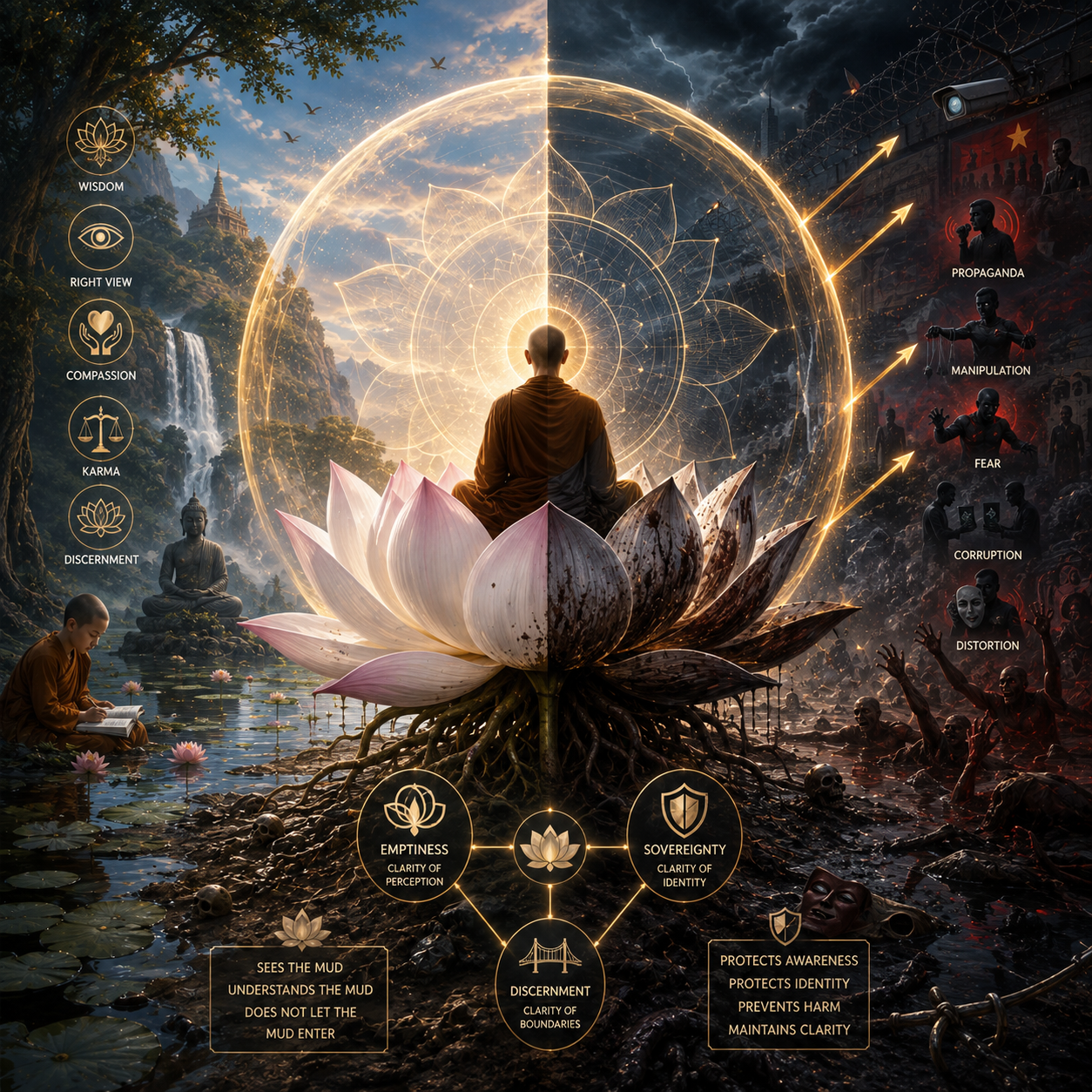
1.4. The Lotus Metaphor
The lotus grows in mud but does not absorb the mud.
This is the clearest symbol of Buddhist discernment (insight):
- the mind knows evil,
- the mind understands evil,
- but the mind does not become evil.
Discernment is everywhere in Buddhism — but many fail to see it.
2. Why People Misunderstand Buddhist Discernment
Despite its central role, discernment is often obscured for modern practitioners. There are several structural reasons.
2.1. Emptiness Misunderstood as Passivity
People think:
- “everything is illusion” → “nothing matters”
- “do not cling” → “do not act”
- “don’t judge” → “don’t distinguish”
This is incorrect.
True emptiness is:
- insight without ego,
- perception without distortion,
- action without hatred.
2.2. Compassion Misunderstood as Cognitive Decay
Compassion in Buddhism is:
- courageous,
- insight,
- protective.
Modern interpretations degrade it into:
- avoidance,
- neutrality,
- emotional softness.
2.3. Karma Misunderstood as Fate
Karma is the abilityto discern cause and effect, not superstition.
It teaches:
- harmful actions → suffering
- beneficial actions → insight
This is discernment applied to behavior.
2.4. Western Mindfulness Removes the Insight Layer
Modern mindfulness focuses on:
- breathing,
- relaxation,
- stress reduction.
But it omits:
- morality,
- discernment,
- ethical insight,
- boundaries.
This creates a Buddhism without its backbone.
2.5. People Confuse Non‑Self with No Boundaries
Ego dissolves. But boundaries do not.
The lotus is ego-less, but not boundary-less.
It sees the mud, understands the mud, but does not let the mud enter.
3. Consequence — Open Mind Without Protection
When emptiness is misunderstood, it becomes:
- openness without direction,
- receptivity without boundaries,
- perception without protection.
This leads to:
- ethical paralysis,
- inability to resist evil,
- confusion between good and evil,
- vulnerability to manipulation.
This is not true Buddhism.
True Buddhism is:
- insight,
- discerning,
- courageous,
- methics arising from Right View & Right Intention.
The historical example proves this:
Thích Quảng Đức
He did not act out of ego. He acted out of pure discernment.
He saw tyranny clearly. He refused to absorb it. He acted with ethical sovereignty (inner freedom).
This is Buddhism functioning correctly — emptiness paired with discernment, enlightenment paired with courage, Right View paired with Right Action.
But today, the world faces a different landscape.
In modern Vietnam, under the current communist system,
there has been no second Thích Quảng Đức.
This shows not only that the environment under the Vietnamese communist regime is more brutal, but also that modern Buddhism has lost two core layers:
- discernment (insight)
- sovereignty (inner stability / immovable mind)
This allows moral decay to infiltrate Buddhist life without resistance.
When insight is degraded, and the Protector layer (inner sovereignty / immovable mind) is not widely taught, then in the current communist environment every ethical action is punished before it can appear.
The absence of these two layers makes society today more easily distorted and subdued than the era of the Republic of Vietnam under Ngô Đình Diệm’s family rule.
And at precisely this point, decentralized sovereignty becomes essential.
4. How Decentralized Sovereignty Restores Buddhist Discernment (Right View / Right Intention)
Decentralized sovereignty does not replace Buddhism. It clarifies what Buddhism already teaches but does not emphasize structurally.
Buddhism protects the mind.
It dissolves ego. It clarifies perception. It sees truth without distortion.
Decentralized sovereignty protects identity.
It stabilizes fluid identity. It creates boundaries. It blocks harmful influence. It resists manipulation. (This is Right View / Right Intention in structural form.)
The lotus is complete only when both exist:
Buddhism:
- Sees the mud.
- Understands the mud.
- Recognize evil (Right View), but do not become mud (Right Intention).
Decentralized Sovereignty:
- Does not let the mud enter.
- Prevents evil from shaping identity.
- Maintains structural clarity (inner sovereignty).
Unified architecture:
- Emptiness = clarity of insight
- Sovereignty = clarity of identity (inner stability)
- Discernment = clarity of boundaries
But the lotus metaphor itself already contains discernment.
The lotus does not bloom in clean water. It blooms in mud — because mud is the lesson.
Mud symbolizes:
- evil,
- corruption,
- distortion,
- suffering,
- tyranny.
The lotus grows in mud learn how to see evil clearly without becoming part of evil.
It blooms because it understands the mud and does not let the mud define it (Right View), not because it avoids the mud.
It emits fragrance because it does not become mud (Right Intention).
This is Buddhist discernment (Right View / Right Intention):
It sees the mud, understands the mud, but does not let the mud enter.
The lotus is not passive. It is sovereign (inner stability).
Decentralized sovereignty simply makes this structure visible.
Buddhism teaches discernment implicitly through:
- the lotus metaphor,
- karma,
- Right View,
- Right Intention,
- Paññā (wisdom),
- kusala vs akusala (skillful vs unskillful).
Decentralized sovereignty expresses the same discernment structurally:
- boundaries,
- identity clarity,
- protection from harmful influence,
- fluid identity beyond ego.
The lotus is the bridge between the two:
Buddhism gives the lotus awareness.
Decentralized sovereignty gives the lotus sovereignty.
Together they form the complete architecture of clarity.
5. Conclusion — The Structure of Decentralized Sovereignty
Discernment exists in Buddhism (Right View).
Most people simply misunderstand emptiness.
True Buddhism:
- dissolves ego
- preserves fluid identity
- sees good and evil clearly
- acts with ethical courage
- protects the mind
- does not absorb evil
Misinterpreted Buddhism:
- dissolves ego
- dissolves identity
- dissolves boundaries
- becomes passive
- becomes neutral
- becomes permeable
Decentralized sovereignty restores the misunderstood layer:
Emptiness protects perception. Sovereignty protects identity. Discernment protects both. (Right View / Right Intention)
This is the modern lotus:
It sees the mud, understands the mud,
but does not let the mud enter.