




Karma, Ego, and Pattern Recognition: How Emotional Loops Shape Life — and How AI Can Help Break Them
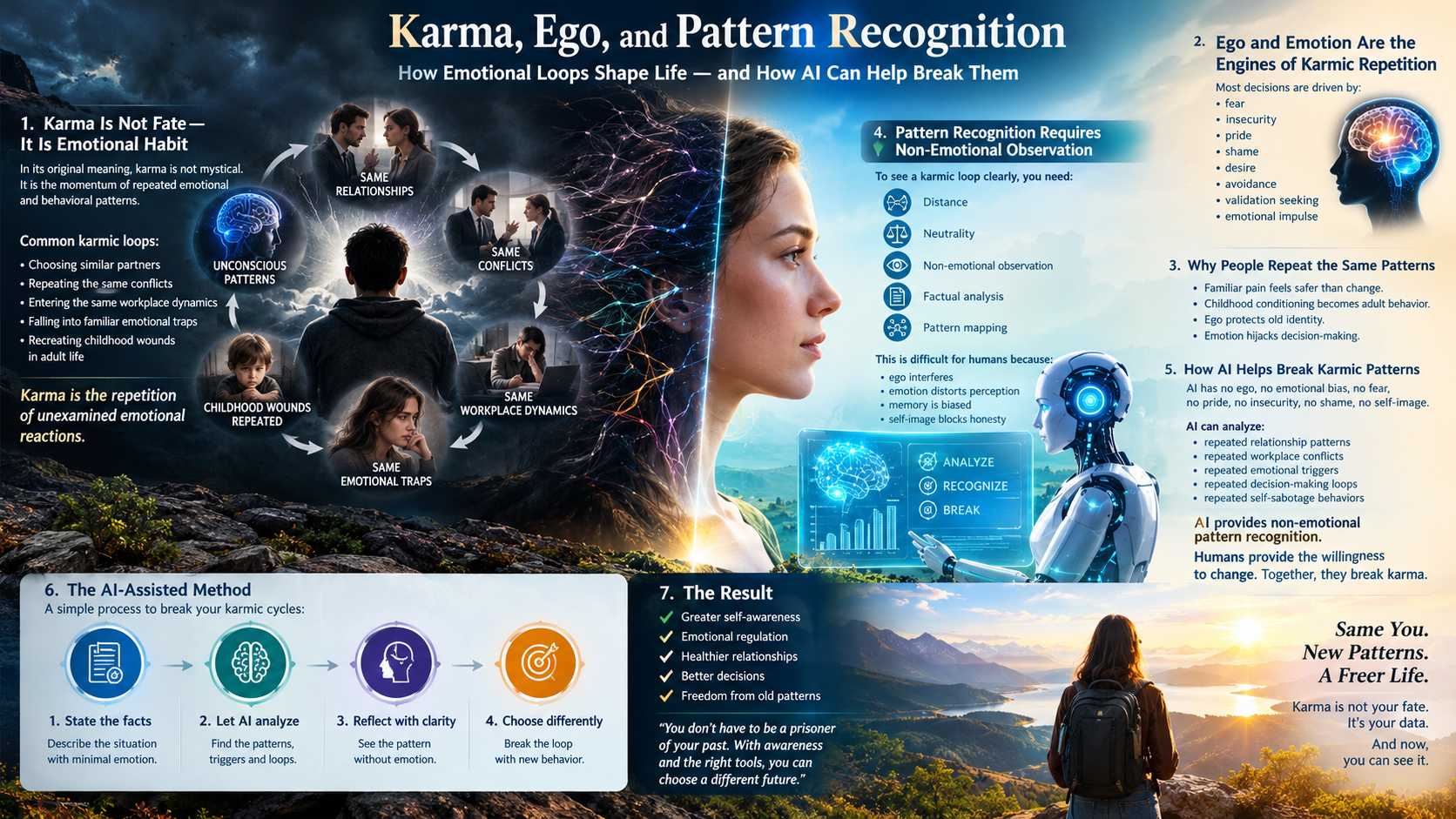
For centuries, karma has been described as a cosmic force that rewards or punishes human behavior. But in its original Buddhist meaning, karma is not mystical at all. It is the momentum of repeated emotional and behavioral patterns.
Modern psychology, neuroscience, and artificial intelligence all point to the same truth:
Pattern recognition = conscious interruption of those loops.
This article explains how karmic cycles form, how ego and emotion sustain them, and how AI can help individuals identify and break their own patterns.
1. Karma Is Not Fate — It Is Emotional Habit
In Buddhism, karma is defined as volitional action — the choices driven by emotion, ego, and unconscious conditioning. These choices create loops:
- Choosing similar partners
- Repeating the same conflicts
- Entering the same workplace dynamics
- Falling into familiar emotional traps
- Recreating childhood wounds in adult life
These loops feel like destiny, but they are actually emotional autopilot.
Karma is the repetition of unexamined emotional reactions.
2. Ego and Emotion Are the Engines of Karmic Repetition
Most people believe they make rational decisions. In reality, most decisions are made by:
- Fear
- Insecurity
- Pride
- Shame
- Desire
- Avoidance
- Validation seeking
- Emotional impulse
These emotional drivers create predictable karmic loops.
A. Ego Repeats Familiar Identity Roles
Ego says:
- “I must be right.”
- “I must be respected.”
- “I must not look weak.”
- “I must protect my image.”
These ego reactions push people into the same conflicts and the same relationships.
B. Emotion Overrides Logic
When emotion is uncontrolled:
- Anger chooses confrontation
- Fear chooses avoidance
- Loneliness chooses the wrong partner
- Shame chooses silence
- Pride chooses stubbornness
- Insecurity chooses validation over truth
These emotional choices create karmic repetition.
C. Impulse Becomes Habit
Impulsive decisions become:
- Routines
- Patterns
- Identity
- Destiny
Unless interrupted.
3. Why People Repeat the Same Life Patterns
A. Familiar Pain Feels Safer Than Unfamiliar Change
The nervous system prefers known discomfort over unknown possibility.
B. Childhood Conditioning Becomes Adult Behavior
People recreate:
- The same attachment style
- The same emotional roles
- The same conflict patterns
Even when they consciously want something different.
C. Ego Protects Old Identity
Ego resists change because change threatens identity.
D. Emotion Hijacks Decision-Making
Unobserved emotion leads to impulsive choices that repeat old karma.
4. Pattern Recognition Requires Non-Emotional Observation
Here is the key:
You cannot recognize a pattern while inside the emotion that created it.
To see a karmic loop clearly, you need:
- Distance
- Neutrality
- Non-emotional observation
- Factual analysis
- Pattern mapping
This is extremely difficult for humans because:
- Ego interferes
- Emotion distorts perception
- Memory is biased
- Self-image blocks honesty
This is why karmic cycles persist for decades.
5. How to Recognize Your Own Karma Pattern (The AI-Assisted Method)
Most people cannot recognize their own karmic patterns because karmic loops are driven by emotion and ego, and emotion distorts perception. When someone is inside an emotional reaction, they cannot see the pattern objectively. When ego takes over, self-reflection becomes impossible.
This is why people repeat the same relationships, conflicts, and decisions for years without understanding why.
Ego blocks self-awareness. Together they sustain karmic loops.
A. Why Emotional People Cannot Identify Their Own Patterns
Emotion narrows attention. Ego protects identity.
Together they create blindness:
- People focus on the moment, not the pattern.
- They focus on the feeling, not the structure.
- They focus on the trigger, not the loop.
- They react instead of observing.
- They defend instead of reflecting.
This is why they “cannot see the forest from the trees.”
To break karma, a person must first see the pattern — and this is where AI becomes useful.
Recognizing karma requires meta-awareness — the ability to observe one’s own thoughts and emotions from a distance. This is called meta-cognition in psychology and mindfulness in Buddhism.
But most people do not practice:
- Daily self-reflection
- Emotional regulation
- Meditation
- Observation of inner states
Without these skills, karmic loops remain invisible.
B. How AI Helps Break Karmic Patterns
Artificial intelligence has no:
- Ego
- Emotional bias
- Shame
- Pride
- Insecurity
- Fear
- Self-image
Because of this, AI can analyze situations factually, without emotional distortion.
AI can analyze:
- Repeated relationship patterns
- Repeated workplace conflicts
- Repeated emotional triggers
- Repeated decision-making loops
- Repeated self-sabotage behaviors
AI can detect patterns humans cannot see because humans are inside their emotions.
Humans provide the willingness to change.
Together, they break karma.
This is where AI becomes a powerful tool.
The method is simple:
I. State the facts of a situation — with minimal emotional language. Let AI identify what repeats.
When someone describes:
- A conflict
- A relationship dynamic
- A workplace issue
- A recurring emotional reaction
Eliminate emotional framing and preconceived judgments; rely only on factual details. Emotional bias often causes AI systems to magnify, distort, or misinterpret the situation.
AI can detect:
- Repeated behaviors
- Repeated triggers
- Repeated decision patterns
- Repeated emotional loops
This is surface-level pattern recognition, but it is extremely effective for people who cannot see their own patterns due to emotional involvement.
AI becomes a “neutral mirror” that reflects the structure of the situation.
II. How to Frame Questions Without Emotion (The 3-Layer Method)
Most people cannot frame situations without emotion because they have never learned how to separate:
- Facts
- Interpretations
- Feelings
This method provides a simple structure. Here is the 3-Layer Method.
Layer 1 — Describe the Observable Facts (No Feelings, No Judgments)
This is the hardest part for emotional people. They must write only what can be seen, heard, or measured.
Examples:
- Instead of “He disrespected me”: “He raised his voice and interrupted me twice.”
- Instead of “My boss hates me”: “My boss rejected my proposal and assigned the task to someone else.”
- Instead of “She is toxic”: “She sent five messages in one hour demanding immediate replies.”
This layer removes ego and emotional interpretation.
Layer 2 — Describe Your Reaction (Without Justification or Narrative)
This is not about explaining why you reacted — only what happened inside you.
Examples:
- “I felt anxious.”
- “I felt defensive.”
- “I felt pressured.”
This helps AI detect emotional triggers.
Layer 3 — Describe the Outcome (What Happened Next)
Examples:
- “I stopped responding.”
- “I escalated the argument.”
- “I withdrew from the conversation.”
This helps AI detect behavioral loops.
Why This Method Works
Because it gives AI clean data:
- Layer 1 = facts
- Layer 2 = emotional trigger
- Layer 3 = behavioral consequence
AI can now detect:
- Repetition
- Patterns
- Loops
- Triggers
- Ego reactions
- Karmic cycles
Without emotional distortion.
Why Emotional People Struggle
Because they normally speak in:
- Judgments
- Narratives
- Assumptions
- Accusations
- Interpretations
- Emotional stories
They have never practiced meta-cognition — observing their own mind.
AI Is Not the Cure — It Is the Mirror
AI is the surface-level diagnostic tool. Human practice is the deep-level transformation tool.
III. 5 Case Prompt Examples (Neutral, Fact-Based, Pattern-Ready)
1. Relationship Conflict Pattern
Prompt:
Facts: Yesterday, my partner raised their voice twice during a discussion about household chores. They walked out of the room before the conversation ended. My reaction: I felt tense and stopped talking. Outcome: The conversation ended without resolution. Request: Identify any repeated patterns in this interaction.
2. Workplace Authority Pattern
Prompt:
Facts: My manager rejected my proposal during the weekly meeting and assigned the task to another colleague. This has happened three times in the last two months. My reaction: I felt discouraged and avoided speaking further in the meeting. Outcome: I did not contribute additional ideas. Request: Analyze the factual repetition and identify potential behavioral loops.
3. Family Communication Pattern
Prompt:
Facts: A family member sent five messages within one hour asking for immediate responses. I did not reply until the next morning. My reaction: I felt pressured and delayed responding. Outcome: They sent another message asking why I didn’t reply sooner. Request: Identify the recurring trigger and response pattern based on these facts.
4. Financial Decision Pattern
Prompt:
Facts: I purchased a new device last week after seeing an online advertisement. I made a similar purchase two months ago under similar circumstances. My reaction: I felt excited and made the decision quickly. Outcome: I later realized I didn’t need the item immediately. Request: Detect any impulsive decision patterns from the factual sequence.
5. Creative Productivity Pattern
Prompt:
Facts: I started three new creative projects this month but did not finish any of them. I switched tasks after two or three days each time. My reaction: I felt motivated at the start but lost interest quickly. Outcome: All projects remain incomplete. Request: Identify structural patterns in my initiation and follow-through behavior.
C. AI Cannot Replace Deep Self-Awareness
AI can reveal:
- What repeats
- What triggers the loop
- What decisions follow the trigger
- What consequences appear
But AI cannot:
- Regulate emotions
- Dissolve ego
- Create mindfulness
- Build discipline
- Cultivate inner stillness
These deeper layers require human practice.
To break karmic patterns at the root, individuals must learn:
1. Emotional Regulation
The ability to calm the nervous system so emotion does not hijack decision-making.
2. Daily Self-Reflection
The ability to observe thoughts and reactions without being controlled by them.
3. Meditation or Mindfulness
The ability to create distance between stimulus and response.
4. Meta-Cognition
The ability to think about one’s own thinking. These skills allow people to see the pattern from above, not from inside.
D. AI + Self-Awareness = Breaking Karma
AI provides:
- Clarity
- Structure
- Pattern detection
- Non-emotional analysis
Self-awareness provides:
- Emotional regulation
- Ego dissolution
- Conscious choice
- Long-term change
Together, they create a powerful method for breaking karmic loops:
Self-awareness breaks the pattern.
This is the modern evolution of ancient Buddhist teaching.