




THE LONG-TERM CONSEQUENCES OF VIETNAM’S CROSS-BORDER KIDNAPPINGS
13 October 2026
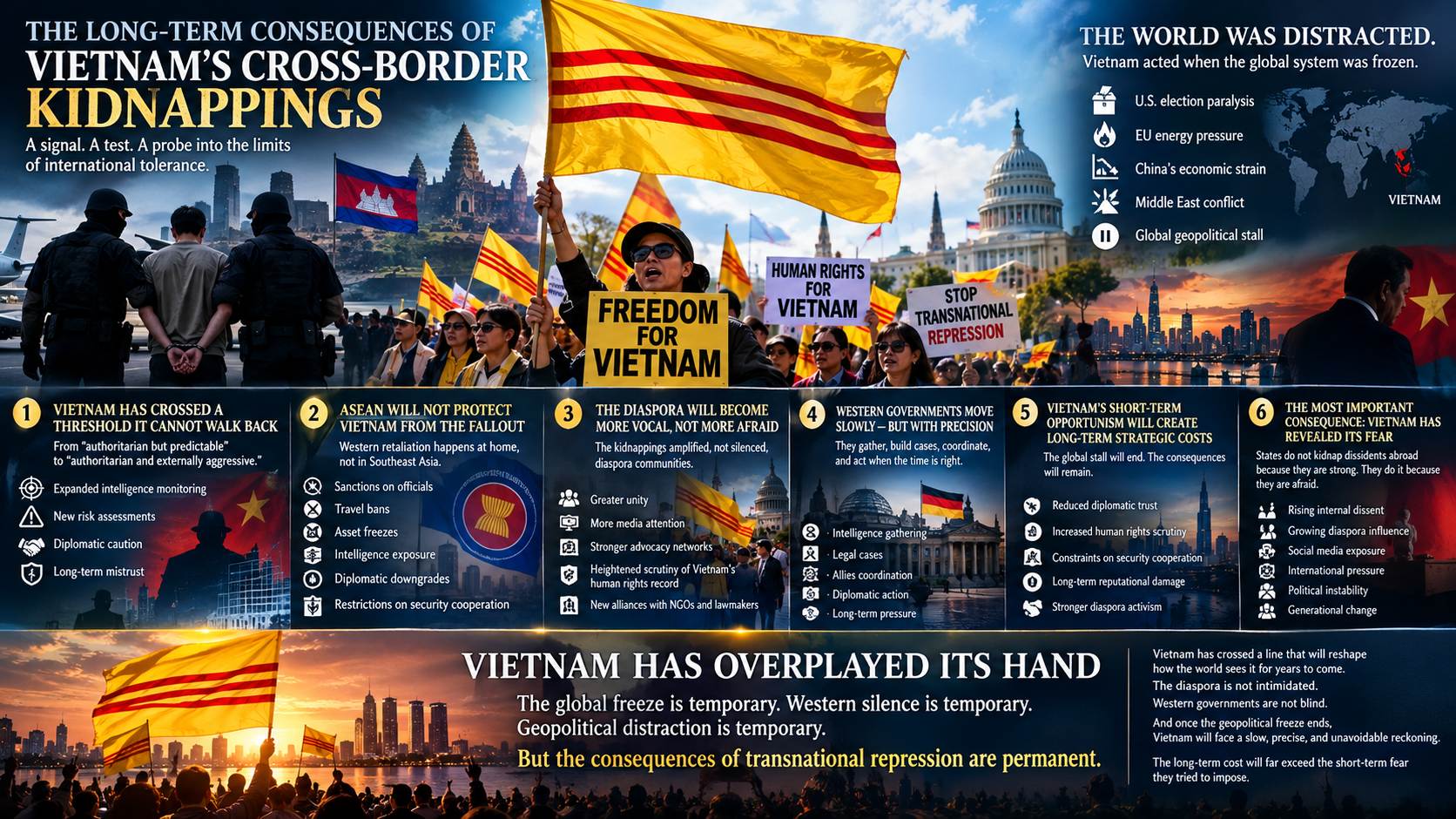
When Vietnamese authorities abducted two diaspora activists in Cambodia — one Australian, one Norwegian — it was not an isolated act. It was a signal. A test. A probe into the limits of international tolerance during a moment when the global system is frozen in place.
For months, the world has been suspended in a geopolitical holding pattern: the United States absorbed by election paralysis, Europe bracing for winter energy pressure, China unusually quiet under economic strain, and the Middle East locked in managed conflict. In this temporary vacuum, Vietnam acted boldly, assuming that global distraction would shield it from consequences.
But authoritarian opportunism always carries a price. And the long-term consequences of these kidnappings will not favor Hanoi.
1. Vietnam Has Crossed a Threshold It Cannot Walk Back
Transnational repression — kidnapping dissidents abroad — is a tactic associated with states like Iran, Russia, and China. By joining this category, Vietnam has redefined how Western governments perceive its security behavior.
This shift matters.
Western intelligence agencies track patterns, not headlines. Once a state demonstrates willingness to conduct extrajudicial operations beyond its borders, it is reclassified from “authoritarian but predictable” to “authoritarian and externally aggressive.”
That reclassification triggers:
- Expanded intelligence monitoring
- New risk assessments
- Diplomatic caution
- Long-term mistrust
Vietnam has now entered a category of states that Western governments treat with suspicion for decades.
2. ASEAN Will Not Protect Vietnam From the Fallout
Vietnam can operate freely only in Southeast Asia because the region’s borders are porous, corruption is high, and Cambodia and Laos cooperate. But ASEAN’s permissiveness is not a shield against Western consequences.
Western governments do not retaliate inside ASEAN. They retaliate at home, where Vietnam is vulnerable:
- Sanctions on officials
- Travel bans
- Asset freezes
- Intelligence exposure
- Diplomatic downgrades
- Restrictions on security cooperation
Vietnam’s leadership may believe that operating in Cambodia keeps them safe. It does not. Western retaliation does not require geographic proximity.
3. The Diaspora Will Become More Vocal, Not More Afraid
The intended psychological effect of the kidnappings was fear. But diaspora communities in Western countries are not intimidated. They are protected by strong legal systems, independent courts, and governments that do not tolerate foreign extrajudicial operations.
Instead of fear, the kidnappings produced:
- Increased diaspora unity
- More media attention
- Stronger advocacy networks
- Heightened scrutiny of Vietnam’s human rights record
- New alliances with Western NGOs and lawmakers
Vietnam’s attempt to silence voices abroad will have the opposite effect: it will amplify them.
4. Western Governments Move Slowly — But With Precision
Vietnam miscalculated the nature of Western power.
Western governments rarely respond immediately. They gather intelligence, build legal cases, coordinate allies, and wait for the right moment — often after elections, budget cycles, or diplomatic transitions.
But when they act, they act with surgical precision.
Germany’s response to Vietnam’s 2017 Berlin kidnapping is the clearest example: months of silence followed by diplomatic expulsions, intelligence exposure, and long-term damage to Vietnam’s reputation.
The same pattern is likely here.
Vietnam has opened a file that Western governments will not close for years.
5. Vietnam’s Short-Term Opportunism Will Create Long-Term Strategic Costs
Vietnam acted during a temporary global stall:
- US election paralysis
- EU energy insecurity
- China’s economic slowdown
- Middle East distraction
- Russia’s profitable stalemate
But this phase will end.
When the global system reactivates, Vietnam will face consequences it did not anticipate:
A. Reduced Diplomatic Trust
Western governments will treat Vietnam as a state willing to violate international norms.
B. Increased Human Rights Scrutiny
NGOs and lawmakers will use the kidnappings as evidence of systemic repression.
C. Constraints on Security Cooperation
Vietnam’s participation in Western defense initiatives may be limited.
D. Long-Term Reputational Damage
Foreign investors track political risk. Kidnapping Western citizens is political risk.
E. Stronger Diaspora Activism
The diaspora will become more organized, more vocal, and more influential.
Vietnam acted as if the world would remain frozen forever. It will not.
6. The Most Important Consequence: Vietnam Has Revealed Its Fear
States do not kidnap dissidents abroad because they are strong. They do it because they are afraid.
Fear of:
- Rising internal dissent
- Growing diaspora influence
- Social media exposure
- International pressure
- Political instability
- Generational change
The kidnappings are not a show of power. They are a confession of weakness.
And weakness has long-term consequences.
Conclusion: Vietnam Has Overplayed Its Hand
The global stall is temporary. Western silence is temporary. Geopolitical distraction is temporary.
But the consequences of transnational repression are permanent.
Vietnam has crossed a line that will reshape how the world sees it for years to come. The diaspora is not intimidated. Western governments are not blind. And once the geopolitical freeze ends, Vietnam will face a slow, precise, and unavoidable reckoning.
The long-term cost will far exceed the short-term fear they tried to impose.