




ARTICLE VII — LÝ ĐÔNG A: PERSONAL LIFE AND ANECDOTES
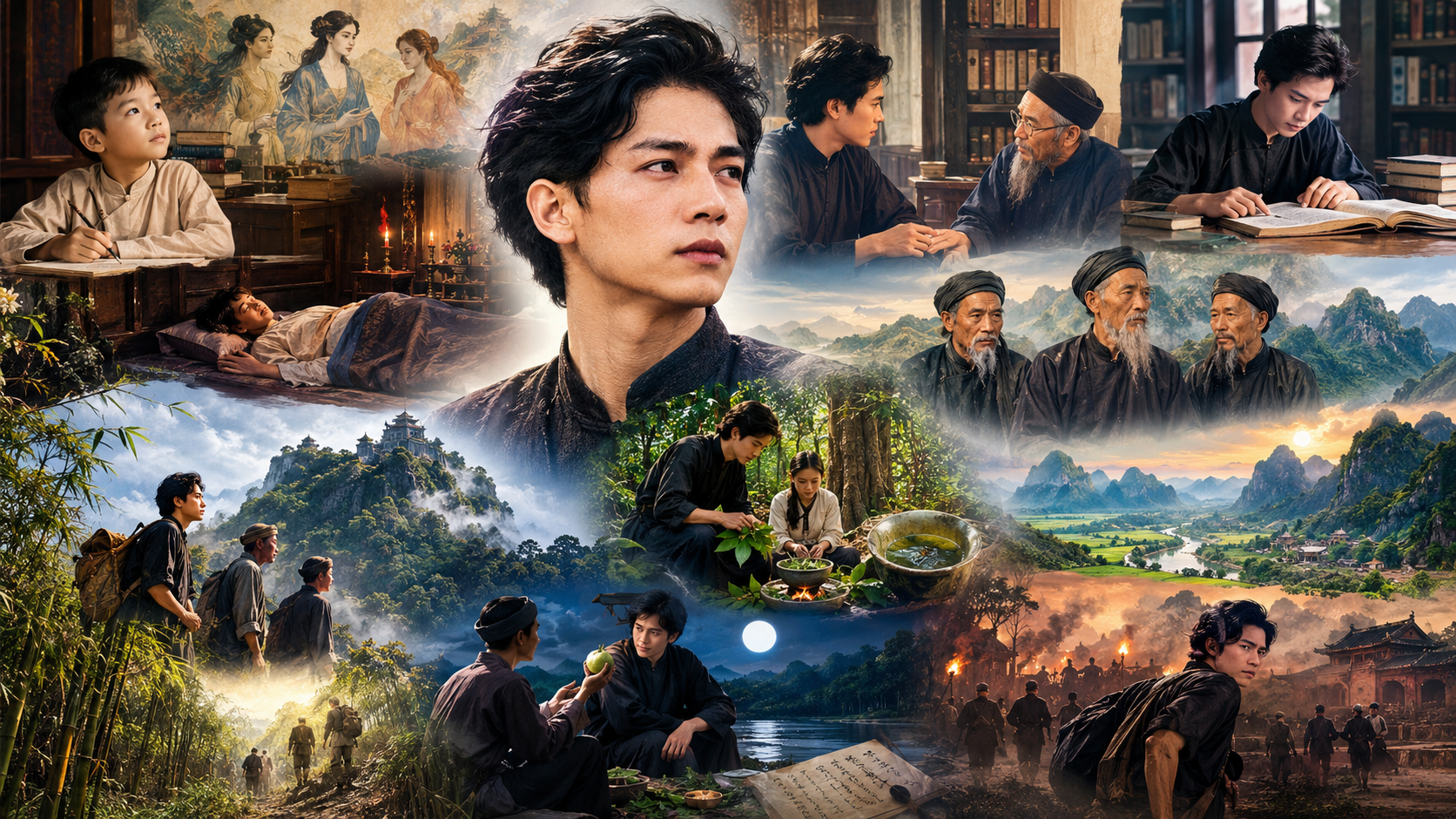
Fragments of a short life that reveal the temperament, intuition, and extraordinary cognition of a young man who became one of Vietnam’s most enigmatic thinkers.
I. A CHILDHOOD MARKED BY STRANGENESS AND BRILLIANCE
Lý Đông A, born Nguyễn Hữu Thanh in 1920, grew up in a middle-class family in Nhuế Cầu, Hà Nam. Even as a child, he displayed unusual traits that puzzled teachers and family members.
He wrote poems about “cô Lý, cô Hình, cô Sử” — personifications of logic, form, and history — instead of paying attention to school lessons. Yet when questioned, he answered flawlessly. His mind operated on a different plane: symbolic, intuitive, and structurally oriented.
At age 13, he entered a mysterious period of withdrawal. He asked his family to place a bed in the ancestral worship hall and lay there for three months, refusing medicine, refusing visitors, and keeping a secret book under his pillow. No one ever discovered what book it was.
This period marked the beginning of his metaphysical awakening.
II. THE DISAPPEARANCE: THREE MONTHS OF SILENCE, THEN A JOURNEY INTO THE MOUNTAINS
After the three-month retreat, he vanished.
His family searched for two months with no success. Finally, a fortune-teller advised them to go toward the southwestern mountains. His older relative, Nguyễn Như Loan, followed the clue and found him sleeping in Trúc Lâm Yên Tử, a remote mountain temple in Ninh Bình.
When awakened, he said:
“Anh làm gì sóng gió ầm ầm ngựa hí quân reo mất cả giấc ngủ của tôi vậy?”“Why are you causing such a racket — waves crashing, thunderous chaos, horses neighing, soldiers shouting — making me lose my entire sleep?”
He had been living with the monks, studying Hán-Nôm and Buddhist metaphysics. The abbot refused to let him shave his head, saying:
“Tôi còn không dám làm điều đó.”“I don’t even dare to do that.”
Even at that age, the monk believed the boy carried a destiny too heavy for the temple.
III. THE SEVEN LEAVES OF THE SUNG TREE
One night, he instructed his young niece to prepare a long stick made from cù nèo. At midnight, he led her behind the ancestral house to a sung tree and picked seven young leaves, roasted them, buried them, then boiled them into a single bowl of medicine.
He drank it and left home again.
This ritual, remembered vividly by family members, became one of the earliest signs of his esoteric knowledge — a blend of folk medicine, metaphysical symbolism, and personal intuition.
IV. THE ASCENT OF BA VÌ: A LEGENDARY JOURNEY
One of the most famous anecdotes describes his desire to climb núi Ba Vì, a sacred mountain associated with Vietnamese myth.
Two local Mường brothers, experts in mountain paths, were recruited. They spent months clearing a route through treacherous golden bamboo thickets. When they finally met him, they knelt and said:
“Ông chủ đây rồi.”“Here’s the boss.”
He climbed past Đền Hạ and Đền Trung, then reached a dry ancient well. There, he opened a secret book and asked his companion to read a page aloud.
Suddenly he stood up:
“Tôi đắc thiên chứ đâu có đắc địa mà cụ bảo tôi ngồi đây!”“I’m aligned with Heaven, not with Earth — so how can you tell me to sit here!”
He then disappeared up the mountain alone.
When he returned, he said:
“Tôi đã lên trên đó, thấy cả rồi.”“I went up there already — I’ve seen everything.”
This journey became part of the oral tradition surrounding him — a symbolic ascent into the metaphysical origins of Vietnamese identity.
V. MEETING PHAN BỘI CHÂU: A TURNING POINT
He sought out Phan Bội Châu, the revered nationalist scholar. During their meeting, he asked:
“Trên thế giới hiện nay có hai hệ phái giữa Duy Tâm và Duy Vật, dân tộc ta theo hệ phái nào?”“Today in the world there are two schools of thought — Idealism and Materialism. Which school does our nation follow?”
Phan replied:
“Dân không Duy Tâm, dân không Duy Vật, dân chỉ Duy Dân.”“The people are not Idealist, the people are not Materialist, the people are only People-Centered.”
This sentence became the philosophical seed of his later movement.
VI. LIFE IN HÀ NỘI: THE PRINTING HOUSE AND THE LIBRARY
In Hà Nội, he worked at a printing house, doing manual labor for minimal pay. His employers soon noticed his intellect and began discussing philosophy with him.
He asked for a library card to the Viễn Đông Bác Cổ (École Française d’Extrême-Orient). There, he developed his famous method:
- He did not read books line-by-line.
- He read entire collections by memorizing their tables of contents.
- He reconstructed the content internally.
Witnesses said he could recount historical events, political systems, and philosophical arguments in perfect detail after reading only the index.
This was the foundation of his compressed writing style.
VII. THE FORMATION OF HIS INNER CIRCLE
Three elderly scholars — Đồ Mạnh, Đồ Khuê, and Đồ Loan — became his advisors. They recognized his unusual cognition and helped him navigate spiritual, historical, and geographical knowledge.
They accompanied him on journeys, including the Ba Vì expedition, and witnessed his metaphysical rituals.
VIII. THE BIRTH OF NGA MY: THE SPIRITUAL AND ORGANIZATIONAL CENTER
He chose Nga My, a Mường region in Ninh Bình, as the spiritual heart of his movement. The area had:
- five surrounding hills symbolizing Ngũ Lĩnh Thái Sơn
- ancient cultural roots
- strategic terrain
- a population with strong ancestral traditions
He built a small shrine and performed a 100-night ritual from 11 PM to 1 AM, attempting to “triệu tinh anh của nòi giống Bách Việt.” (“the million elites of the Bách Việt lineage.”)
When a disciple accidentally drank the sacred water from the altar, he lamented:
“Thôi thế là lỡ một cơ hội rồi.”“Well, that’s a missed opportunity then.”
This moment became one of the most tragic anecdotes in the oral history of Duy Dân.
IX. THE MOONLIT NIGHT AT NGA MY: A GLIMPSE OF HIS HUMANITY
One evening, he invited Nguyễn Đình Chiểu (Chiểu còi) to walk under the autumn moon. Chiểu picked a half-ripe guava and offered it to him.
He said:
“Đêm nay trăng đẹp quá, anh làm thơ đi.”“Tonight the moon is so beautiful — write a poem.”
Chiểu protested that he couldn’t write poetry. So Lý Đông A dictated the poem Nga My Nguyệt, and Chiểu wrote it down.
Afterward, he said:
“Hôm nay tôi thực sự là người và anh cũng mới thực sự là người. Chỉ khi nào thực sự làm gì cho đất nước mới được kể là người.”“Today I am truly a human being, and you are only now truly a human being as well. Only when one genuinely does something for the country can one be counted as a human being.”
Chiểu never forgot that night.
X. THE FINAL YEARS: DANGER, BETRAYAL, AND DISAPPEARANCE
As political tensions escalated, he warned his followers:
“Không bao lâu nữa cộng sản sẽ tấn công chiến khu này.”“Not long from now, the communists will attack this base.”
He ordered most members to disperse. Five insisted on staying with him.
Three days later, thousands of militia surrounded Nga My. Two defenders died. Three were captured. He escaped with the help of local villagers.
After this event, he vanished from public sight.
Many believe he was later captured and executed by the Việt Minh. His body was never found. His fate remains one of the great mysteries of Vietnamese history.
XI. LEGACY OF A LIFE LIVED INTENSELY AND BRIEFLY
Lý Đông A’s personal life was marked by:
- metaphysical intuition
- symbolic rituals
- accelerated learning
- deep solitude
- sudden disappearances
- poetic expression
- spiritual exploration
- revolutionary commitment
He lived only into his mid-twenties, yet left behind:
- a metaphysical system
- an ethical philosophy
- a cultural vision
- a political strategy
- an organizational structure
- a body of poetry
- and a legacy carried by thousands
His anecdotes reveal a young man who was:
- brilliant
- strange
- compassionate
- intense
- visionary
- and profoundly human
A life short in years, but vast in depth.