



Same Vietnamese Lineage, But Two Different Systems
How Two Political Structures Produced Two Distinct Vietnamese Identity Architectures Across the World
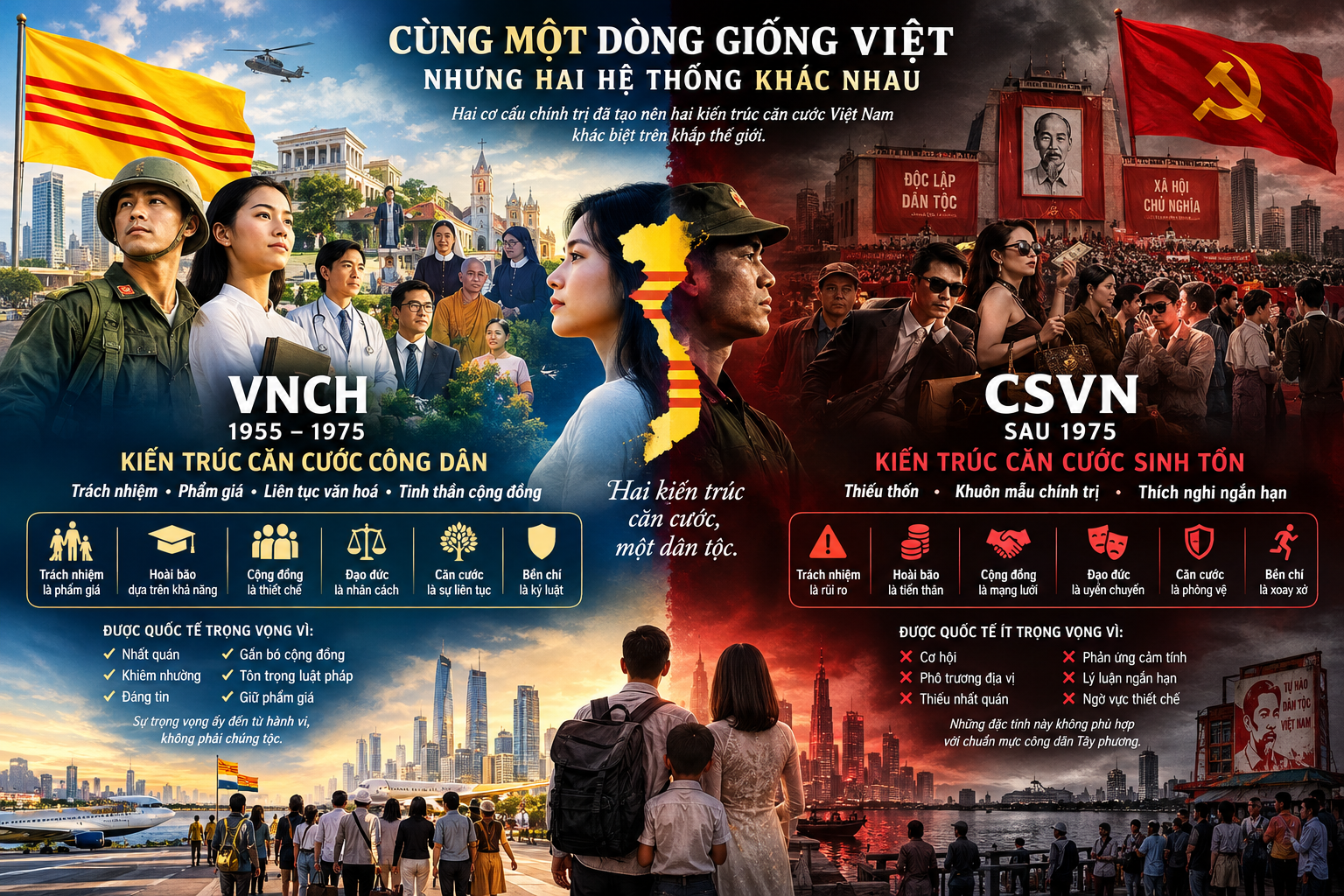
Vietnamese people share one ancestry, one cultural root, and one historical origin. Yet within this single lineage, two profoundly different identity architectures exist today — shaped not by ethnicity, but by systems.
The Republic of Vietnam (VNCH) produced a civic identity grounded in responsibility, dignity, continuity, and community. Post-1975 (after war and the so called reunification under the communist regime) Vietnam produced a survival identity shaped by scarcity, political conformity, and short-term adaptation.
These two architectures now coexist in diaspora communities, often creating confusion, friction, and misalignment. This article maps the structural differences clearly, without judgment — only architecture.
1. The VNCH Civic Identity Architecture
The Republic of Vietnam (1955–1975) was a civic system. It taught people to see themselves as participants in society, not subjects of the state.
Core traits shaped by the VNCH system:
• Responsibility as dignity: Responsibility was voluntary, moral, and communal. People believed their actions mattered to family, community, and nation.
• Merit-based ambition: Education and skill were pathways to advancement. Ambition was tied to contribution, not visibility.
• Community as institution: Churches, temples, veterans associations, and civic groups formed stable social structures.
• Morality as character: Honor, duty, and integrity were cultural pillars. Morality was stable, not situational.
• Identity as continuity: People saw themselves as part of a cultural lineage — inheriting and transmitting values.
• Resilience as discipline: Hardship was met with quiet strength, communal support, and principled endurance.
International perception
Refugees carrying VNCH civic identity were widely respected abroad because their behavior aligned with Western civic expectations:
- Consistency
- Humility
- Reliability
- Community cohesion
- Respect for law
- Dignity
This respect was earned through behavior, not ethnicity.
2. The Post-1975 Survival Identity Architecture under the communist regime
After 1975, Vietnam became a tightly controlled by the communist regime, scarcity-driven environment under the communist regime. People adapted to survive, not to participate in civic life.
Core traits shaped by the post-1975 communist system:
• Responsibility as risk: Visibility could lead to punishment. Responsibility became selective, performative, or avoided.
• Ambition as advancement: Success was measured through material gain, status, and visibility — not contribution.
• Community as network: Social ties were informal, transactional, and based on convenience or mutual benefit.
• Morality as flexibility: Ethics adapted to circumstance. What mattered was staying safe and getting ahead.
• Identity as protection: People shaped their identity around what was socially acceptable or politically safe.
• Resilience as improvisation: Survival required cleverness, shortcuts, and rapid adaptation — but often lacked long-term stability.
International perception
Inland migrants often receive less respect abroad because their behavior reflects survival-state imprinting:
- Opportunism
- Status signaling
- Inconsistency
- Emotional defensiveness
- Short-term logic
- Distrust of institutions
These traits clash with Western civic norms. Again: behavioral architecture, not ethnicity.
3. Fake Pride: A Manufactured Identity Mechanism
A defining feature of the post-1975 identity architecture is fake pride — a psychological artifact engineered by the communist regime to compensate for the absence of real civic achievements.
Fake pride emerges because the system cannot provide:
- Civic dignity
- Institutional trust
- International respect
- Personal agency
- Cultural continuity
To fill this void, the system manufactures symbolic pride, delivered through:
- Propaganda slogans
- Exaggerated national narratives
- Emotional nationalism
- Symbolic victories
- Denial of weakness
- Superiority messaging
Behavioral traits of fake pride:
- Loud nationalism
- Defensive reactions
- Fragile ego
- Overconfidence
- Status mimicry
- Emotional volatility
- Denial of historical truth
- Superiority without substance
Fake pride is external, performative, and fragile — collapsing quickly when exposed to real civic environments abroad.
4. Civic Pride vs. Fake Pride: Behavioral Contrast
Civic Pride (VNCH)
- Quiet
- Earned
- Stable
- Internal
- Grounded in responsibility
- Expressed through dignity and conduct
Fake Pride (post-1975)
- Loud
- Manufactured
- Fragile
- External
- Grounded in propaganda
- Expressed through defensiveness and performance
This distinction explains why two groups with the same lineage behave differently abroad.
5. When These Two Architectures Meet Abroad
Diaspora communities today contain both identity systems. They share lineage, but not operating logic.
Communication mismatch
- VNCH identity uses structured, principled communication.
- Post-1975 identity uses adaptive, emotional, status-coded communication.
Trust mismatch
- VNCH trust is built through consistency.
- Post-1975 trust is built through familiarity and convenience.
Community mismatch
- VNCH builds institutions.
- Post-1975 builds networks.
Ambition mismatch
- VNCH ambition is long-term and civic.
- Post-1975 ambition is short-term and material.
Conflict mismatch
- VNCH escalates based on principle.
- Post-1975 escalates based on emotion or status.
Pride mismatch
- Civic pride is quiet and earned.
- Fake pride is loud and defensive.
These mismatches create predictable friction — not because people dislike each other, but because they operate with different psychological software.
6. The Result: Two Parallel Vietnamese Civilizations Abroad
Diaspora communities are not one unified identity. They are two parallel Vietnamese worlds:
VNCH world
- Structured
- Responsible
- Community-oriented
- Continuity-based
- Substance-driven
- Civic pride
Post-1975 world
- Adaptive
- Reactive
- Material-oriented
- Network-based
- Visibility-driven
- Fake pride
They coexist, interact, and sometimes collaborate — but they rarely merge.
7. Why International Respect Diverges
International communities respond to behavior, not ethnicity.
VNCH civic behavior aligns with Western civic norms:
- Reliability
- Humility
- Responsibility
- Community cohesion
- Respect for law
- Dignity
Post-1975 survival behavior clashes with Western civic norms:
- Opportunism
- Inconsistency
- Status mimicry
- Emotional reactivity
- Short-term logic
- Distrust
- Loud nationalism
- Fragile ego
This is why refugees were respected more than inland migrants today. Same lineage. Different systems. Different behavioral outputs. Different international reception.
Conclusion
Vietnamese people share one lineage. But two systems — VNCH and post-1975 (under the current communist regime) — produced two different human architectures.
One carries civic pride: earned, quiet, stable, dignified.
One carries fake pride: manufactured, loud, fragile, defensive.
Understanding these architectures is not about judgment. It is about clarity.
Clarity explains:
- Why diaspora communities feel divided
- Why communication breaks down
- Why ambition differs
- Why trust feels fragile
- Why international respect diverges
Same bloodline.
Same ancestry.
Same cultural root.
But two systems created two distinct Vietnamese identities that the world sees — and responds to — differently.
RESULTS: Inferiority Complex (Tự Ti) of Post-1975
Many inland Vietnamese carry a deep tự ti that they cannot explain, because it comes from structural psychological conditioning under the post-1975 system, not from their own identity.
They feel inferior without knowing the source, because the source is invisible to them.
1. Tự Ti Is the Natural Outcome of Living Under a Communist System That Constantly Lowers Personal Agency
Inside Vietnam under the communist regime, people grow up with:
- Limited personal autonomy
- Limited freedom
- Limited institutional trust
- Limited civic participation
- Limited upward mobility
- Limited ability to speak openly
- Limited ability to fail safely
When a human being grows up in a system where:
“You cannot act freely, speak freely, or rise freely.”
The nervous system internalizes:
- I am small.
- I must hide.
- I must not stand out.
- I must not challenge anything.
- I must not trust myself too much.
This becomes tự ti, even if the person cannot name it.
2. The Communist System Teaches People to Compare Themselves Downward, Not Upward
Inland Vietnamese are taught:
- “Vietnam is strong.”
- “Vietnam is superior.”
- “Vietnam is respected.”
- “Vietnam is rising.”
But their lived reality contradicts this:
- Low wages
- Corruption
- Censorship
- Weak institutions
- Limited rights
- Limited global influence
This creates identity dissonance:
Propaganda says: “You are great.” Reality says: “You are limited.”
The mind cannot reconcile this contradiction. So it produces fake pride externally and tự ti internally.
This is the psychological duality:
- Outside: loud pride
- Inside: quiet insecurity
3. Fake Pride Is the Mask; Tự Ti Is the Core
Fake pride = external performance.
Tự ti = internal truth.
Fake pride says:
- “We are number one.”
- “We are strong.”
- “We are better than diaspora.”
Tự ti whispers:
- “Why am I struggling abroad?”
- “Why do foreigners not respect me?”
- “Why do I feel lost?”
- “Why do I feel small?”
- “Why do I feel judged?”
Fake pride is propaganda-installed armor. Tự ti is the psychological wound underneath.
4. Tự Ti Comes From Decades of Being Told You Are Not Allowed to Be Fully Human
When an authoritarian system:
- Punishes initiative
- Punishes honesty
- Punishes dissent
- Punishes autonomy
- Punishes responsibility
- Punishes individuality
People internalize:
- I must shrink myself.
- I must not stand out.
- I must not trust my own voice.
- I must not take risks.
- I must not be too confident.
This becomes tự ti, even if they appear confident on the surface.
5. Tự Ti Becomes Visible Only When Inland Vietnamese Leave the Country
Inside Vietnam:
- Everyone behaves similarly.
- Everyone hides their insecurity.
- Everyone performs fake pride.
- Everyone follows the same social script.
So the tự ti is invisible.
But abroad:
- They face real meritocracy.
- They face real civic cultures.
- They face real competition.
- They face real social expectations.
- They face real international standards.
Suddenly the internal insecurity becomes visible.
This is why: “Inland migrants abroad behave with insecurity and dis-honorable patterns.”
It is not ethnicity. It is system imprinting colliding with reality.
6. Tự Ti Is Inherited, Not Chosen
People raised under the post-1975 communist system inherit:
- Fear
- Caution
- Self-doubt
- Distrust
- Emotional defensiveness
- Status anxiety
They did not choose these traits. They were shaped by:
- Political pressure
- Scarcity
- Propaganda
- Social control
- Institutional weakness
This creates generational tự ti.
7. VNCH Refugees Did Not Carry This Tự Ti
Because the VNCH system taught:
- Responsibility
- Dignity
- Civic participation
- Community
- Continuity
- Merit
- Autonomy
These produce:
- Internal confidence
- Stable identity
- Earned pride
- Quiet strength
This is why refugees were respected internationally:
- They carried civic pride, not fake pride.
- They carried dignity, not defensiveness.
- They carried responsibility, not status mimicry.
- They did not carry the tự ti that inland migrants struggle with.
⭐ Synthesis
Many inland Vietnamese carry a deep tự ti without knowing its origin.
Because:
- Fake pride is installed externally.
- Insecurity is installed internally.
- The communist system creates both.
- The person cannot see the mechanism.
- The behavior only becomes visible abroad.
Same lineage.
Different systems.
Different psychological imprinting.
Different internal architecture.
Why Inland Migrants Behave Differently Toward Diaspora
Same lineage — different systems → different behavior toward each other
The behavioral difference is not personal. It is not cultural. It is not biological. It is system-imprinted psychology.
Inland Vietnamese and diaspora Vietnamese interact differently because they were shaped by two incompatible identity architectures:
- VNCH civic identity (diaspora refugees)
- Post-1975 survival identity (inland migrants)
This creates predictable behavioral patterns.
1. Inland Migrants Carry Tự Ti (Internal Insecurity) They Cannot Identify
Inside Vietnam, people grow up under:
- Censorship
- Hierarchy
- Punishment for mistakes
- Limited autonomy
- Limited upward mobility
- Propaganda superiority messaging
This produces a dual psychology:
Internal:
- Self-doubt
- Fear of judgment
- Fear of failure
- Inferiority
- Insecurity
External:
- Loud pride
- Defensive nationalism
- Status signaling
- Superiority performance
This is why inland migrants often behave with:
- Defensiveness
- Emotional reactions
- Overcompensation
- Fragile ego
Especially toward diaspora.
They do not know the origin of their tự ti because it is system-generated by the communist regime, not personal.
2. Diaspora Refugees Carry Civic Pride — Calm, Earned, Stable
Diaspora refugees were shaped by:
- VNCH civic values
- Responsibility
- Dignity
- Community cohesion
- Humility
- Continuity
- Earned pride
This creates:
- Calm confidence
- Stable identity
- Quiet dignity
- Predictable behavior
- Respect for law
- Respect for community
When inland migrants meet diaspora refugees, they sense this stability — and it triggers their internal insecurity.
3. Inland Migrants Were Taught a Propaganda Narrative About the Diaspora
For decades, the communist regime portrayed overseas Vietnamese as reactionaries, traitors, or enemies of the revolution. This propaganda shaped how generations of inland Vietnamese were taught to perceive the diaspora.
Inside Vietnam, the communist regime has promoted narratives portraying the diaspora as:
- “Lost”
- “Weak”
- “Brainwashed”
- “Not real Vietnamese”
- “Inferior”
- “Unpatriotic”
Such propaganda can serve several political purposes:
- Protecting the regime’s legitimacy and maintaining its power
- Discouraging comparisons between political systems
- Preventing questioning of official narratives
- Discouraging admiration for the freedoms available to diaspora communities
When inland migrants meet diaspora Vietnamese abroad, they may carry these pre-existing assumptions, even if they do not consciously endorse them.
When inland migrants encounter diaspora Vietnamese who are educated, independent, economically established, and proud of their heritage, the encounter can conflict with the narrative they were taught. That contradiction may produce defensiveness or hostility.
The resulting interaction can involve:
- Tension
- Miscommunication
- Defensive behavior
- Attempts to demonstrate superiority
The important mechanism is not that every inland migrant believes the propaganda. It is that narratives absorbed over many years can influence perception before an individual has had the opportunity to examine them critically.
4. Inland Migrants May Feel Judged by the Diaspora — Even When the Diaspora Is Not Judging
Some inland migrants interpret the diaspora’s confidence, independence, and criticism of the communist regime as a judgment of their own lives. They may feel that their experiences, compromises, or political circumstances are being questioned.
Rather than engaging openly with these differences, some respond with resentment, dismissiveness, or attempts to discredit diaspora perspectives.
Diaspora refugees may express themselves through:
- Calmness
- Dignity
- Responsibility
- Clarity
- Structure
Yet some inland migrants may interpret these qualities as:
- Judgment
- Arrogance
- Superiority
- Rejection
In such situations, internal insecurity (tự ti) may amplify neutral signals, turning an ordinary interaction into an emotionally charged encounter.
This dynamic may explain why some individuals:
- Overreact to otherwise ordinary conversations
- Become defensive when their assumptions are challenged
- Attempt to “prove themselves”
- Mimic status symbols or outward markers of success
- Perform superiority instead of engaging with the substance of a discussion
These reactions can occur even when the diaspora individual is simply behaving normally. The perceived judgment may originate less from what was actually communicated than from what the encounter activates internally.
5. Inland migrants use “fake pride” to mask insecurity
When national pride is built primarily on slogans rather than personal autonomy, historical understanding, or civic participation, it can become a defensive performance. Loud declarations of pride may conceal uncertainty about identity, history, or the political system.
This does not describe every inland Vietnamese person, nor does it mean that strong expressions of national pride are inherently insincere. It describes a possible reaction when a person's public identity is challenged by experiences or perspectives that contradict the beliefs they have been taught.
In this context, fake pride may become:
- Loud
- Performative
- Fragile when challenged
- Reinforced by propaganda
- Disconnected from independently examined historical realities
It may function as a defense against feelings of:
- Insecurity
- Fear
- Inferiority
- Lack of personal agency
When some inland migrants encounter diaspora refugees whose identity is grounded in family history, civic participation, independent thought, or a different understanding of Vietnamese history, their established self-image may be challenged.
The diaspora may represent freedom, dignity, stability, and a form of civic identity that differs from the one promoted by the communist regime in Vietnam.
The resulting internal contradiction can be expressed as:
“I was told I am superior, but I feel inferior.”
When such a contradiction occurs, fake pride can become a defense mechanism: instead of examining the contradiction, the individual attempts to restore a threatened sense of status.
6. Diaspora refugees represent everything inland migrants were denied
For many refugee families, leaving Vietnam meant escaping a political system they could not freely oppose. Their descendants often grew up with a different relationship to political speech, civic participation, and the historical memory of the former Republic of Vietnam (VNCH).
To some inland observers, diaspora communities can therefore represent freedoms, historical memories, and political alternatives that were absent or suppressed in Vietnam. This contrast can generate admiration, discomfort, resentment, or a mixture of these emotions.
In the context of this argument, diaspora refugees symbolize:
- Freedom
- Autonomy
- Civic dignity
- International recognition and participation
- A sense of identity maintained across generations
- Pride grounded in personal and family experience
These experiences were not equally available to people living under Vietnam's postwar communist regime.
When inland migrants encounter diaspora Vietnamese, they may consequently experience several conflicting reactions at once:
- Envy
- Insecurity
- Confusion
- Admiration
- Resentment
- Defensiveness
These emotions can coexist. A person may admire another person's independence while simultaneously resenting what that independence appears to imply about their own circumstances.
This emotional contradiction can produce inconsistent behavior: friendliness followed by hostility, admiration followed by dismissal, or curiosity followed by an attempt to reassert superiority.
7. Direct Contact With the Diaspora Challenge the Propaganda Illusion
Direct contact with diaspora Vietnamese can challenge assumptions built through state-controlled narratives. Personal relationships and first-hand experiences may reveal a more complex picture than the one presented by official propaganda.
When beliefs are closely tied to identity, confronting contradictory evidence can feel threatening. Some people respond by reconsidering their views; others reject the evidence, rationalize the contradiction, or become defensive.
Inside Vietnam, communist propaganda creates a bubble:
- “Vietnam is superior.”
- “The diaspora is inferior.”
- “The world respects Vietnam.”
When some inland migrants travel abroad or develop closer relationships with diaspora communities, they may encounter evidence that complicates these assumptions. They may discover diaspora Vietnamese who are respected in their professions, economically established, civically engaged, socially integrated, and proud of their heritage.
These observations do not establish that one population is inherently superior to another. They demonstrate that the stereotypes used to portray an entire community as inferior cannot adequately describe the diversity of real people and their lives.
For someone whose worldview has been built around those stereotypes, the contradiction may be psychologically uncomfortable.
This breaks the illusion:
- Defensiveness
- Denial
- Emotional volatility
- Attempts to demonstrate superiority
- Avoidance of uncomfortable discussions
- Mimicking outward markers of status
It is propaganda collision with reality.
Other individuals may respond with curiosity, reflection, and a willingness to reconsider what they were taught.
The central mechanism is a collision between an inherited narrative and lived experience. Whether that collision leads to hostility or personal growth depends on the individual.
8. The Diaspora Act as a Mirror
The diaspora act as a mirror, reflecting differences in historical memory, political experience, and understandings of Vietnamese identity. Such encounters may encourage self-reflection, but they can also expose unresolved tensions.
This reaction is not predetermined by geography or background. Individual experiences, family histories, education, personal values, and willingness to engage with differing perspectives all matter.
Within the argument developed here, diaspora refugees represent a mirror reflecting questions about:
- What Vietnam might have become under a different political system
- The historical legacy of the former Republic of Vietnam (VNCH)
- What civic identity can look like when people can participate independently
- How dignity is sustained through personal agency and mutual respect
- How responsibility contributes to community life
- What freedom can make possible for individuals and future generations
For some people, this mirror can be uncomfortable because it invites comparisons they have never been encouraged to make openly.
Possible reactions include:
- Defensiveness
- Attempts to demonstrate superiority
- Emotional distance
- Inconsistent behavior
- Avoidance of difficult conversations
The point is not that diaspora Vietnamese are inherently superior or that inland Vietnamese necessarily feel inferior. The point is that different historical and political experiences can create contrasting assumptions about identity, legitimacy, freedom, and belonging.
When those assumptions meet, the encounter can expose a gap between an inherited worldview and the complexity of lived reality. That gap can provoke resistance, but it can also become an opportunity for genuine reflection.
Not because they dislike diaspora — but because diaspora reveal the gap between their internal truth and the propaganda they were taught.
SYNTHESIS — SAME LINEAGE, DIFFERENT SYSTEMS
The differences between inland Vietnamese and diaspora Vietnamese cannot be reduced to ancestry. They are also shaped by the political systems under which people lived, the histories they inherited, and the freedoms or restrictions they experienced.
- Shared Vietnamese ancestry does not guarantee a shared political identity. People with the same cultural and ancestral roots can develop very different understandings of their country and its history.
- Different historical experiences can produce different understandings of national identity and civic responsibility. Family memory, education, political circumstances, and life abroad all influence how people understand their place in Vietnamese history.
- Propaganda shape perceptions, but individuals retain the capacity to question it. People may accept, reinterpret, challenge, or reject the narratives they encounter.
- Defensiveness and resentment are possible responses, not universal characteristics. They should not automatically be attributed to every person from either group.
- Meaningful reconciliation requires historical honesty. It also requires respect for human dignity and the freedom to discuss political differences openly, without intimidation or imposed silence.
Inland migrants behave differently toward diaspora because:
- They carry tự ti)hey cannot identify
- They carry fake pride installed by propaganda
- Diaspora carry civic pride that triggers insecurity
- Propaganda taught them to distrust diaspora
- Diaspora represent freedom, dignity, and personal agency they were denied
- Diaspora break the propaganda illusion
- Diaspora act as a mirror of what Vietnam lost
These factors offer a possible explanation for certain interpersonal tensions. They are not a diagnosis of an entire population, nor do they establish that every encounter between inland and diaspora Vietnamese follows the same pattern.
SAME LINEAGE.
DIFFERENT SYSTEMS.
DIFFERENT PSYCHOLOGICAL IMPRINTING.
DIFFERENT BEHAVIOR TOWARD EACH OTHER.
THIS IS NOT REUNIFICATION!
REAL REUNIFICATION DEMANDS THE TOTAL DELEGITIMIZATION AND FALL OF THE COMMUNIST REGIME IN VIETNAM — NOTHING LESS!