




THE IRAN PARADOX: HOW A “MANAGED CONFLICT” REWIRES GLOBAL POWER
17 September 2026
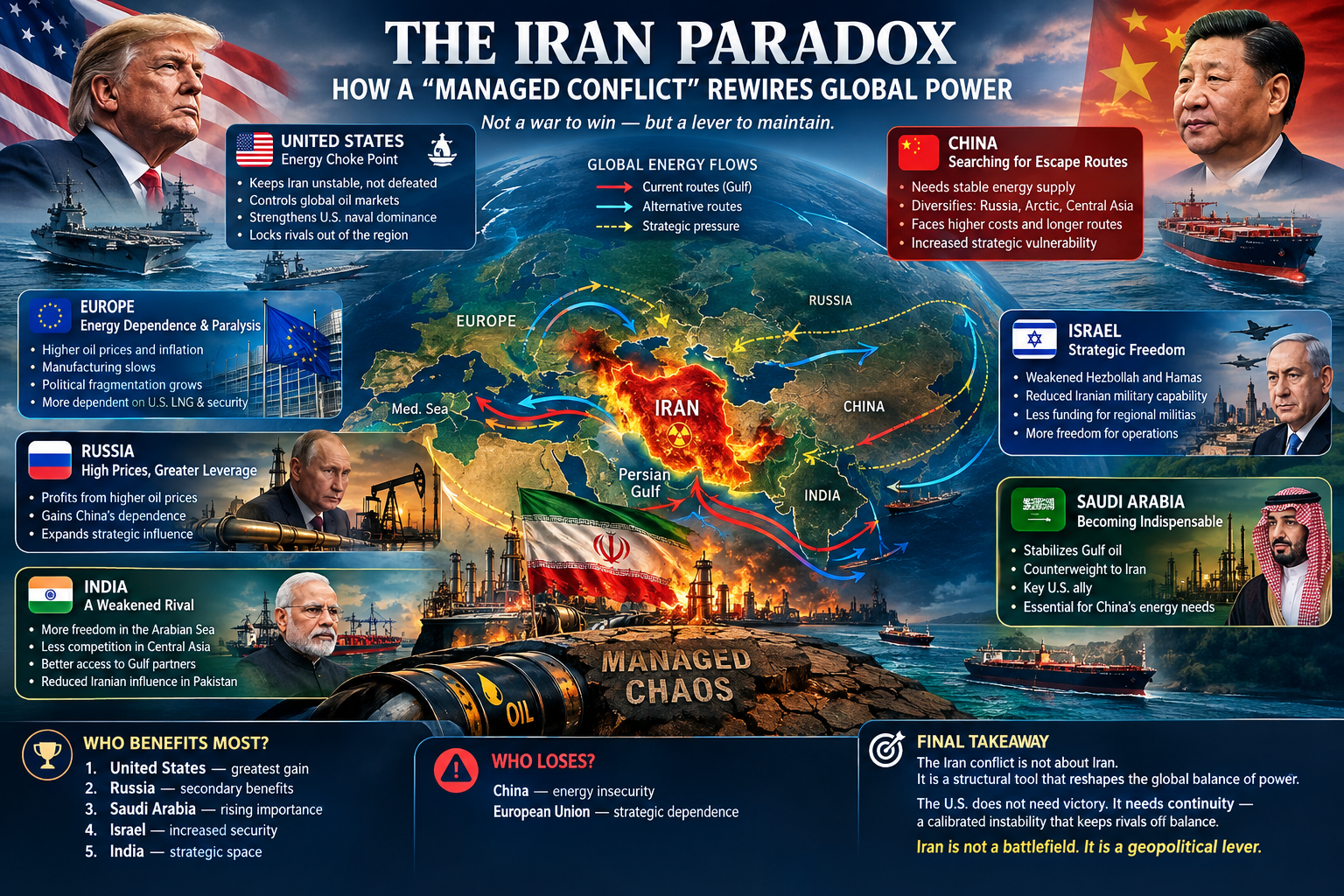
For decades, Iran has stood at the crossroads of global energy, ideology, and great-power competition. Yet the most striking feature of the U.S.–Iran confrontation is not the intensity of the conflict — but its incompleteness. The United States has overwhelming military superiority, but it has never chosen to end the conflict decisively. Instead, Washington maintains a calibrated level of instability around Iran, neither allowing collapse nor permitting full recovery.
This is not accidental. It is structural.
A “managed chaos” in Iran reshapes the strategic environment for every major power: the United States, China, the European Union, Russia, India, Israel, and Saudi Arabia. Each actor experiences different consequences — some painful, some advantageous.
This article maps the deeper geometry of that system and concludes who ultimately benefits.
1. THE U.S. STRATEGY: IRAN AS AN ENERGY CHOKE POINT
The United States does not need to defeat Iran. It only needs Iran to remain:
- too unstable to export oil reliably
- too unpredictable for China to depend on
- too dangerous for Europe to rely on
- too divided to negotiate from strength
This creates a permanent pressure valve in the global energy system.
WHY THE U.S. PREFERS INSTABILITY OVER VICTORY
A decisive victory would require:
- regime change
- occupation
- reconstruction
- long-term stabilization
- preventing China from entering reconstruction deals
This is a trillion-dollar commitment.
A controlled conflict, however:
- keeps oil markets volatile
- forces China to diversify energy sources
- increases Europe’s dependence on U.S. LNG
- strengthens U.S. naval dominance in the Gulf
- prevents Iran from becoming a Chinese satellite
Thus, Iran becomes a strategic choke point — not a battlefield to win, but a lever to maintain.
2. CHINA’S DILEMMA: SEARCHING FOR ESCAPE ROUTES
China’s rise depends on:
- cheap oil
- predictable shipping routes
- stable Middle Eastern partners
Iran is one of China’s most flexible suppliers, especially under sanctions. But instability in Iran forces China to seek alternatives.
CHINA’S BYPASS STRATEGY
China is now trying to escape Middle Eastern vulnerability through:
- Russia: pipelines, discounted oil, and energy corridors
- The Arctic: Northern Sea Route for shipping
- Central Asia: overland Belt & Road routes
These alternatives are expensive, politically fragile, and slower than maritime oil from the Gulf. Every year Iran remains unstable, China’s long-term energy security becomes more complicated.
3. EUROPE’S TRAP: ENERGY DEPENDENCE AND STRATEGIC PARALYSIS
Europe is the world’s largest importer of Middle Eastern oil. When Iran is unstable:
- oil prices rise
- inflation spikes
- manufacturing slows
- political fragmentation increases
- far-right movements gain traction
- Europe becomes more dependent on U.S. LNG and U.S. security guarantees
Europe cannot align economically with China while its energy lifeline is unstable. Thus, Iran’s chaos indirectly locks Europe into the U.S. orbit.
4. RUSSIA’S WINDFALL: HIGH OIL PRICES AND STRATEGIC LEVERAGE
Russia benefits from instability in Iran in two major ways:
HIGHER OIL PRICES
Every disruption in the Gulf pushes global oil prices upward. Russia, as a major exporter, profits directly.
CHINA’S INCREASED DEPENDENCE
When Iran becomes unreliable, China turns to Russia for energy. This strengthens Moscow’s leverage over Beijing.
Russia gains without firing a shot.
5. INDIA’S QUIET ADVANTAGE: A WEAKENED RIVAL
India and Iran historically competed for influence in:
- Afghanistan
- Central Asia
- Indian Ocean shipping routes
A weakened Iran gives India:
- more freedom in the Arabian Sea
- less competition in Central Asia
- better access to Gulf partners
- reduced Iranian influence over Pakistan
India benefits quietly, without public involvement.
6. ISRAEL’S STRATEGIC FREEDOM: A WEAKENED ADVERSARY
Iran is Israel’s most persistent regional adversary. Instability in Iran provides Israel:
- reduced proxy support for Hezbollah and Hamas
- weakened Iranian military capability
- less Iranian funding for regional militias
- more freedom for Israeli operations in Syria and Lebanon
Israel does not need Iran to collapse — only to remain too weak to project power.
7. SAUDI ARABIA’S RISE: BECOMING INDISPENSABLE
As Iran weakens, Saudi Arabia becomes:
- the primary stabilizer of Gulf oil
- the main Arab counterweight to Iran
- the essential partner for global energy markets
- the key U.S. ally in Middle Eastern security
- a necessary partner for China’s energy needs
Saudi Arabia’s geopolitical value increases every year Iran remains unstable.
CONCLUSION: WHO BENEFITS MOST?
1. THE UNITED STATES
The U.S. gains the most from a managed conflict:
- China’s energy insecurity
- Europe’s dependence
- Russia’s containment through controlled instability
- Israel’s protection
- Saudi Arabia’s alignment
- U.S. naval dominance in the Gulf
Iran becomes a strategic pressure point that strengthens U.S. leverage globally.
2. RUSSIA
High oil prices and China’s dependence give Russia secondary benefits.
3. SAUDI ARABIA
Iran’s weakness elevates Saudi Arabia’s regional and global importance.
4. ISRAEL
A weakened Iran reduces threats and increases operational freedom.
5. INDIA
India quietly gains strategic space in the region.
WHO LOSES?
China and the European Union — both suffer from energy insecurity and strategic dependence.
FINAL TAKEAWAY
The Iran conflict is not about Iran. It is a structural tool that reshapes the global balance of power.
The U.S. does not need victory. It needs continuity — a calibrated instability that keeps rivals off balance.
Iran is not a battlefield. It is a geopolitical lever.