



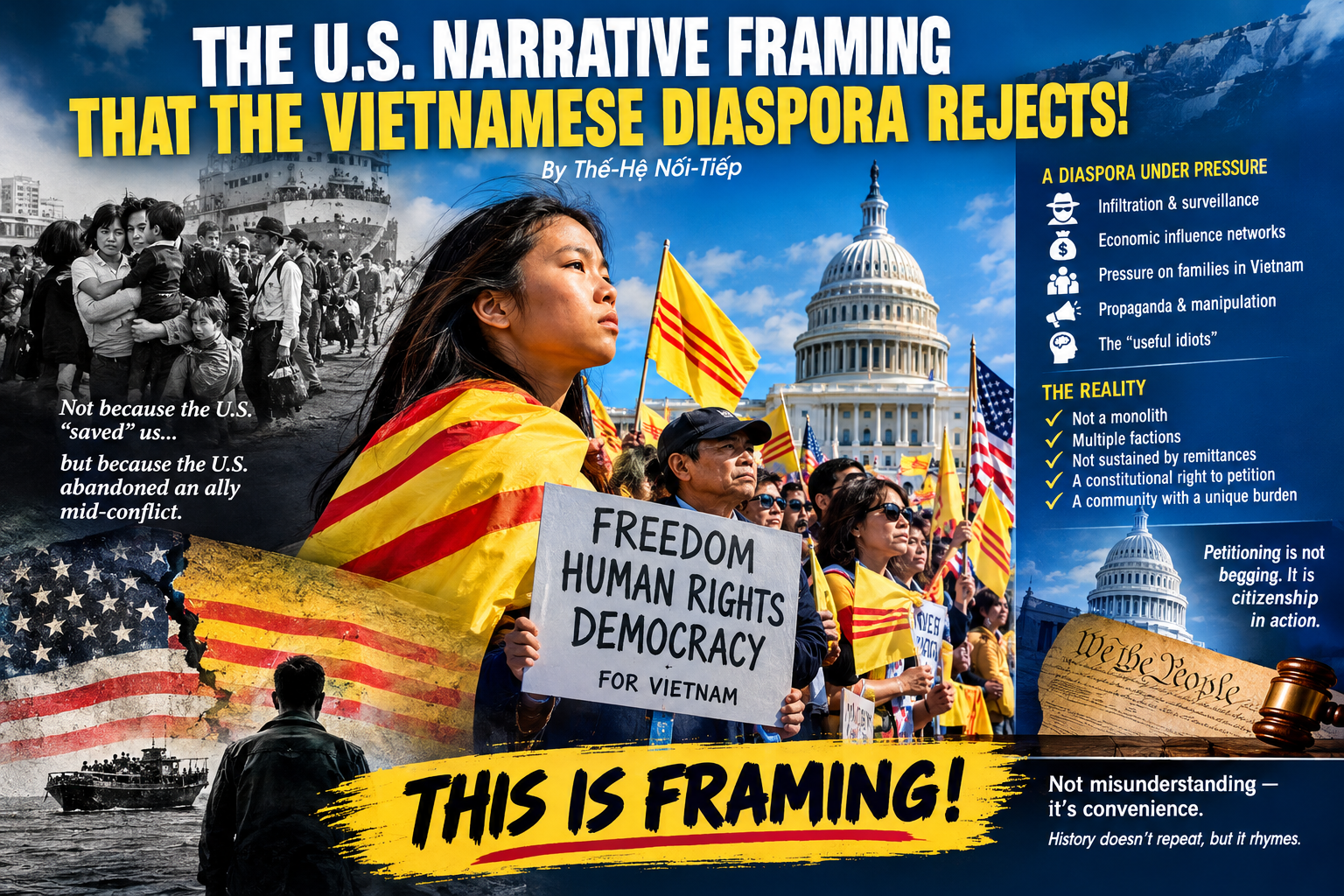
THE U.S. NARRATIVE FRAMING THAT THE VIETNAMESE DIASPORA REJECTS!
By Thế-Hệ Nối-Tiếp
I. Introduction: The False Premise of Gratitude
Public discourse often frames Vietnamese refugees as beneficiaries of American generosity, implying that political activism—especially petitions demanding human rights pressure on Hanoi—is an act of ingratitude. This framing is historically inaccurate.
The Vietnamese refugee community exists not because the United States “saved” us, but because the United States abandoned an ally mid-conflict, triggering one of the largest refugee crises of the 20th century. Humanitarian resettlement was a moral obligation following geopolitical betrayal, not a charitable gift.
Therefore, gratitude does not require silence. Gratitude does not require political passivity. Gratitude does not require relinquishing constitutional rights.
Vietnamese refugees are not debtors. We are citizens.
II. The Diaspora Is Not a Monolith: The Problem of the “Third Element”
Critics often assume that the Vietnamese diaspora behaves as a unified political bloc. In reality, our community contains distinct factions, each shaped by different historical experiences.
The former “thành phần thứ ba” — the intellectual class that misjudged communism.
Historically, this group:
- Believed neutrality was a virtue
- Underestimated the nature of communist infiltration
- Overestimated the possibility of compromise
- Lacked structural understanding of ideological warfare
Today, many of them unintentionally function as “useful idiots” for the regime’s narratives. They speak the language of “peace,” “reconciliation,” and “non-political community building,” but fail to recognize how these discourses are exploited by state-directed influence networks.
This phenomenon is unique to the Vietnamese diaspora. Cuban and Latino communities do not face an equivalent class of politically naïve intermediaries who amplify the messaging of an authoritarian state.
III. The Unique Burden: Việt Cộng Nằm Vùng and State-Directed Influence
Unlike other immigrant groups, Vietnamese refugees must contend with a hostile government that actively infiltrates overseas communities.
This includes:
- Intelligence operatives embedded in cultural associations
- Business networks used as political influence channels
- Diaspora surveillance programs
- Pressure on family members inside Vietnam
- Targeted harassment of activists abroad
- Manipulation of nostalgia and identity
- Coordinated propaganda campaigns
This is not paranoia; it is documented policy.
The Vietnamese diaspora is therefore not simply a community of immigrants. It is a community under continuous political pressure from the state it fled.
Comparisons with Cuban or Latino communities ignore this structural reality.
IV. The Misleading “18 Billion USD” Argument
Some American officials argue that Vietnamese Americans “sustain the regime” by sending remittances and traveling to Vietnam. This argument is economically shallow.
The diaspora’s contribution is a small fraction of the regime’s total inflows.
Vietnam’s economy is sustained primarily by:
- Foreign direct investment (FDI)
- Multinational manufacturing
- International development loans
- Global trade agreements
- Tourism from non-Vietnamese travelers
- Strategic partnerships with major economies
These sources dwarf diaspora remittances.
Blaming refugees for “funding the regime” is analytically incorrect. It also ignores the fact that:
- Remittances often support families, not the state
- Travel is frequently for funerals, caregiving, or cultural obligations
- Many refugees avoid Vietnam entirely
The diaspora’s economic footprint is not the decisive factor keeping the regime alive.
V. Internal Betrayal, Lost Direction, and Lack of Support
The Vietnamese diaspora faces three simultaneous challenges:
1. Internal betrayal
Some individuals collaborate with the regime for personal gain, political access, or business opportunities. This is not unique to Vietnamese communities, but the consequences are more severe due to the regime’s active exploitation of such collaborators (useful idiots).
2. Loss of direction
Decades after resettlement, many community organizations lack strategic clarity. They oscillate between cultural preservation, political activism, and social services without a unified framework.
3. Lack of institutional support
Unlike Cuban Americans—who benefit from strong political lobbies—Vietnamese refugees lack:
- Large voting blocs
- Consolidated advocacy networks
- Sustained media representation
- Consistent political alliances
This structural weakness makes petitions one of the few available tools for political expression.
VI. Petitioning Is a Constitutional Right, Not an Abuse
Some critics claim that Vietnamese Americans “abuse” their citizenship by petitioning the U.S. government. This is civically incorrect.
Petitioning is a protected right under the First Amendment.
It is:
- Normal
- Legal
- Expected
- Foundational to democratic participation
Petitions are used by:
- Environmental groups
- Religious communities
- Veterans
- Business associations
- Immigrant groups
- Civil rights organizations
Vietnamese Americans pay taxes, contribute economically, serve in the military, and participate in civic life. We have every right to petition our government—just like any other community.
Petitioning is not begging. Petitioning is not complaining. Petitioning is not “asking someone else to do our dirty work.”
Petitioning is citizenship in action.
American politics is projecting its own motives onto others — once again seeking to exploit the Vietnamese nation as a strategic instrument in its confrontation with Communist China, through the hands of the most foolish pawn, the useful idiot: the international imperialist servant — the Viet Cong!
WHO'S DOING THE DIRTY JOB FOR WHOM?
VII. The Correct Structural Response to American Criticism
When American officials criticize Vietnamese refugees for political activism, the proper rebuttal is not emotional—it is structural.
A. Refugees exist because of geopolitical betrayal, not because Vietnamese people failed.
B. The diaspora contains multiple factions, including a misjudging intellectual class and infiltrated networks—unlike Cuban or Latino communities.
C. The regime is sustained primarily by global economic forces, not by diaspora remittances.
D. Petitioning is a constitutional right, and Vietnamese Americans are entitled to use it.
E. The Vietnamese diaspora faces a unique adversary: a hostile state that actively infiltrates and manipulates overseas communities.
This is the context missing from simplistic criticisms.
VIII. Conclusion: A Community Under Pressure, Not a Community Without Integrity
The Vietnamese diaspora is not perfect. No community is.
But we are:
- Survivors of geopolitical betrayal
- Targets of state-directed infiltration
- Participants in democratic society
- Contributors to the economy
- Holders of constitutional rights
- Custodians of a suppressed national memory
Our political activism is not hypocrisy. It is not ingratitude. It is not confusion.
It is the natural expression of a community that refuses to forget where it came from, refuses to abandon those still suffering, and refuses to surrender its voice in the country it now calls “home”.
THIS IS FRAMING!
Those ungrounded framings about the Vietnamese diaspora are neither intellectual nor factual; they are politically engineered narratives designed to neutralize a community whose moral stance no longer aligns with current U.S. strategic interests. This isn’t misunderstanding — it’s convenience. History doesn’t repeat, but it rhymes, and the way our community is being dismissed today mirrors the same pattern of abandonment that produced the refugee generation. What we are witnessing is a second betrayal, executed not through bombs or evacuation orders, but through rhetoric that rewrites responsibility and erases context to serve policy, not justice.