




U.S. Policy Toward Vietnam After the Introduction of Resolution 23
New Jersey – August 19, 2026
Issued on August 2, 2026, Resolution No. 23-NQ/TW of the Politburo redefines the 6.5 million overseas Vietnamese as a “strategic national resource” rather than merely a source of remittances. From the U.S. perspective—including the large Vietnamese American community—this shift from passive connection to collaborative co-creation is seen as a practical, technology-oriented approach.
Major changes and U.S. reactions: Beyond remittances, observers note that Hanoi is no longer seeking only financial support or family assistance, but is aiming to access intellectual assets, advanced scientific networks, and high-tech expertise (such as AI and semiconductors).
Diaspora reactions: Vietnamese Americans on the U.S. East Coast and elsewhere have actively discussed this policy framework. Many experts and engineers view it as a goodwill invitation to contribute, though reactions vary—from enthusiasm for technical cooperation to caution regarding Vietnam’s legal and working environment.
Institutional challenges: U.S. analysts point out that for the policy to succeed, Vietnam must move beyond asking what the diaspora can do for the country, and instead proactively reform domestic work culture, increase transparency, and improve research infrastructure to attract and meet the needs of global talent.
If Resolution 23-NQ/TW (August 2, 2026) is placed within the broader U.S.–Vietnam relationship, the United States will not see it as something capable of reversing its policy toward Vietnam. But Washington will pay particular attention to how Resolution 23 is implemented toward the Vietnamese community in the United States.
The key point is to separate U.S. policy toward Vietnam from U.S. policy toward Vietnamese people living in the United States. These are two distinct issues.
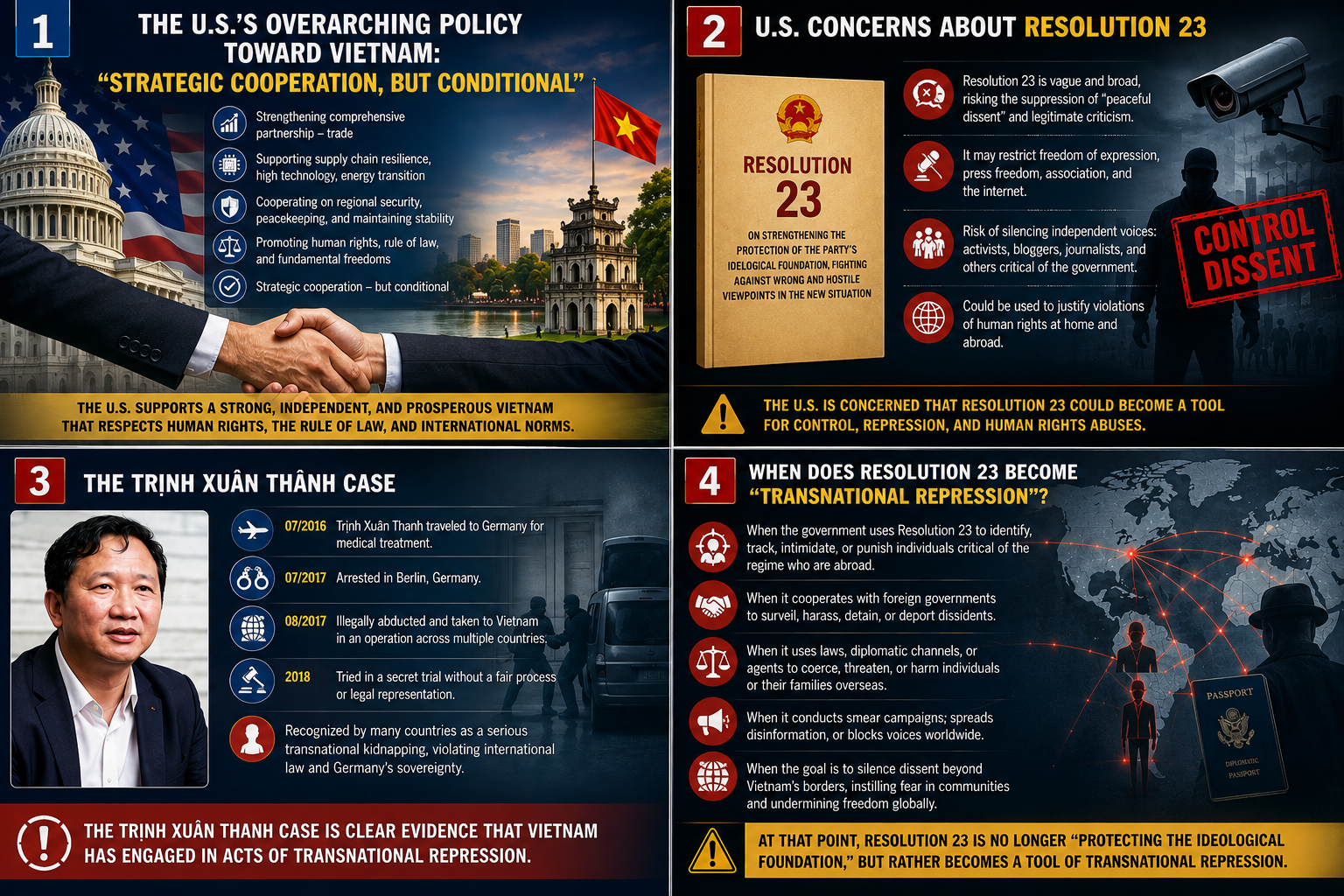
1. The U.S.’s Overarching Policy Toward Vietnam: “Strategic Cooperation, but Conditional”
U.S.–Vietnam relations were elevated to a Comprehensive Strategic Partnership in September 2023. In 2026, cooperation remains strong: the U.S. continues to value relations with Vietnam, defense cooperation is progressing, and the visit of the aircraft carrier USS George Washington to Da Nang in late July is a notable sign.
However, the current Trump administration places much heavier emphasis on fair and reciprocal trade, preventing trans-shipment through Vietnam to evade U.S. tariffs, viewing Vietnam as part of the national supply chain, prioritizing economic security, closely watching China’s tactics, and emphasizing defense and the Indo-Pacific axis.
For example, Washington is pressuring Vietnam on trans-shipment and origin fraud. Hanoi has stated it will engage in dialogue and resolve this issue within the Comprehensive Strategic Partnership framework.
In other words: Resolution 23 is not the center of U.S. policy toward Vietnam.
2. U.S. Concerns About Resolution 23
There are 6.5 million overseas Vietnamese, more than 50% of whom live in the United States. Resolution 23 significantly changes how Vietnam views the diaspora—not merely as people to be encouraged to return, but as a strategic resource for national development and status. Documents released after Resolution 23 emphasize mobilizing this community’s resources.
Washington will not react negatively simply because Vietnam wants to be closer to its diaspora. That is normal. But Washington will pay attention if “connection” turns into pressure, political influence, or control over people living in the United States.
This is a critical boundary in U.S.–Vietnam relations. The U.S. may view Resolution 23 through three lenses:
• Diaspora Engagement
If Vietnam encourages overseas Vietnamese to invest, transfer technology, visit home, contribute to science, education, and the economy, the U.S. has no reason to object. This is normal for any country engaging its diaspora.
• Transnational Influence
If Vietnamese agencies attempt to influence political activities of Vietnamese Americans, mobilize organizations toward Hanoi’s political goals, pressure dissenters, or use intermediaries to exert political influence, the issue changes.
The U.S. may classify this as foreign influence / transnational repression. This is where Resolution 23 requires close monitoring.
• Coercive Actions on U.S. Soil
This is the most serious level. If actions occur in the U.S.—threats, surveillance, coercion, retaliation against dissidents, or using individuals or organizations in the U.S. to apply pressure—the U.S. will respond under U.S. law, not under Vietnam’s claim of “diaspora work.”
Resolution 23 itself is not “terrorism,” but certain methods of implementation outside Vietnam could become U.S. national security or legal issues.
Resolution 23 may benefit Vietnam while also drawing more U.S. attention. The more successfully Vietnam mobilizes Vietnamese Americans, the more strategically important this community becomes—thus the more Washington will monitor Vietnam’s interactions with them.
This is not necessarily confrontation; it may simply be normal oversight.
The correct question is not “Will the U.S. oppose Resolution 23?” The correct question is:
“How will the U.S. evaluate Resolution 23 when it is implemented among Vietnamese Americans?”
Current answer: Washington will continue strong cooperation with Hanoi in economics, trade, supply chains, defense, and Indo-Pacific strategy; while not overlooking human rights, rule of law, or any signs of transnational coercion.
This is a cooperate + compete + monitor policy, not confrontation.
Resolution 23 may create new opportunities for young Vietnamese Americans if Hanoi genuinely wants to attract intellectuals, scientists, entrepreneurs, and professionals born abroad. But if the deeper goal is political control over the diaspora, that is a different story—and the younger generation will recognize sincerity versus manipulation.
3. The Trịnh Xuân Thanh Case
Resolution 23 does not fundamentally change U.S. policy toward Vietnam, but it may make Washington more attentive to Vietnam’s influence on Vietnamese Americans. This is what makes Resolution 23 “newer” than Resolution 36 (2004).
The more Resolution 23 expands goodwill toward the diaspora, the less reason the U.S. has to worry. But if implementation moves toward control, pressure, or interference in political life, the issue becomes U.S. law and security—not Resolution 23.
The Trịnh Xuân Thanh case in Germany is a clear example of the boundary between “diaspora policy” and “transnational coercion.”
Germany declared the 2017 Berlin kidnapping a blatant violation of German and international law, demanded an apology, and demanded assurances it would not recur.
If Resolution 23 were used as a tool of intimidation in the U.S.—through threats, surveillance, harassment of dissidents, coercion, threats to family in Vietnam, use of intermediaries, or worst of all, kidnapping or forced repatriation—the U.S. would classify it as transnational repression (TNR).
The FBI defines TNR as a foreign government crossing borders to intimidate, silence, coerce, harass, or harm diaspora/exile communities in the U.S. The FBI explicitly lists attempted kidnapping as a form of TNR.
If such an incident occurred in the U.S., the victim would be protected by U.S. law and the Constitution. Any kidnapping attempt would become an FBI, DOJ, and national security matter.
U.S. Response Would Unfold in Stages
Stage 1: Investigation
FBI determines:
- Who acted
- Who directed
- Funding sources
- Links to Vietnamese government
- U.S.-based intermediaries
This stage establishes evidence.
Stage 2: Prosecution
If evidence is sufficient, the U.S. may prosecute individuals involved. “No one can claim ‘I was just following Resolution 23’”—Vietnamese resolutions do not exempt anyone from U.S. criminal law.
Stage 3: Diplomacy
If government involvement is found, the issue escalates:
- Diplomatic summons
- Demands for explanation
- Orders to cease activities
- Expulsion of individuals
- Persona non grata declarations
- Restrictions or changes in cooperation
Measures depend on severity.
4. When Does Resolution 23 Become “Transnational Repression”?
If Vietnam identifies certain overseas Vietnamese as “targets,” and agencies or related organizations threaten, monitor, or pressure them—and the person is assaulted or kidnapped in the U.S.—Resolution 23 becomes evidence of intent or policy behind the acts.
Vietnam may encourage patriotism, investment, cooperation, and scientific contribution. But Vietnam cannot use Resolution 23 to coerce someone living in the U.S. into obeying Hanoi’s political will. Nor can it justify illegal actions on U.S. soil.
The FBI has an entire program dedicated to TNR. FBI Dallas (April 2026) publicly warned that TNR occurs when a foreign state or its agents cross borders to intimidate, silence, coerce, harass, or harm refugee communities in the U.S.
Even small actions can be recorded, investigated, and accumulate into a larger picture.
5. Author’s Personal Thoughts
Resolution 23 should not be judged by fears or suspicions of what it might do; it should be judged by Vietnam’s actual actions toward the diaspora in the coming days.
If Resolution 23 is used to threaten, coerce, or repress Vietnamese in the U.S., its implementation could transform it from a foreign/diaspora policy into a U.S. national security and legal issue.
If it escalates to kidnapping or violence, the Trịnh Xuân Thanh case shows it could become a serious diplomatic crisis, followed by U.S. legal action.
The U.S. will judge Resolution 23 not by its text, but by Vietnam’s actions.
Resolution 23 can be a Vietnam–U.S. bridge if implemented with reconciliation and goodwill; but if used as a tool of transnational repression, it could become a source of serious tension.
Time and reality will decide.
“Do not look at Resolution 23 through its text; look at Resolution 23 through its actions.”
Mai Thanh Truyết
Con đường Việt Nam