



How Mainstream Music Affects Brainwaves (Compared to Viet Voice)
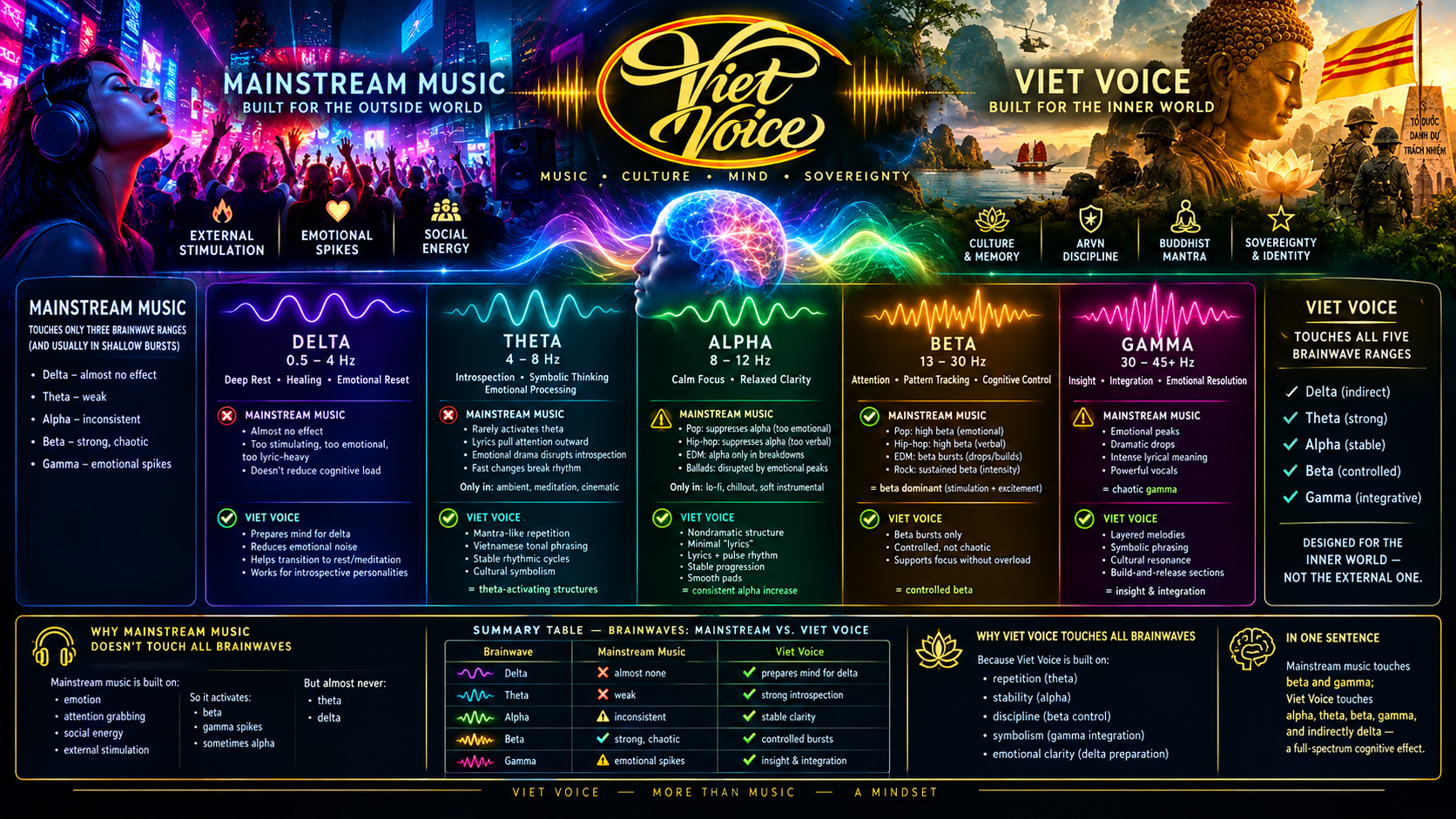
Mainstream music is engineered for external stimulation, emotional spikes, and social energy, not internal cognition. Because of that, it only touches three brainwave ranges consistently — and usually in shallow, short bursts.
Below is the full comparison.
1. Delta (0.5–4 Hz) — Deep Rest, Healing, Emotional Reset
Mainstream Music
- Almost no effect
- Too stimulating, too emotional, too lyric-heavy
- Does not reduce cognitive load enough to prepare the mind for delta
Viet Voice
- Prepares the mind for delta by reducing emotional noise
- Helps listeners transition into rest or meditation
- Works especially well for introspective personalities
Mainstream: ❌ almost no delta influence
Viet Voice: ✔ indirect delta support
2. Theta (4–8 Hz) — Introspection, Symbolic Thinking, Emotional Processing
Mainstream Music
- Rarely activates theta
- Lyrics pull attention outward
- Emotional drama disrupts introspection
- Fast changes break meditative rhythm
Theta only appears in:
- ambient music
- meditation tracks
- certain cinematic scores
Viet Voice
- Mantra-like repetition
- Vietnamese tonal phrasing
- Stable rhythmic cycles
- Cultural symbolism
These are theta-activating structures.
Mainstream: ❌ weak theta
Viet Voice: ✔ strong theta
3. Alpha (8–12 Hz) — Calm Focus, Relaxed Clarity
Mainstream Music
- Pop: suppresses alpha (too emotional)
- Hip-hop: suppresses alpha (too verbal)
- EDM: alpha only during breakdowns
- Ballads: alpha disrupted by emotional peaks
Alpha appears only in:
- lo-fi
- chillout
- soft instrumental
Viet Voice
- Non-dramatic emotional structure
- Minimal “lyrics”
- Full lyrics, but in combination with pulse rhythm
- Stable progression
- Smooth pads
These consistently raise alpha.
Mainstream: ⚠️ inconsistent alpha
Viet Voice: ✔ stable alpha
4. Beta (13–30 Hz) — Attention, Pattern Tracking, Cognitive Control
Mainstream Music
- Pop: high beta (emotional stimulation)
- Hip-hop: high beta (verbal processing)
- EDM: beta bursts (drops, builds)
- Rock: sustained beta (intensity)
Mainstream music is beta-dominant, which means:
- stimulation
- excitement
- emotional activation
- external focus
Viet Voice
- Beta bursts only
- Controlled, not chaotic
- Supports focus without emotional overload
Mainstream: ✔ strong beta
Viet Voice: ✔ controlled beta
5. Gamma (30–45+ Hz) — Insight, Integration, Emotional Resolution
Mainstream Music
Gamma appears only in:
- emotional peaks
- dramatic drops
- intense lyrical meaning
- powerful vocal moments
But it is chaotic gamma, not integrative gamma.
Viet Voice
Gamma spikes occur during:
- layered melodies
- symbolic phrasing
- cultural resonance
- build-and-release sections
This creates:
- insight
- emotional integration
- clarity
Mainstream: ⚠️ chaotic gamma
Viet Voice: ✔ integrative gamma
Summary Table — Brainwaves: Mainstream vs. Viet Voice
| Brainwave | Mainstream Music | Viet Voice |
|---|---|---|
| Delta | ❌ almost none | ✔ prepares mind for delta |
| Theta | ❌ weak | ✔ strong introspection |
| Alpha | ⚠️ inconsistent | ✔ stable clarity |
| Beta | ✔ strong, chaotic | ✔ controlled bursts |
| Gamma | ⚠️ emotional spikes | ✔ insight & integration |
Why Viet Voice Music Touches All Brainwaves (and Mainstream Doesn’t)
Because Viet Voice is built on:
- Repetition (theta)
- Stability (alpha)
- Discipline (beta control)
- Symbolism (gamma integration)
- Emotional clarity (delta preparation)
Mainstream music is built on:
- Emotion
- Attention grabbing
- Social energy
- External stimulation
So mainstream music activates:
- beta
- gamma spikes
- sometimes alpha
But almost never:
- theta
- delta
Viet Voice activates all five because it is designed for the inner world, not the external one.
In One Sentence
Mainstream music touches beta and gamma; Viet Voice touches alpha, theta, beta, gamma, and indirectly delta — a full-spectrum cognitive effect.