




A structural look at Vietnam’s economic ambitions, institutional constraints, and the contradictions shaping its next decade
INTRODUCTION
Vietnam is entering a new phase of national ambition. Tax reform, investment liberalization, AI partnerships, semiconductor commitments, infrastructure acceleration, and APEC 2027 preparations all point to a country trying to redefine its economic identity.
But beneath the headlines lies a harder truth:
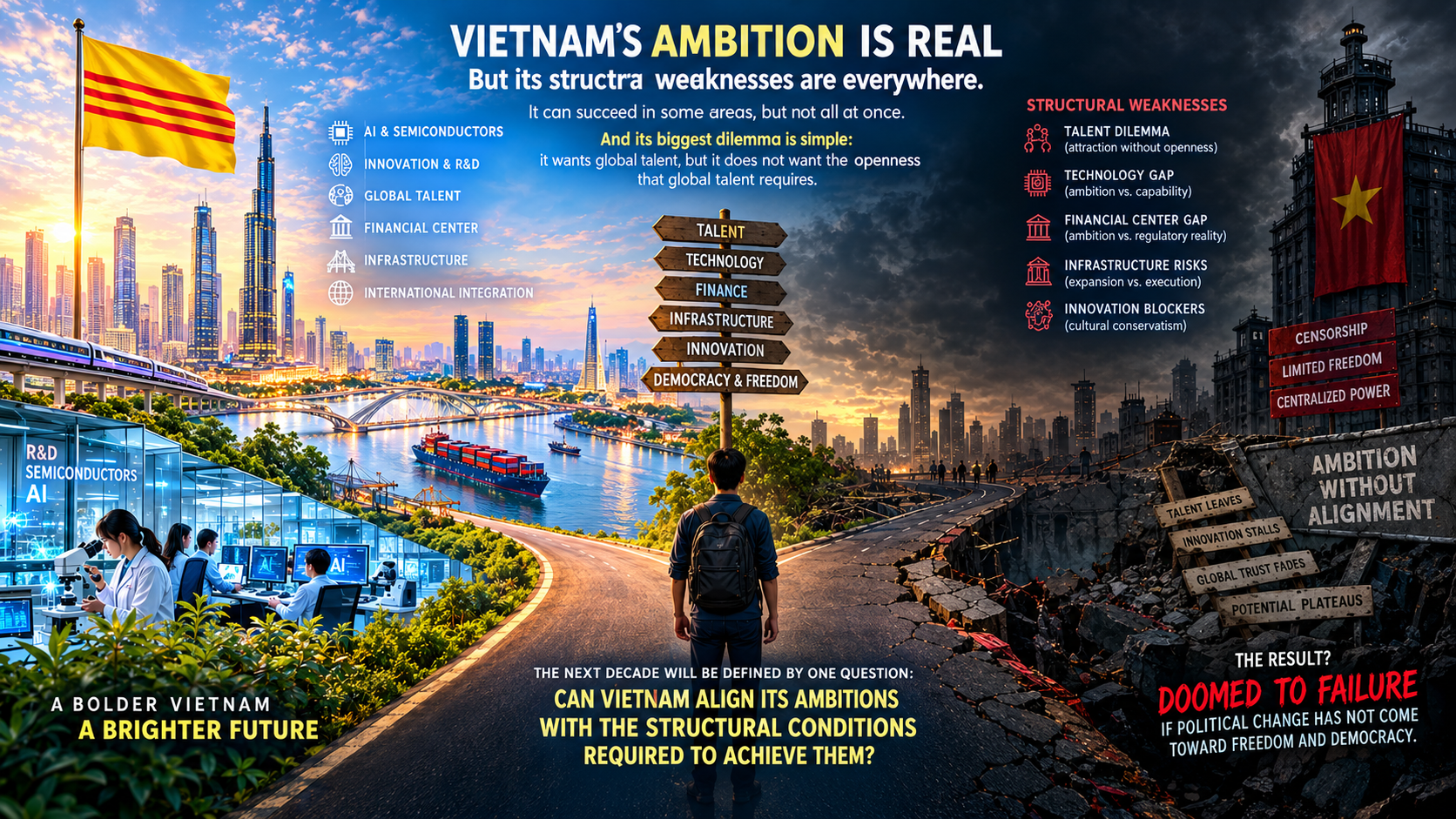
Vietnam’s ambitions are real — but its structural weaknesses are everywhere. The country can succeed in some areas, but not all at once. And its biggest dilemma is simple: it wants global talent, but it does not want the openness that global talent requires.
This tension will shape Vietnam’s next decade more than any policy announcement.
THE RISE OF AMBITION
Vietnam is trying to move beyond its traditional role as a manufacturing base. The government is signaling a shift toward:
- advanced technology
- AI and semiconductor research
- financial services
- global talent attraction
- high-value infrastructure
- international integration
Qualcomm’s plan to make Vietnam its third-largest AI R&D center globally is not symbolic. Samsung surpassing $500 billion in cumulative exports is not accidental. Tax cuts and investment law reforms are not cosmetic.
Vietnam is trying to build a new economic system — one that competes on capability, not just cost.
But ambition alone does not create capacity.
THE STRUCTURAL WEAKNESSES THAT DON’T GO AWAY
1. THE TALENT DILEMMA: ATTRACTION WITHOUT OPENNESS
Vietnam wants:
- AI researchers
- semiconductor engineers
- startup founders
- global finance professionals
- creative innovators
But global talent does not move only for salary or tax incentives. They move for:
- intellectual freedom
- creative freedom
- academic independence
- predictable governance
- transparent regulation
- freedom of expression
- the ability to build without fear of arbitrary intervention
Vietnam remains restrictive in:
- media
- public discourse
- academic research
- cultural experimentation
- civil society
- political expression
This creates a fundamental contradiction:
Vietnam wants the outcomes of openness without the conditions of openness.
You cannot build a world-class innovation ecosystem while limiting the very freedoms that produce innovation.
This is Vietnam’s hardest structural barrier.
2. TECHNOLOGY AMBITION VS. CAPABILITY GAPS
Vietnam wants to climb the value chain into:
- AI
- semiconductor design
- advanced R&D
- next-generation computing
But the country still lacks:
- senior engineering talent
- deep research institutions
- strong university–industry pipelines
- high-level semiconductor expertise
- robust IP protection
- long-term research funding culture
Qualcomm and Samsung can build R&D centers. But Vietnam cannot yet produce the talent those centers require.
This is why the Talent Visa matters — but also why it may not be enough.
3. FINANCIAL CENTER AMBITION VS. REGULATORY REALITY
The Vietnam International Financial Center (HCMC + Da Nang) is bold. But financial centers require:
- rule of law
- capital mobility
- independent courts
- regulatory predictability
- low political risk
- global trust
Vietnam does not yet meet these conditions.
The ambition is real. The foundation is incomplete.
4. INFRASTRUCTURE EXPANSION VS. EXECUTION RISK
Vietnam is building:
- metros
- airports
- expressways
- logistics hubs
- new city clusters
But the country still struggles with:
- delays
- cost overruns
- land clearance issues
- fragmented planning
- inconsistent contractors
- local-level bureaucracy
Infrastructure is improving, but execution remains uneven.
5. INNOVATION GOALS VS. CULTURAL CONSERVATISM
Innovation requires:
- questioning norms
- challenging assumptions
- experimenting
- failing
- debating
- pushing boundaries
Vietnamese institutional culture — academically, socially, bureaucratically — is still:
- hierarchical
- risk-averse
- conformity-driven
- stability-focused
This slows down the creativity Vietnam wants to unlock.
VIETNAM CAN SUCCEED — BUT NOT EVERYWHERE AT ONCE
Vietnam will likely succeed in:
- upgrading manufacturing
- expanding supply chains
- selective R&D partnerships
- attracting certain types of foreign capital
- building major infrastructure
- improving administrative efficiency
But Vietnam will struggle in:
- attracting world-class creative and research talent
- building a true innovation culture
- establishing a credible financial center
- competing with Singapore, Korea, and Taiwan on high-end talent
- protecting intellectual freedom
- developing world-class universities
- enabling decentralized creativity
The country is moving — but it is moving with contradictions.
THE CORE REALITY: AMBITION WITHOUT ALIGNMENT
Vietnam is trying to leap into a future that requires:
- openness
- trust
- transparency
- creativity
- institutional independence
- global-level governance
But it is doing so while maintaining:
- tight political control
- limited freedom of expression
- conservative cultural norms
- centralized decision-making
- cautious bureaucracy
This mismatch is the defining challenge of Vietnam’s modernization.
THE NEXT DECADE WILL BE DEFINED BY ONE QUESTION
Can Vietnam align its ambitions with the structural conditions required to achieve them?
If it can, Vietnam becomes a regional powerhouse. If it cannot, Vietnam will rise — but plateau below its potential.
The ambition is clear. The weaknesses are clear. The dilemma is unavoidable.