

INTRODUCTION TO DECENTRALIZED AUTONOMOUS COMMUNITY (DAC)
In a Decentralized Autonomous Community (DAC), we honour every human being—not as consumers, obedient citizens, or productive workers, but as sovereign individuals. Many of our greatest qualities are suppressed by cultural expectations, ideological pressures, political structures, financial limitations, and economic systems. Much of our behaviour, our dreams, our thoughts, and even our feelings are shaped by a society that existed long before we were born. It is worth asking: have we ever truly lived our own dreams, or expressed our sovereign self?
Human beings are meant to embody love, compassion, and kindness. We are not meant to serve systems, ideologies, institutions, or social pressures. The core problem is not ideology, not economics, not politics, not culture— because all of these operate within the boundaries of a centralized system that conditions people to conform rather than to evolve.
Within the DAC, new communities can be formed, and society itself can take new shape. Each individual is empowered to design the community they wish to participate in and to grow into their sovereign being. The DAC offers the opportunity to create a new tomorrow through decentralized, human‑centered systems. Here, you become a co‑creator of the society of the future.
In centralized systems, rules flow from the top—layer upon layer of authority—creating barriers so thick that people no longer know where those rules originate. Non‑consent compliance becomes a requirement for survival, trapping individuals in automated, conditioned behaviour that sinks into the subconscious as something “natural.” People are forced to align with those at the top, never with their true sovereign self. And while centralized systems reserve all credit for the top and the “top of the tops,” the burdens always fall on the people.
How can we achieve a Decentralized Autonomous Community?
There are three core pillars that must be honoured, because without them the entire structure collapses. These pillars are cooperation, transparency, and meta‑sovereignty.
Cooperation
Our understanding of cooperation is rooted in a defining moment in Vietnamese history during the Trần dynasty, at a time when the world feared the unstoppable Mongol armies. China had already been conquered and ruled by the third generation of Genghis Khan, and Đại Việt—then a small nation of only a few million inhabitants—faced the threat of invasion. When news arrived of the Mongols’ demand for unconditional surrender, the Trần court organized the historic Hội Nghị Diên Hồng, a national assembly where the people were asked a single question: fight or surrender. The people answered with one voice: fight, fight, fight.
History records that Vietnam defeated the Mongol forces three times in a row. These victories were not the result of size or wealth, but of the free and determined spirit carried by our ancestors. Without that spirit, the nation might have fallen, and Vietnam could have become just another province under China rule. At the heart of this story lies a universal truth: every human being has the right to defend themselves against tyranny in all its forms.
This spirit of unity and shared purpose is what we bring into the DAC philosophy. In a decentralized community, building something together must arise from mutual respect and the understanding that no individual is perfect alone—but together, we become complete. Decentralization is essential because it removes the hierarchy that limits human potential; it allows every person’s strengths to surface and prevents any single authority from controlling the direction of the whole. Each individual carries unique abilities and limitations, and when these are combined freely—without centralized interference—our collective creativity expands far beyond what any one of us could achieve alone. True cooperation can only flourish in a decentralized environment, where contributions flow horizontally, not from top to bottom.
Transparency
In the DAC philosophy, transparency is a foundational principle that protects the community and strengthens decentralized cooperation. Collaboration alone is not enough; without openness, even good intentions can be exploited. Transparency ensures that all essential activities, decisions, and processes are visible to every participating sovereign individual. This shared clarity gives people the knowledge and understanding they need to make their own decisions, preventing hidden power structures, internal politics, and manipulation.
At the same time, transparency does not violate personal privacy—private boundaries remain respected—yet the mechanisms that shape collective life stay open and accountable. In such an environment, there is no need for a separate commissioner or supervisory body, because every active member becomes a commissioner in their own right. Through transparency, the DAC creates a fair, self‑governing society where responsibility, sovereignty, and cooperation reinforce one another.
Meta‑sovereignty
We may fail many times in life or make choices we later regret, but what truly matters is our ability to self‑reflect every day in order to create a better tomorrow. Every human being is worthy of life, dignity, and growth, and it is up to each individual to choose the path they wish to walk. Whatever path you choose, you remain responsible for your own life—not those who believe they can dictate your future or define your worth.
Meta‑sovereignty means reclaiming this inner authority. It means that your work ethic, your decisions, and your direction in life must align with your own sovereign self, not with external pressures or centralized expectations. In a decentralized world, no institution, ideology, or hierarchy has the right to override your personal journey. You are the one who carries the responsibility for your choices, and you are the one who holds the power to transform your life.
Meta‑sovereignty is the foundation that allows a decentralized community to thrive: individuals who are self‑aware, self‑responsible, and aligned with their own truth can cooperate freely without coercion, manipulation, or imposed authority.
Conclusion
Building a community that can endure every tomorrow requires more than vision — it requires people who dare to co‑create a new path. The DAC model offers one of the most peaceful forms of human evolution: a way for individuals to reclaim their sovereignty, cooperate freely, and shape a decentralized future grounded in dignity, responsibility, and human‑centered design.
Our Core Modules, Core Principles, Constitution, and Roadmap are not fixed or theoretical concepts — they are living components that continue to develop as the community grows. Nothing is imposed from above; everything is shaped collectively, step by step, by those who choose to participate. DAC is not meant to remain an abstract ideal but a practical model that we actively put into real‑world application through cooperation, responsibility, and transparent processes. You are warmly invited to join us, contribute your strengths, and help shape the future of DAC as we build it together.
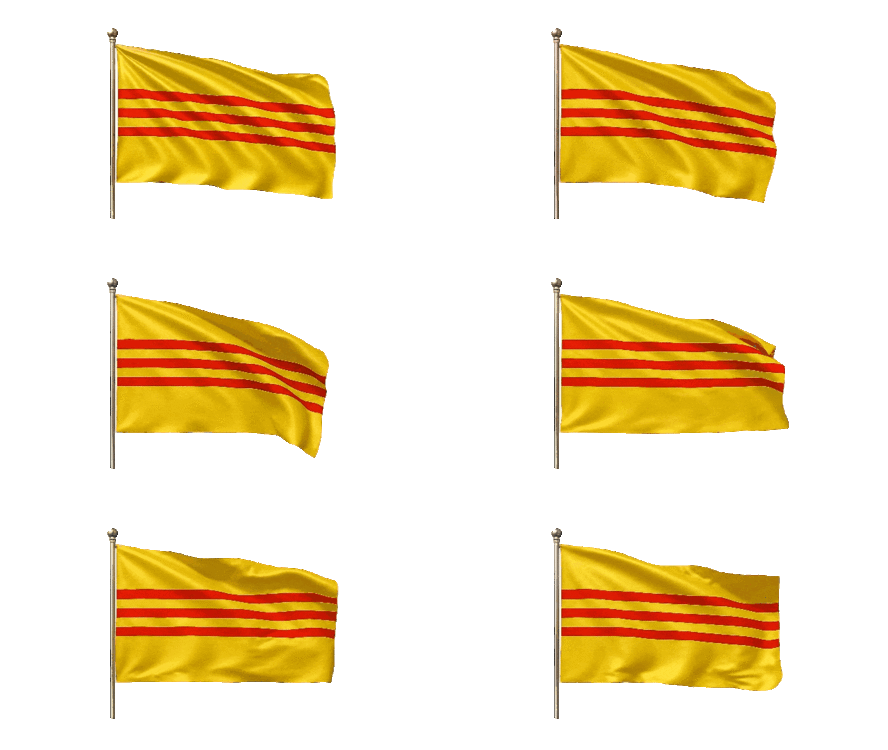
How you can help: If you appreciate this work and wish to support the movement, there are several meaningful ways to contribute. Carrying our yellow flag symbol — available in the Symbolic Items section — already makes a powerful difference by keeping our heritage and identity visible. You can also support by listening to and sharing Viet Voice music, or by offering a donation if you feel called to do so.
Every gesture, no matter how small, strengthens the foundation of a community built for tomorrow. Together, we are not only imagining a new society — we are building it, shaping it, and becoming it.