

Meta‑Sovereignty: The Heart of DAC and the Five Layers of Self‑Knowledge
A decentralized community is not built from technology, governance, or economic systems alone. These are only instruments. The true foundation of DAC is the human being — the sovereign individual who stands with clarity, responsibility, and inner authority. This is why meta‑sovereignty is the heart of DAC: it is the inner journey that makes the outer structure meaningful.
Meta‑sovereignty is not a political concept. It is a form of self‑knowledge. It is the recognition that every human carries an inner compass, an inner truth, and an inner responsibility that cannot be outsourced to institutions, leaders, or external authorities. In centralized systems, people are shaped by pressure, expectation, and hierarchy. In DAC, people are shaped by self‑reflection, community experience, and conscious participation.
This is why the DAC environment is essential. One cannot walk the path of meta‑sovereignty alone, nor can it be imposed from above. It emerges only when individuals participate in a decentralized space where their actions matter, their voice is equal, and their presence has real impact. In such an environment, every interaction becomes a mirror. Every collaboration becomes a lesson. Every conflict becomes an opportunity to grow. Through this process, the community becomes a living field of self‑discovery.
At the center of this journey are the five layers of self‑knowledge that shape the DAC profile: Identity, Mastery, Responsibility, Mission, and Expression. These layers are not administrative fields — they are indicators of consciousness. They reveal how individuals understand themselves, how they act, and how they evolve.
Identity — Knowing Who You Are
Identity is the foundation of sovereignty. In DAC, identity is not a label or a role. It is the inner recognition of one’s own existence, dignity, and uniqueness. When a person defines their identity consciously, they begin to understand the patterns, values, and experiences that shape their behavior.
Identity fields reveal:
- how one sees oneself
- what one carries from their past
- what one chooses to preserve
- what one stands for
This clarity is the first step toward self‑ownership. Without knowing who you are, you cannot act as a sovereign human being.
Mastery — Knowing What You Can Do
Mastery is the expression of one’s abilities, strengths, and lived experience. It is not limited to professional skills — it includes emotional intelligence, cultural knowledge, symbolic understanding, and personal gifts.
Mastery fields reveal:
- what one has learned
- what one can offer
- how one contributes to others
- how one grows through practice
When individuals recognize their mastery, they stop comparing themselves to others. They begin to understand their unique value. This is essential in a decentralized environment, where cooperation is based on synergy, not hierarchy.
Responsibility — Knowing How You Act
Responsibility is the bridge between inner sovereignty and outer participation. It shows how a person handles commitments, relationships, and consequences. In DAC, responsibility is not imposed — it is chosen.
Responsibility fields reveal:
- how one honors agreements
- how one communicates
- how one handles conflict
- how one supports the community
Responsibility transforms freedom into harmony. It ensures that sovereignty does not become ego, and that individuality does not become isolation.
Mission — Knowing Why You Are Here
Mission is the inner purpose that guides one’s actions. It is not a grand vision or a fixed goal. It is the quiet clarity of knowing what one is meant to contribute to the world.
Mission fields reveal:
- what motivates a person
- what they want to build
- what they want to protect
- what they want to leave behind
When individuals articulate their mission, they align their actions with meaning. This creates coherence — both within themselves and within the community.
Expression — Knowing How You Share Yourself
Expression is the outward manifestation of identity, mastery, responsibility, and mission. It is how a person communicates, creates, collaborates, and participates.
Expression fields reveal:
- how one interacts with others
- how one shares ideas
- how one contributes to culture
- how one embodies their sovereignty
Expression is where self‑knowledge becomes visible. It is where the inner journey meets the outer world.
The Loop of Human Development in DAC
In DAC, human development is central. The community and the individual evolve together through a continuous loop:
Self‑reflection → Participation → Contribution → Feedback → Growth → deeper Self‑reflection
- The fields guide the individual toward self‑knowledge.
- The individual brings that knowledge back into the community.
- The community becomes stronger, wiser, and more harmonious.
- And this harmony supports the next cycle of personal growth.
Each cycle brings more clarity, more awareness, and more sovereignty.
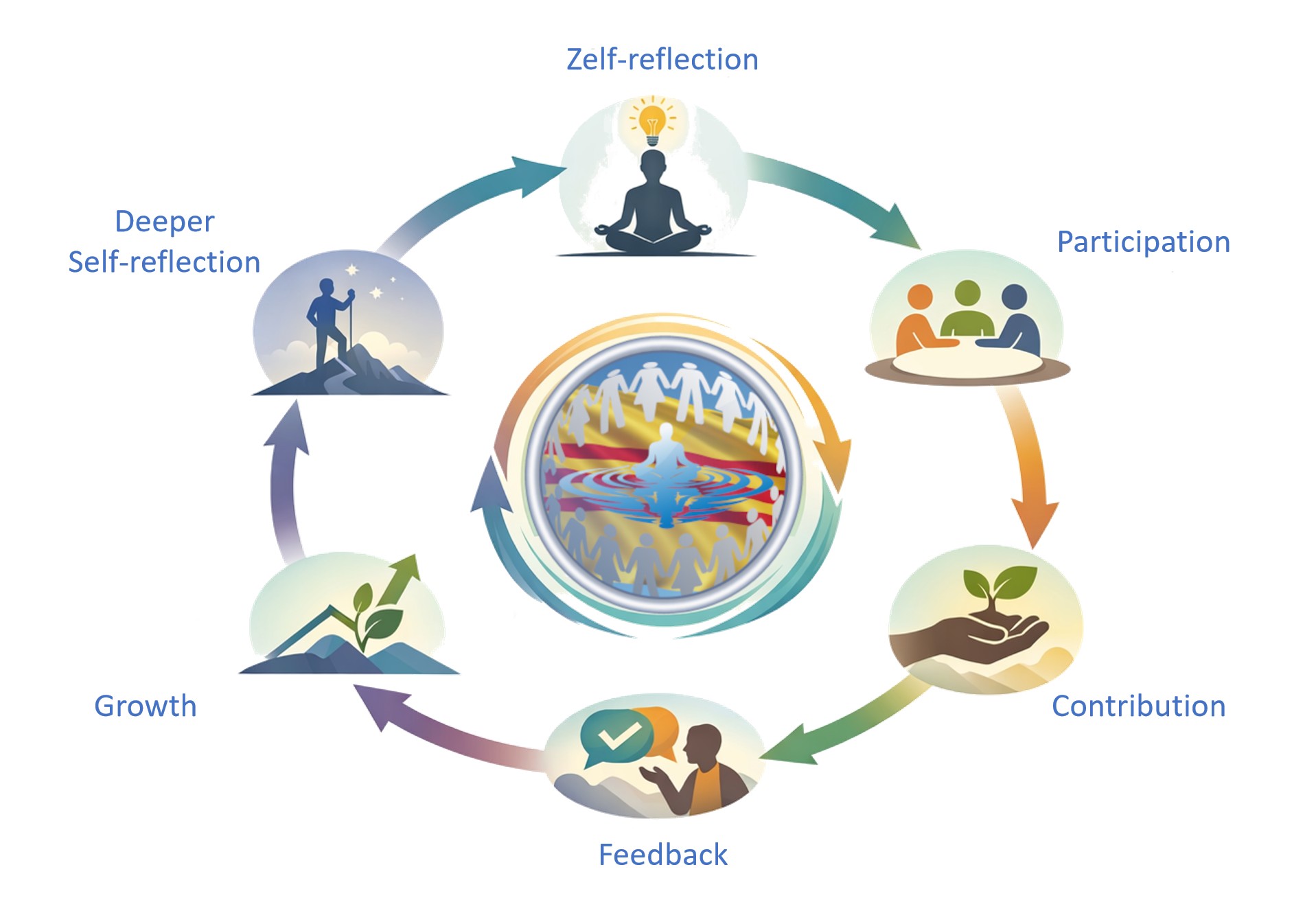
This loop is only possible in a decentralized environment. Without hierarchy to hide behind, each person must face themselves. Without external pressure, each person must choose consciously. Without imposed authority, each person must learn to lead themselves. This naturally encourages mindfulness: the awareness of how one behaves, communicates, collaborates, and responds to challenges.
Only in a non‑hierarchical space can individuals:
- act without external pressure
- express themselves without fear
- learn through real participation
- grow through authentic feedback
- discover their true selves without manipulation
When conflicts arise — as they inevitably do — the fields help maintain harmony. They remind each member of their identity, their responsibilities, their values, and their commitment to the community. Individuals become less reactive and more reflective. Conflicts become catalysts for growth rather than sources of division.
Through community experience, each person learns more about themselves. Through self‑knowledge, each person contributes more consciously to the community. This creates harmony — not because conflict disappears, but because individuals approach conflict with awareness rather than reaction.
Becoming a Sovereign Human Being
The end result of this journey is not perfection. It is sovereignty — the ability to stand as one’s own authority, to act with integrity, and to contribute to the community from a place of inner clarity.
A sovereign person:
- knows who they are
- understands their strengths and limitations
- acts with responsibility
- communicates with honesty
- participates consciously
- leads themselves before leading others
This is the highest form of leadership: self‑ownership.
DAC is not merely a system for organizing communities. It is a path for individuals to discover their true selves, free from external manipulation, free from imposed hierarchy, and free from the pressures that distort human potential.
Meta‑sovereignty is the heart of DAC because it is the heart of human evolution. When individuals grow, the community grows. When the community grows, individuals grow. This is the loop that sustains harmony, resilience, and collective wisdom.
And this is how a decentralized community becomes not only functional — but transformative.