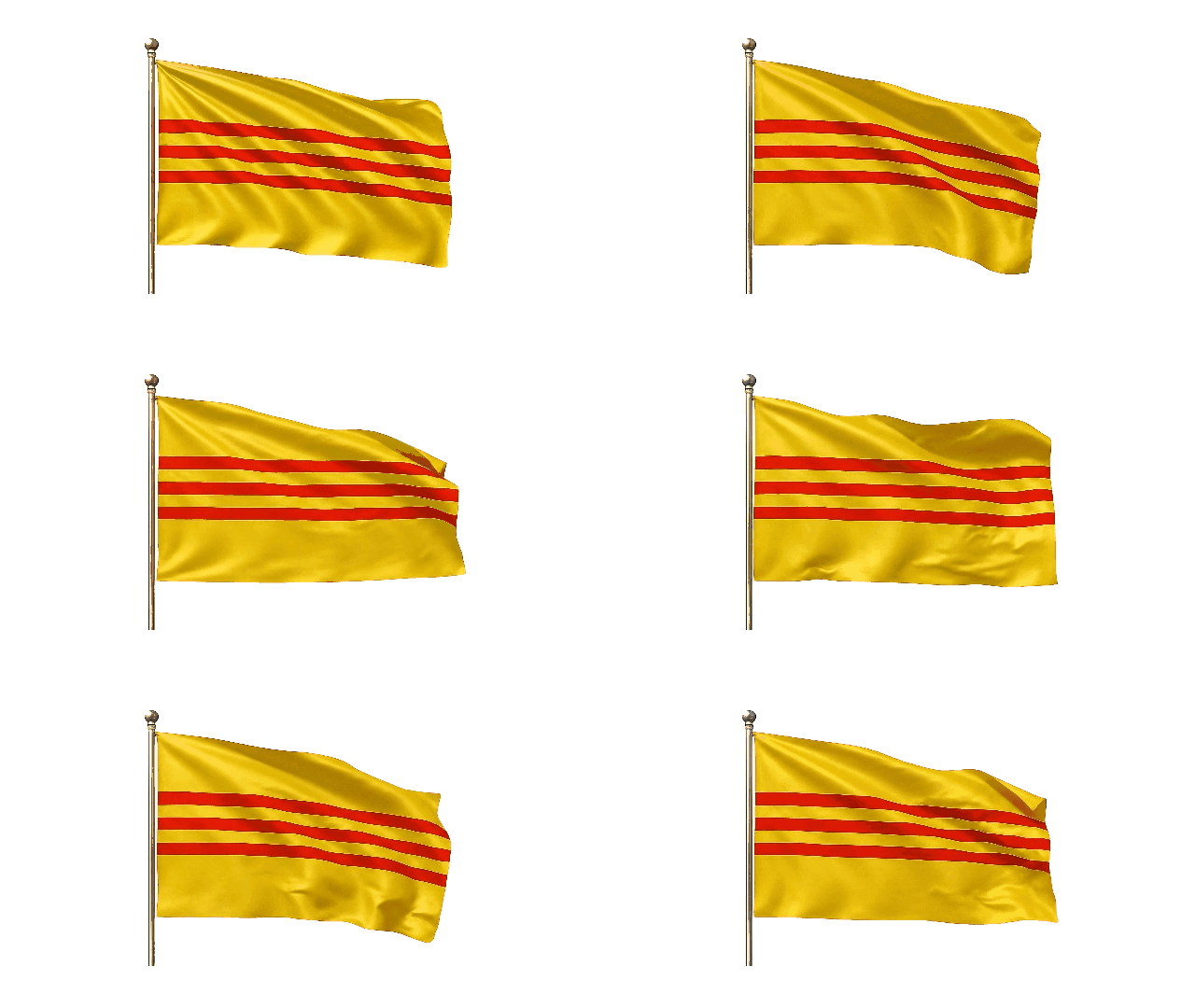

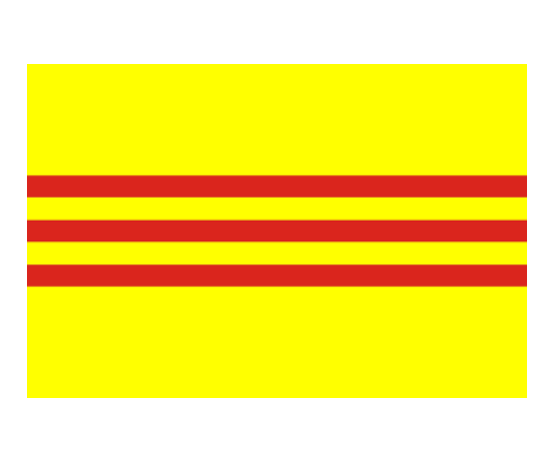


THE MEANING OF THE YELLOW FLAG WITH THREE RED STRIPES
AND THE “NATIONAL ANTHEM”
Lê Duy San
Introduction
There have been dozens of articles about the history and meaning of the Yellow Flag with Three Red Stripes (the national flag of the Republic of Vietnam) and the song “Call to Citizens” (the national anthem of the Republic of Vietnam), along with many debates about whether Vietnamese refugees should display the flag and sing the anthem at community events. Many articles are detailed and valuable—such as “Vietnamese National Flag and National Anthem” by the late Professor Nguyễn Ngọc Huy—but even he stated that his purpose was only to present historical facts.
However, there has been almost no article that clearly and concisely explains the meaning of the Yellow Flag with Three Red Stripes and the “National Anthem” so that Vietnamese people—especially today— understand why those who fled communism must honor and uphold them whenever gathering publicly.
I. History and Meaning of the Yellow Flag and “National Anthem” Before 1975
a/ History of the Yellow Flag and the Anthem
Before Japan overthrew French colonial rule in Indochina on March 9, 1945, Vietnam had no national flag or national anthem. On April 17, 1945, the Trần Trọng Kim government was formed, and the Quẻ Ly flag (a yellow field with a broken red stripe) was adopted as the national flag. This was essentially Vietnam’s first national flag.
However, in practice, it represented only the northern and central regions because Japan had not yet returned Cochinchina (the South) to the Huế court. Only on August 14, 1945—four days after Japan surrendered—did the Quẻ Ly flag officially represent all three regions of Vietnam. The national anthem at that time was “Vietnam, the Eastern Pearl” by composer Hùng Lân.
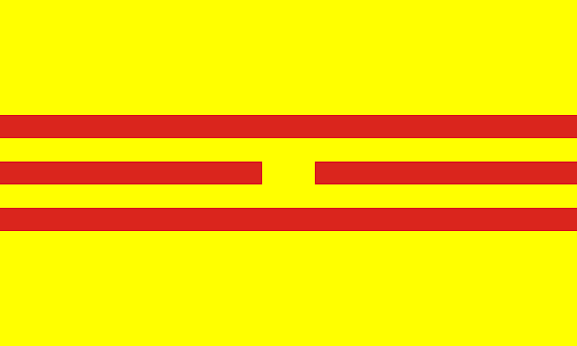
The period during which the Quẻ Ly national flag and the national anthem Vietnam, the Eastern Pearl existed was extremely short, because five days later—on August 19, 1945—the Trần Trọng Kim government was overthrown by the Việt Minh, that is, Hồ Chí Minh, a puppet of the Third International Communist movement, who seized state power. The national flag was replaced with the Red Flag with a Yellow Star—the party flag of the Communist Party of Vietnam—and the national anthem was replaced with Văn Cao’s Tiến Quân Ca.
After seizing power, on March 6, 1946, Hồ Chí Minh signed the Preliminary Franco-Vietnamese Agreement with Jean Sainteny, the representative of the French Republic, bringing French troops back in so that he would have his hands free to eliminate the nationalist parties; only after that did Hồ Chí Minh launch the war against France in order to claim political legitimacy. The Vietnam–France war (Việt Minh vs. France) broke out on December 19, 1946. France occupied almost all the cities in all three regions—Central, South, and North—forcing the Việt Minh to withdraw into the hinterlands to wage resistance.
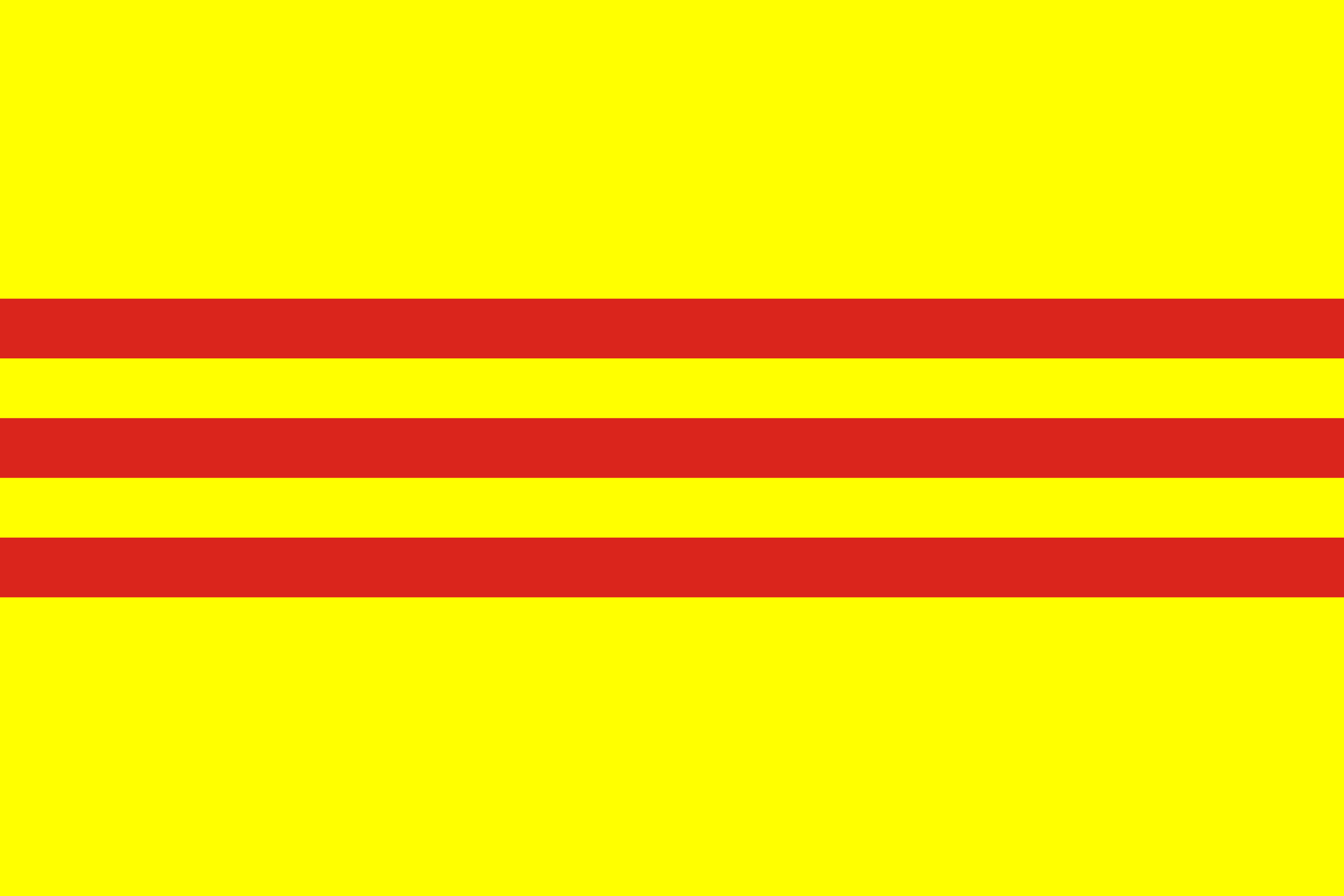
After more than two years of fighting the Việt Minh, the French realized they could not win, so they contacted Emperor Bảo Đại to return independence to Vietnam, though still within the French Union. On June 2, 1948, the Provisional Government of Vietnam was established under General Nguyễn Văn Xuân; the Yellow Flag with Three Red Stripes, proposed by artist Lê Văn Đệ, was accepted as the national flag, and the song Call to Youth by Lưu Hữu Phước—renamed Call to Citizens—was accepted as the national anthem of the State of Vietnam.
In 1954, Ngô Đình Diệm returned to Vietnam and established the First Republic. The 1956 Constitutional Assembly kept “Call to Citizens” as the national anthem but changed the lyrics.
Ðồng lòng cùng đi, hy sinh tiếc gì thân sống!
Vì tương lai quốc dân, cùng xông pha khói tên,
Làm sao cho núi sông từ nay luôn vững bền.
Dầu cho thây phơi trên gươm giáo,
Thù nước lấy máu đào đem báo.
Nòi giống lúc biến phải cần giải nguy,
Người công dân luôn vững bền tâm trí,
Hùng tráng quyết chiến đấu làm cho khắp nơi
Vang tiếng người nước Nam cho đến muôn đời!
(Ðiệp khúc)
Công dân ơi! Mau hiến thân dưới cờ!
Công dân ơi! Mau làm cho cõi bờ
Thoát cơn tàn phá, vẻ vang đời sống
Xứng danh ngàn năm dòng giống Lạc Hồng.
The article notes that although Lưu Hữu Phước later joined the Communist Party, the anthem used only his melody; the lyrics were almost entirely rewritten. When he composed “Call to Youth,” he was simply a patriotic student, not yet affiliated with any political party.
b/ Meaning of the Yellow Flag and “Call to Citizens”
Professor Nguyễn Ngọc Huy explained:
The three red stripes symbolize the three regions of Vietnam.
The yellow background symbolizes the Vietnamese nation.
Thus, the flag expresses that Vietnam is one nation of three regions united.
The Yellow Flag and “Call to Citizens” were not only the national symbols of Vietnam—they represented freedom, democracy, and human rights, recognized by democratic nations worldwide.
By contrast, the Red Flag with Yellow Star and “Tiến Quân Ca” were symbols of communist dictatorship. They were recognized only by the authoritarian, one-party dictatorships within the Communist bloc.
For nearly three decades, from 1948 to 1975, countless Vietnamese civilians who sought to preserve a free Vietnam, together with soldiers of the Republic of Vietnam (South Vietnam) who fought against Vietnamese communism, sacrificed their lives and shed immeasurable amounts of blood. Their struggle, they believed, was not undertaken in defense of any particular ideology or political doctrine, but rather to preserve Freedom, Democracy, and Human Rights for Vietnam.
From this perspective, the Yellow Flag with Three Red Stripes and the song Tiếng Gọi Công Dân (The Citizens’ Call) represent far more than the national flag and anthem of the former Republic of Vietnam. They have also come to symbolize Freedom, Democracy, Human Rights, and the aspirations of the Vietnamese nation and its people.
By contrast, the Red Flag with a Yellow Star and Tiến Quân Ca (Marching Song) are viewed as symbols of communism and Marxism-Leninism. In the original text's characterization, communism represents a doctrine that rejects the traditional bonds of homeland, religion, and family, while Marxism-Leninism advocates the principle of proletarian dictatorship.
Accordingly, from this perspective, those who fought under the Red Flag with a Yellow Star and marched to the sound of Tiến Quân Ca were not fighting for Freedom, Democracy, and Human Rights, nor primarily for the interests of the Vietnamese nation and its people. Rather, they were fighting in the service of the Communist Party and the Marxist-Leninist ideology it embraced.
II. Why Vietnamese Refugees Must Honor the Yellow Flag and “Call to Citizens”
a/ To affirm the legitimacy of the Vietnamese national cause
In 1954, nearly one million people in North Vietnam were forced to leave behind their homes, land, and possessions and flee the Viet Cong, migrating south with little more than the clothes on their backs. They made this difficult journey because they sought the freedom, democracy, and human rights they believed were offered by the government of South Vietnam—the national government of Vietnam, represented by the Yellow Flag with Three Red Stripes.
Throughout the twenty-year Vietnam War, from 1954 to 1975, wherever the Viet Cong advanced, Vietnamese civilians fled. Seeking safety and protection, they made their way toward areas under the Yellow Flag with Three Red Stripes—the territory controlled by the national government. Millions of soldiers, civilians, government officials, and civil servants of the Republic of Vietnam sacrificed their lives in the defense of that flag and, in their view, in defense of the people of South Vietnam and their right to live in freedom, democracy, and dignity.
In 1975, the Viet Cong repudiated the Paris Peace Accords and forcibly took control of South Vietnam. Once again, more than one million Vietnamese people abandoned their homes, property, and land, leaving with little or nothing in their desperate search for freedom. Of those who fled, several hundred thousand are believed to have perished at sea while attempting to escape—victims of the same desperate pursuit of freedom.
b/ To preserve the identity of Vietnamese refugees from communism
After 1975, the Republic of Vietnam ceased to exist, and the Yellow Flag with Three Red Stripes and Tiếng Gọi Công Dân (The Citizens’ Call) were no longer the official national flag and national anthem of Vietnam. Nevertheless, for many Vietnamese people—both those who had left the country and those who remained—the Yellow Flag with Three Red Stripes and Tiếng Gọi Công Dân continued to carry a deeper symbolic meaning: they represented Freedom, Democracy, and Human Rights.
We left our homeland because we did not want to live under what we regarded as the brutal and inhumane communist regime in Vietnam. The free countries of the world accepted us as immigrants in recognition of our status as political refugees. Therefore, as Vietnamese refugees from communism, we believe that we should preserve this identity by honoring and paying tribute to the Yellow Flag with Three Red Stripes as the flag of the former Republic of Vietnam, and to Tiếng Gọi Công Dân as its national anthem, whenever we gather publicly.
c/ To clearly distinguish the national and communist causes
The Yellow Flag with Three Red Stripes and Tiếng Gọi Công Dân are more than symbols associated with Vietnamese refugees from communism. The flag is the emblem of the former Republic of Vietnam, while the anthem is its national song; together, they have also come to represent the values of Freedom, Democracy, and Human Rights embraced by the Vietnamese national cause. At the same time, they serve as a visible and audible means of distinguishing the Vietnamese national cause from the communist cause.
At a public gathering, if the Yellow Flag with Three Red Stripes is not displayed and Tiếng Gọi Công Dân is not performed, it may be difficult to determine whether the gathering represents the Vietnamese national cause or the communist cause.
For this reason, as Vietnamese refugees from communism, we believe that we should not only refrain from attending public gatherings where the Yellow Flag with Three Red Stripes is not displayed and Tiếng Gọi Công Dân is not performed, but also have a responsibility to boycott such gatherings and inform others so that they may choose to stay away as well.
Around the world, a number of countries have adopted resolutions recognizing or honoring the Yellow Flag with Three Red Stripes as a symbol of Vietnamese refugees from communism, particularly in the United States. In his article “The National Flag and National Anthem of Vietnam,” the late Professor Nguyễn Ngọc Huy stated:
Outside Vietnam, foreigners likewise recognize it as the symbol of those Vietnamese who oppose communism. No other symbol can replace the Yellow Flag with Three Red Stripes in these respects.
Therefore, showing respect for the yellow national flag with three red stripes and displaying it widely wherever Vietnamese nationalists gather constitutes a significant contribution to the effort to liberate the country from communist rule.”
In conclusion, although, since April 30, 1975, the Yellow Flag with Three Red Stripes and Tiếng Gọi Công Dân (The Citizens’ Call) have no longer been the official national flag and national anthem of Vietnam, they continue, for Vietnamese refugees from communism, to symbolize Freedom, Democracy, and Human Rights, as well as the identity of Vietnamese refugees from communism. They also serve as a means of distinguishing those who identify with the Vietnamese national cause from those who support communism.
It is not only Vietnamese refugees from communism—particularly those from South Vietnam who lived under the Republic of Vietnam and benefited from its institutions—who cherish and defend the Yellow Flag with Three Red Stripes and hope that one day it will once again represent Vietnam. Even some people who were born under the communist regime and educated under its system have expressed the hope that the Yellow Flag with Three Red Stripes will one day fly once again throughout the skies of Vietnam.
In an article entitled “As Long as the Red Flag with a Yellow Star Remains, There Can Never Be Independence, Freedom, and Happiness,” published in an underground newspaper in Vietnam, Báo Sinh Viên Yêu Nước (Patriotic Student Newspaper), the author Lê Trung Thành, a Vietnamese student studying in Taiwan, stated: “The Yellow Flag with Three Red Stripes will certainly fly proudly once again over the homeland of Vietnam.”
Any act of abusing, disrespecting, or showing contempt for the Yellow Flag with Three Red Stripes and Tiếng Gọi Công Dân by those who act without due awareness or respect should be strongly condemned.
Lê Duy San
Notes
(1) In fact, the flag of the Communist Party of Vietnam is also the Hammer-and-Sickle flag, like those of the Russian and Chinese Communist parties. However, in an effort to deceive the population and the various nationalist political parties, the Communists chose the Red Flag with a Yellow Star instead. After seizing power from the government of Trần Trọng Kim, they imposed the Red Flag with a Yellow Star as Vietnam’s national flag.
(2) The agreement included the following principal provisions:
- The French Government recognized the Democratic Republic of Vietnam as a free state within the Indochinese Federation and the French Union, with its own government, parliament, military, and finances.
- The Vietnamese Government agreed to allow 15,000 French troops to enter North Vietnam to replace the 200,000 Chinese Nationalist troops who had been stationed there to carry out the disarmament of Japanese forces. France pledged to withdraw all of its troops within five years, at a rate of 3,000 troops per year.
(3) On June 8, 1948, aboard a warship anchored in Hạ Long Bay, French High Commissioner Émile Bollaert, representing the French Government, and Nguyễn Văn Xuân, Prime Minister of the Provisional Central Government of Vietnam, signed the Hạ Long Bay Agreement. France recognized Vietnam as an independent and free country with the right to pursue national reunification.
On March 8, 1949, at the French Presidential Palace (the Élysée Palace), former Emperor Bảo Đại and French President Vincent Auriol signed the Élysée Agreement. France formally recognized Vietnam as a unified and independent state within the French Union. (Vũ Quốc Thúc, Thời Đại Của Tôi [My Era]).
(4) The song Tiếng Gọi Thanh Niên (Call to the Youth), written by Lưu Hữu Phước, is as follows:
Ðồng lòng cùng đi, đi, mở đường khai lối.
Vì non sông nước xưa, truyền muôn năm chớ quên,
Nào anh em Bắc Nam! Cùng nhau ta kết đoàn!
Hồn thanh xuân như gương trong sáng,
Ðừng tiếc máu nóng, tài xin ráng!
Thời khó, thế khó, khó làm yếu ta,
Dầu muôn chông gai vững lòng chi sá.
Ðường mới kíp phóng mắt nhìn xa bốn phương,
Tung cánh hồn thiếu niên ai đó can trường.
(Ðiệp khúc)
Sinh viên ơi! Ta quyết đi đến cùng!
Sinh viên ơi! Ta thề đem hết lòng!
Tiến lên đồng tiến! Vẻ vang đời sống!
Chớ quên rằng ta là giống Lạc Hồng!
2. Này sinh viên ơi! Dấu xưa vết còn chưa xoá!
Hùng cường trời Nam, ghi trên bảng vàng bia đá!
Lùa quân Chiêm nát tan, thành công Nam tiến luôn,
Bình bao phen Tống Nguyên, từng ca câu khải hoàn.
Hồ Tây tranh phong oai son phấn,
Lừng tiếng Sát Thát Trần Quốc Tuấn.
Mài kiếm cứu nước nhớ người núi Lam,
Trừ Thanh, Quang Trung giết hằng bao đám.
Nòi giống có khí phách từ xưa chớ quên,
Mong đến ngày vẻ vang, ta thắp hương nguyền.
(Trở lại điệp khúc)
3. Này sinh viên ơi! Muốn đi đến ngày tươi sáng,
Hành trình còn xa, chúng ta phải cùng nhau gắng!
Ngày xưa ai biết đem tài cao cho núi sông,
Ngày nay ta cũng đem lòng son cho giống dòng.
Là sinh viên vun cây văn hoá,
Từ trước sẵn có nhiều hoa lá.
Ðời mới kiến thiết đáp lòng những ai
Hằng mong ta ra vững cầm tay lái.
Bền chí quyết cố gắng làm cho khắp nơi
Vang tiếng người nước Nam cho đến muôn đời!
(Trở lại điệp khúc)